AI Visibility Tools 31 min read Published Updated
20 Best AI Visibility Tools in 2026 (Expert Review)
I ranked these twenty the way I actually buy: which engines they cover, what the published price includes, and which team should bother. Field notes, not a brochure.
On this page
- How I ranked the best AI visibility tools
- 1. Cognizo
- 2. Peec AI
- 3. Goodie AI
- 4. Conductor
- 5. Rankability
- 6. SE Ranking
- 7. Ahrefs
- 8. Surfer SEO
- 9. Nightwatch
- 10. Search Atlas
- 11. seoClarity
- 12. LLMrefs
- 13. ZipTie
- 14. Yotpo (Discover)
- 15. Google Search Console
- 16. Bing Webmaster Tools
- 17. Perplexity Sonar
- 18. ChatGPT Astra (GPT-6 Astra)
- 19. Claude Fable (Fable 5 / 5.1)
- 20. Google Gemini
- Picking among the best AI visibility tools
- 01
I rank the best AI visibility tools by engine list, collection method, and published price, not by homepage adjectives.
- 02
Dedicated AEO platforms, SEO-suite modules, free first-party logs, and DIY APIs solve four different jobs.
- 03
Google Search Console and Bing Webmaster Tools are incomplete and still not optional if you need first-party AI-surface data.
- 04
API citation payloads are raw material: you still have to score them, and some vendor terms restrict analysis.
How I ranked the best AI visibility tools
I ranked these twenty the way I actually buy: which engines each tool covers, what the published price includes, how answers get collected, and which team should bother. No logo-size tiebreakers. I pulled pricing pages and docs myself, and where a vendor does not publish a price or a collection method, I write that rather than fill the gap with a guess. One credential behind these notes: I ran a citation lift across 90 published pieces, and took a consultancy from effectively zero to roughly 70% citation presence on its core prompts. That work is why the ranking of best ai visibility tools below weights rendered answers over dashboard polish. Reported confidence numbers back that approach: Pew Research's full June 2026 report on Americans and AI finds that 45% of chatbot users have little or no confidence that chatbots provide accurate information, and only about one in five U.S. adults are extremely or very confident in their own ability to use one.
The job AI visibility software has to do
Strip the branding away and ai visibility software does one job: run a set of prompts against answer engines, then record whether your brand was mentioned, which URLs were cited, and how the answer framed you. Pew's June 2026 survey puts 49% of U.S. adults as having ever used a chatbot, about one-quarter using one daily, and 42% of chatbot users saying they use them to search for information. That is why prompt-level measurement exists at all. The same research reports 45% of chatbot users having little or no confidence in chatbot accuracy, which is exactly why I open the raw answer text in every tool I test before trusting a score. A number without the answer behind it tells me little. For a wider framework, here is more on how to choose ai visibility tool.
How I scored engines, price, and fit
My scoring runs in this order. First, dedicated AEO platforms built for multi-engine prompt tracking. Second, SEO suites with AI modules, where AI tracking is an addition to an existing rank-tracking subscription. Third, commerce-native tools built around product and review content. Fourth, free first-party logs, which see one provider's surface and nothing else. Fifth, DIY API work, which ships no score at all. Collection method matters inside each tier. UI scraping captures the rendered answer a person actually sees. API sampling captures a model response under programmatic conditions. First-party logs capture serving data for a single provider. I treat those as different instruments and label them that way. The later entries in this list of best ai visibility tools are measurement layers rather than packaged dashboards, and I rank them by what they let you build, not by the metric names on a pricing page.
1. Cognizo
Cognizo opens the list because it reads as a full AEO platform rather than a tracker: ten named engines, a daily collection of the rendered answer, and six core metrics including a split between owned and earned citations. That owned/earned split is the number I reach for first, since it separates pages you wrote from third-party pages that cited you. It is also why Cognizo sits at the top of my best ai visibility tools ranking for teams that want tracking and content production in one place.
Engines, collection, and the six metrics
The engine list covers ChatGPT, Perplexity, Google AI Overviews, Google AI Mode, Gemini, Copilot, Meta AI, Claude, Grok and DeepSeek. Growth and Pro pick five from a stated subset; Enterprise covers all ten. Collection runs daily and is UI scraping of the rendered answer rather than API sampling alone, which matters when the two disagree. The six core metrics are visibility, share of voice, citation share, source mention rate, sentiment and positioning accuracy. Citation share is the one I watch most, and in the domains I have tracked, earned citations typically dominate owned ones, the pages doing the work are not always yours. Around the tracking: Content Studio for drafts and FAQs, crawler audits, a ChatGPT Ads library, a 64-tool MCP, API access from Growth, and unlimited seats.
Published pricing and who I put on it
Growth is $499/mo for 8 articles, 150 prompts, 22,500 responses and 5 platforms. Pro is $999/mo for 20 articles, 350 prompts and 52,500 responses, plus a monthly strategy review. Enterprise is custom. Comparing those figures against the rest of this piece, more on ai visibility tools pricing sets out how the meters differ across vendors, prompts versus responses versus credits is the distinction that trips most buyers up. The team I would put on Cognizo wants tracking plus a content agent pointed at one domain, and accepts the platform choice that comes with that. Shopping for a keyword suite with an AI module added is a different purchase, and the next entries fit it better.
2. Peec AI
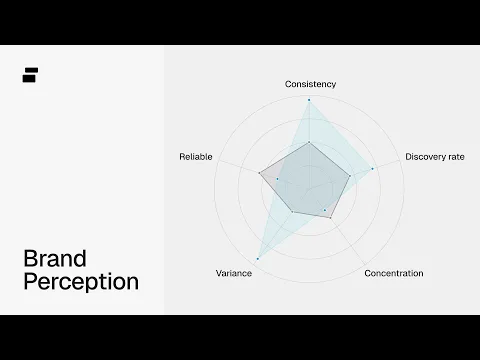
Peec AI ranks second on two things: it covers thirteen engines, more than anything else in this batch, and the analytics depth behind them is the strongest I have worked in. Collection is UI scraping through browser automation. Peec is Berlin-based, prices in USD monthly on its own pricing page, and publishes a 15% discount for annual billing. The engine count is the headline; the domain-level reporting underneath it is the reason I keep it open.
Thirteen engines and the metrics I actually open
The base set is ChatGPT, Google AI Mode, AI Overviews, Copilot, Perplexity and Gemini. Higher tiers add Claude Sonnet 4, GPT-5 Search, Grok, DeepSeek, Qwen, Mistral and Meta Spark. On Starter, Pro and Advanced you pick three engines; seeing all thirteen requires Enterprise. Refresh is daily. The metrics I actually open are visibility percentage, share of voice, a 0–100 sentiment score, and Citation Rate alongside Citation Retrieved, Peec reports citation coverage in two forms rather than a single named citation-share figure, and I like knowing which one I am reading. For the broader picture, see our guide to how to measure ai visibility. Domains are classified into classes such as CORPORATE and EDITORIAL. There are 92 MCP tools, REST API access is Enterprise-only, and GA4 AI referral traffic is surfaced in the product.
Starter to Enterprise, and the fit
Starter is $95/mo for 50 prompts, 4,500 answers and one country. Pro is $245/mo for 150 prompts, 13,500 answers and three countries. Advanced is $495/mo for 350 prompts plus a Looker connector. Enterprise is custom. Users are unlimited on the paid tiers, and a free trial exists, though its length was not published on the pages I read. The buyer I would put on this platform is an analytics-led team that wants many models and log or CDN ingestion rather than a content factory. Bringing your own server logs and layering them beside sampled answers is the workflow Peec is built for. Its Agent is human-in-the-loop by design and does not publish on its own.
3. Goodie AI
Goodie AI (higoodie.com) sits where tracking and doing meet: prompt-level AEO monitoring plus optimization action credits in one account, with commerce feeds built in. That combination is why I rank it above the general-purpose suites for retail brands. One point I want stated plainly, the collection method is not described on official pages as of my review, so I worked from what the product reports rather than assuming how it samples answers.
Models, action credits, and who it fits
Coverage starts narrow and widens by tier. Core is $399 a month and covers five models, ChatGPT, AI Overviews, Perplexity, AI Mode and Copilot, with 100 prompts, 10 action credits, three seats and two countries or languages. Pro is $999 and adds Gemini, Alexa and Sparky, taking prompts to 250 and credits to 30. Enterprise is custom and reaches up to 12 models, including Claude, Meta AI, DeepSeek and Grok. There is a 7-day Core trial.
The rest of the stack is where Goodie separates itself: Brand Command monitors for inaccurate claims about the brand, Content Studio produces articles, and GA4 connects AI visits to sessions. MCP is available on Core and Pro; the full API is Enterprise. My read is that this fits a mid-market brand wanting scored actions and shopping-feed visibility more than a 13-engine research panel.
4. Conductor
Conductor is the clearest example of an enterprise SEO platform that added AEO rather than a dedicated AEO product built from scratch. It is API-first, which the vendor states, and it carries no published list price on official pages, the site shows quotas and routes buyers to a trial or a demo. Generate Draft is in beta as of my review. It stays near the top because for a large SEO team the value here is consolidation, not engine count.
Nine engines, unpublished list price, enterprise fit
Conductor lists nine surfaces: ChatGPT Auto and Search, Claude Sonnet, Gemini, AI Mode, AI Overviews, Grok Auto, Copilot and Perplexity. One detail worth knowing before you buy, the AI Search Performance report does not support Claude or Grok, so two of those nine sit outside that particular view.
Quotas replace prices. Essentials carries no AI Search credits and 60 drafts a year; Growth carries 2,500 credits and 180 drafts; Enterprise is custom. The free trial is described as three weeks in the page title and 30 days in the metadata, and there is a free AI Visibility Report.
What ships: share of voice, citations, brand mentions, and sentiment on a 1–10 scale, plus five MCP tools and GA4 sessions and conversions. The fit is a company already buying Conductor for SEO that wants API-sampled AI answers in the same stack.
5. Rankability
Rankability treats AI search visibility as the core product rather than a module bolted onto a rank tracker, which is one reason it ranks this high among the best AI visibility tools. Content workflow, audits and a blended SPI score sit on top of the tracking layer. Engines are tier-gated, seats are unlimited, and workspaces are what actually gate the account, one, three or ten depending on plan. I would buy it for an agency desk, not as one dashboard per client login.
SPI, tiered engines, and the buyer
Starter is $99 for 60 prompts and 5,475 answers across ChatGPT, Google AI Mode and Claude. Core at $199 adds AI Overviews and Perplexity. Team at $399 adds Gemini, Grok and Copilot for eight surfaces. The help centre documents 11 engines, including Brave AI, DeepSeek and Meta AI, though those are not listed on the published tiers.
SPI is the blended score that separates this from single-purpose AEO trackers: traditional rankings 30%, video 10%, AI mentions 35%, AI citations 25%. The documentation is explicit that SPI is not market share. Sentiment is reported; share of voice is not a metric here. Autopilot stages drafts but does not publish, which suits how I work. There are 97 MCP tools, API access on every paid tier and GA4 AI referrers. It fits an agency that wants AI and classic ranks in one score and reviews each draft.
6. SE Ranking

SE Ranking approaches this from a different direction than the first five entries: it started life as a rank tracker and layered AI surfaces on top. Three products are worth keeping apart, AI Results Tracker, AI Overviews Tracker, and the standalone SE Visible. Visibility Score, share of voice, and Net Sentiment are documented for SE Visible only, and I noticed that split before I compared anything else. It earns a place on a list of the best ai visibility tools aimed at SEO teams, not at a team shopping for its first AEO platform.
Plans, the AI Search add-on, and fit
Five engines sit on every plan: AI Overviews, AI Mode, ChatGPT, Gemini, and Perplexity. Core is $129 for 100 daily AI prompts and one seat; Growth is $279 for 250 prompts, three seats, and all-time history; Enterprise is custom. There is a 14-day trial. Prompt volume expands through the AI Search Add-on, priced in checks where one prompt on one platform equals one check: 200 checks $89, 450 checks $179, 1,000 checks $345, and buying that add-on is also what unlocks SE Visible.
Collection is UI scraping of rendered answers. Coverage on lower tiers is narrower than the help centre implies: the help centre documents 11 engines including Brave AI, DeepSeek, and Meta AI, and those are not listed on the published tiers. The MCP tool count is worth flagging, official pages disagree, listing 160 and 180, so I report both. Official pages do not name the AI crawlers being checked. Ideal user: an SEO team already working inside SE Ranking that will buy the add-on rather than stand up a separate AEO platform.
7. Ahrefs
Ahrefs is where an AEO layer arrives as a module inside a subscription I already pay for. Brand Radar sits in the plan rather than beside it, and that single decision changes which tier makes sense. Two things I check before recommending it: whether the tier in question includes Brand Radar at all, and where the prompt volumes come from. Both answers shape the recommendation more than the engine list does.
Brand Radar tiers and the right buyer
Starter at $29 carries no Brand Radar, one seat, and one month of history. Lite at $129 adds Brand Radar, 150 custom prompt checks, API access, and MCP. Standard $249 and Advanced $449 raise the check counts and history; Enterprise is $1,499. There is no trial of the paid plans, though Ahrefs Free is available after ownership verification. Coverage runs to seven engines, and Claude is reachable only through Custom Prompts.
Cadence is mixed: chatbot indexes refresh monthly over a 90-day window, AI Overviews every few days, custom prompts on a selectable schedule. Ahrefs states the collection is API-first. Metrics are mentions, citations, AI Share of Voice, and estimated impressions, no composite visibility score and no documented sentiment. Prompt volumes are modeled from Ahrefs' keyword and PAA corpus rather than observed AI logs. Grok collection is noted as temporarily paused. Ideal user: a team already living in Ahrefs that adds Brand Radar at Lite or above, not someone making a first AEO purchase.
8. Surfer SEO
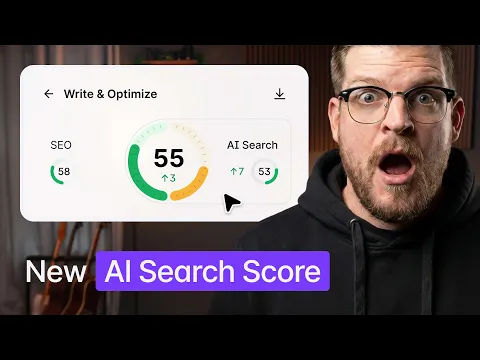
Surfer is a content platform first, and its AI Tracker sits beside the editor rather than in a separate console, which shapes who it suits. One documentation conflict is worth flagging: the homepage lists Claude among tracked engines, while the /ai-instructions/ page does not. I treat the specific page as the source and report the conflict rather than guess. Discovery has no AI tracking at all. For content teams, it belongs on a best ai visibility tools shortlist.
AI Tracker plans and the content-led buyer
Five engines are tracked: ChatGPT, Gemini, AI Overviews, AI Mode, and Perplexity. Standard at $99 covers 25 prompts weekly on ChatGPT only. Pro at $182 raises that to 50 prompts daily across all five and adds MCP. Peace of Mind at $299 is 100 prompts daily with API access, and Enterprise is $999. Standalone AI Search Analytics is priced separately: 50 prompts $95, 100 prompts $185, 200 prompts $365. There is a 7-day Pro trial.
Collection is UI scraping of front-end responses. Reported metrics are Visibility Score, Share of Voice, Mention Rate, and Brand Sentiment, with Mention Gap reporting that shows where a competitor is mentioned and a brand is not. There is no GA4 AI traffic product. Ideal user: a content team already scoring pages in Surfer that wants mention tracking inside the same editor rather than bot-log analytics.
9. Nightwatch
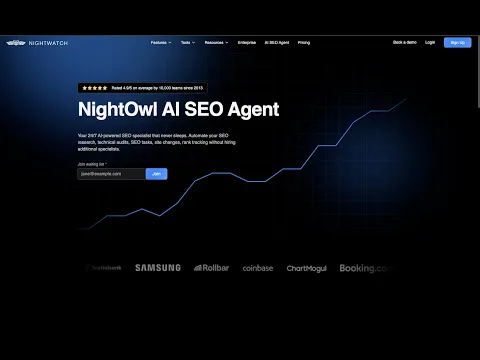
Nightwatch sits ninth because it does something most of the best ai visibility tools in this list don't: AI tracking is inside the base subscription rather than a separate module. Prices are published in EUR, the LLM surfaces are not tier-gated, and the whole thing lives inside a rank tracker I'd already be paying for. The catch worth reading twice is that the limits are counted twice, prompts and AI answers per month, so sizing has to account for both numbers, not just the prompt count.
EUR plans, five LLMs, and the rank-tracker buyer
The engine list is ChatGPT, Claude, Gemini, Perplexity, and Copilot, with AI Overviews and AI Mode treated as SERP surfaces rather than separate subscriptions, and no engine gating by tier, which is the part that decided its placement for me. Starter is EUR 79 for 50 prompts and 1,500 AI answers a month; Professional EUR 159 for 150 and 4,500 plus API access; Agency EUR 399 for 500 and 15,000 with a dedicated account manager. Enterprise is custom with SSO. Vendor wording describes simulated query sampling. Daily updates, AI Visibility percentage, share of voice, Citation Intelligence, and sentiment all ship in-plan; MCP arrives from Professional up, and seats are unlimited.
One arithmetic note: 50 prompts across five engines daily would exceed Starter's 1,500-answer ceiling, so I size the answer cap before the prompt cap. NightOwl handles SEO tasks; it does not publish or act on the AI findings. This belongs with a rank-tracking shop that wants mentions in the same daily scan.
10. Search Atlas
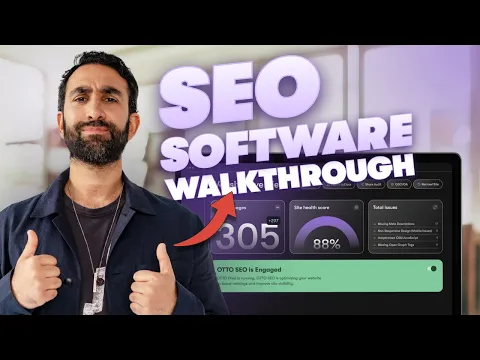
Search Atlas enters tenth as an SEO platform whose AI layer is metered in credits rather than prompts, which changes how I budget it against the rest of the best ai visibility tools here. The spend tracks real behavior: Pew Research's 2026 Americans and AI survey reports that 49% of U.S. adults have ever used a chatbot, that about one-quarter use one daily, and that 42% of chatbot users turn to them to search for information. The vendor's own pages do not describe one single engine lineup: the pricing page lists ChatGPT, Gemini, Google AI, Perplexity, and Copilot, while Claude appears on none of the published tier lists I read. Cadence and collection method were not disclosed on the pages I checked, so I treat the numbers as directional until a trial confirms them.
LLM credits, OTTO, and who should buy
Credits, not seats, are the unit here. Starter is $99 for three engines and 3,500 LLM credits; Growth $199 lifts credits to 20,000; Pro $399 adds a fifth engine and 50,000 credits; Agency is $999. A 7-day trial is available. On reporting I get a visibility score, share of voice, a citation share table, sentiment, and placement, first, last, or skipped, which is a more useful cut than raw mention counts for anything long-form.
OTTO is the differentiator: it can deploy on-site changes through a CMS or a JavaScript tag, and an approval mode exists for teams that want a human in the loop. Thirty AEO tools ship over MCP; API access is Enterprise and quote-only, and there is no AI traffic product, Search Console is integrated instead. This fits an agency that wants OTTO's on-site actions plus a credit-metered LLM dashboard, and will confirm the live engine list on the pricing page before signing.
11. seoClarity
seoClarity is the first entry in this batch I would not call self-serve. AI visibility lives in Clarity ArcAI, an add-on quoted separately from the core platform, and the publicly listed $2,500 / $3,200 / $4,500 figures are for the core SEO packages, not for ArcAI. Collection method was not disclosed on the official pages I read. That combination makes it an enterprise procurement conversation, so I ranked it on coverage and reporting rather than the price transparency I expect from self-serve ai visibility software.
ArcAI as an add-on, and the enterprise buyer
ArcAI Core covers nine engines with no tier-based engine gating, and the entry point starts at 500 prompt queries. Weekly is the default refresh; daily is available. The metrics I'd actually put in front of a board are presence rate, mentions, citations, share-of-voice benchmarking, and sentiment, plus an Accuracy module that tracks factual errors in how engines describe the brand, which is the check most tools on this list leave you to run by hand.
The published platform figures are Research & Content at $2,500, Technical SEO at $3,200, and Enterprise at $4,500; ArcAI itself is quoted. Users are unlimited and every subscription includes a dedicated CSM, alongside warehouse and BI integrations deep enough that reporting can live in your own stack. Sia is human-in-the-loop. This is for an enterprise already running seoClarity that will quote ArcAI as a separate line rather than adopt a self-serve tracker.
12. LLMrefs

LLMrefs has the simplest pricing story in this batch: one published paid tier that covers every engine the platform tracks, with no per-engine fee and no seat count to negotiate. That structure suits a small team that wants all eleven models on a single invoice. What it does not give you is a published statement of how answers are collected, that was not documented on the official pages as of my review, so I recorded it as unconfirmed rather than assuming a method.
One paid plan, eleven engines, simple fit
All in One is $79 a month: 500 prompts, weekly refresh, 50-plus countries and 20-plus languages, with unlimited seats, projects and domains. CSV export and API access are included. There is a free account plus a 7-day trial, and the FAQ mentions a 50-keyword baseline for getting started.
The engine list is the long part: ChatGPT, ChatGPT Search, AI Overviews, AI Mode, Gemini, Perplexity, Claude, Grok, Copilot, Meta AI and DeepSeek. You get an AI Visibility Score and share of voice. The prompt database behind discovery is described as 4.5M+ ChatGPT prompts assembled from public datasets and clickstream.
Two observations. There is no GA4 or Search Console product, so AI-driven sessions stay outside this tool. And the API documentation page rendered empty when I opened it, which I read as documentation still in progress rather than a missing feature. No MCP server. A partial crawlability checker rounds it out.
Ideal user: a small team that wants every engine on one invoice and will accept a weekly cadence and lighter documentation.
13. ZipTie
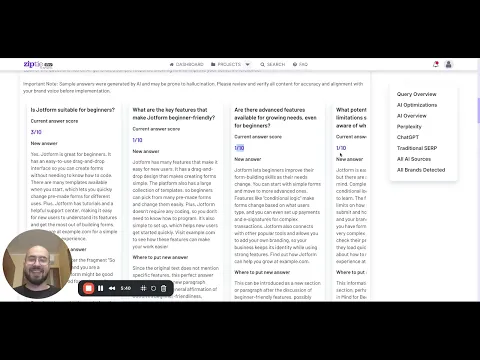
ZipTie does not sell a subscription ladder. Most entries on my list of the best ai visibility tools sell a seat count; ZipTie sells prompt slots and refresh cadence through a usage configurator, so the invoice reflects how much you decide to watch. Preset configurations I saw started at $42.75 a month and ran to $659.59 and $3,137.09. Third-party pages still quote retired fixed tiers that do not match the live configurator, so I check the configurator itself before comparing prices.
Usage pricing, seven engines, monitoring fit
Seven engines are covered: ChatGPT, AI Overviews, AI Mode, Gemini, Perplexity, Copilot and Bing AI Overview. Claude and Grok are not on that list, which is the first gap to weigh if those surfaces matter in your category. Cadence is a price input rather than a plan feature, daily, weekly and monthly pools are all configurable.
The trial gives you 25 daily prompts for 7 days with no card. Scoring is an AI Success Score from 0 to 100, plus share of voice, citation share, an owned/earned/third-party citation split, and sentiment. The dashboard holds a 365-day range with no backfill, so history starts the day you switch it on.
Content Generation and API/MCP access are add-ons, roughly $20 per context and $10 for API and MCP. Seats are unlimited. The Action Center recommends changes rather than making them.
Ideal user: a practitioner who would rather buy prompt slots and cadence than seats, and does not need Claude in the panel.
14. Yotpo (Discover)
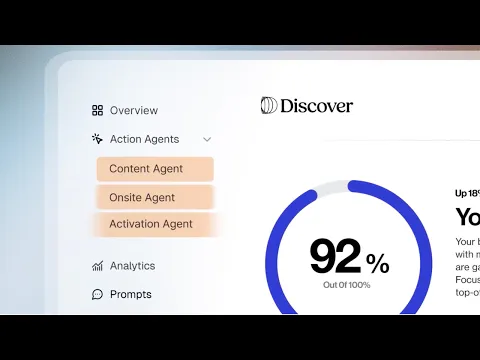
Yotpo's Discover module is commerce-native: it lives inside the Yotpo platform and is quoted rather than listed. Access is gated to merchants at $10M+ annual GMV, with a waitlist below that threshold. Several fields I would normally record, cadence, share of voice, sentiment, list price, were not published on the pages I reviewed, so I marked them unpublished rather than filling them in. There is also no Discover endpoint in Yotpo's developer documentation.
Four engines, review data, commerce buyer
Four engines are covered: ChatGPT, Gemini, Claude and Google AI Mode. Visibility, citation share and source mention are the metrics confirmed on official pages. Share of voice, sentiment, refresh cadence and price were not disclosed. Each account gets an assigned AEO consultant.
On the output side, Discover generates briefs, drafts and FAQs, and it runs technical crawler audits. Three named agents are documented; how much autonomy they carry is not. Review content is the differentiator: LLM review schema works on non-headless Shopify, Reviews Syndication pushes structured review data outward, and a Discover MCP server is available for Claude.
This is not general-purpose ai visibility software and does not read like it. Ideal user: a large Shopify merchant already running Yotpo reviews that wants review content surfacing in AI answers, rather than a self-serve multi-engine research panel.
15. Google Search Console
Google Search Console is the only entry here that nobody sells me. I put it fifteenth because it is genuinely first-party: Google reports which of my URLs appeared inside its own generative surfaces instead of a vendor sampling answers on my behalf. It is also the narrowest item in this batch, Google only, no prompt dimension, no competitor set. That combination makes it the checkpoint I open before any paid dashboard, not the answer on its own.
What the generative AI report actually shows
Google introduced dedicated performance reports for generative AI features in Search, covering AI Overviews and AI Mode, and I read them as two numbers I can defend. The report shows impressions tied to those features in both Search and Discover, and it lists which URLs appeared there. AI Overviews and AI Mode are pooled, so I cannot split the two. Nothing from ChatGPT, Perplexity or Claude appears, because this is Google's own surface. Data lands daily, usually two to three days behind. The dimensions are Pages, Countries, Dates and Devices; Queries is not one of them, which is the limitation I feel most. Clicks are not in this report either. The API type enum has no AI value and the BigQuery export carries no generative AI fields, so I pull the interface. Sixteen months of history sits in the UI.
My source for the report's scope is Google's June 2026 announcement on generative AI performance reports.
Why I still keep it beside paid AI visibility software
I keep Search Console beside paid ai visibility software for one reason: it is first-party serving data, while every paid tool is a proxy that fetches or samples answers and hopes to match what a real user saw. I treat those as different evidence types and never average them together. Two operational notes matter here. Blocking Google-Extended in robots.txt does not remove a site from AI Overviews, because those surfaces run on Googlebot plus snippet controls. The opt-out under Settings is the switch that means no generative AI traffic or impressions get reported at all. Google's published guidance also says no extra schema is required for these features and that llms.txt is not used by Google Search. Ideal user: any site owner with Search traffic who wants a free, Google-only impression check sitting next to a multi-engine tool.
16. Bing Webmaster Tools
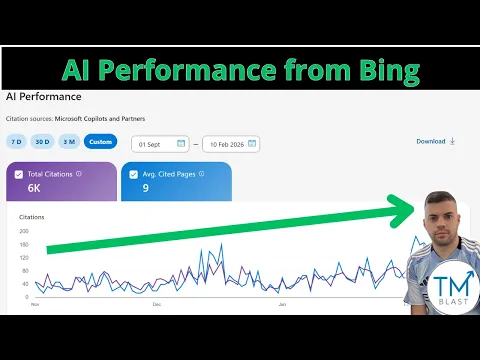
Bing Webmaster Tools costs nothing and reports Copilot citations directly from Microsoft, which is why I keep it in the stack alongside paid platforms. Microsoft states the data represents a sample rather than a full census, so I read every figure as directional and compare it against my own panel. What it adds that Search Console does not is a share figure for my citations and the retrieval phrases that pulled my content into an answer.
Citation Share, grounding queries, and fit
The AI Performance section pools Copilot, Bing AI summaries and unnamed partner integrations, so I cannot attribute a citation to one product. Three metrics carry the weight for me: Total Citations, Average Cited Pages, and Citation Share, which is my share of citations for the same grounding query, expressed without naming the other sites involved. Since June 2026, Grounding Queries also exposes Intents and Topics, the phrases used to retrieve my content. There is no sentiment field and no click data in the AI report. On the crawl side, bingbot is the one crawler behind these surfaces, and nocache, noarchive and data-nosnippet are the controls that change what can be quoted. Ideal user: anyone who wants first-party Copilot citation counts and retrieval phrases at zero cost, knowing the numbers are sampled and Microsoft-only.
17. Perplexity Sonar

Perplexity Sonar is not an AEO dashboard. It is an API I call myself, and not every entry among the best ai visibility tools is a packaged interface. It sits this low in my ranking because I have to build every metric on top of it. The reason I still use it: the citation payload is the most structured of the three frontier APIs I sample, and it returns sources I can diff week over week.
Request fees, citation payload, DIY buyer
On sonar, input and output run $1 per million tokens each, and search adds a request fee that scales with search_context_size: $5, $8 or $12 per 1,000 requests depending on the setting. I hold search_context_size constant across an entire panel, otherwise the sources shift for reasons that have nothing to do with my brand. Each response returns search_results with url, title, snippet, date and last_updated, and search_domain_filter lets me build a competitor panel without touching my own domain. Perplexity also ships a first-party MCP server with four tools. What it does not ship is a visibility score, share of voice or sentiment; those are mine to compute and document. Chat Completions sunsets on 27 September 2026, so I am migrating to the Agent API. The API and the consumer app return different sources, which is why I label anything from this layer a proxy. Ideal user: an engineer building a Perplexity citation panel who will own the scoring.
18. ChatGPT Astra (GPT-6 Astra)
Astra is the OpenAI surface I treat as a build-it-yourself layer rather than a dashboard. The route is the Responses API with the web_search tool, which returns citation annotations I can parse, store, and score myself. OpenAI does not state that API web_search returns the same sources as consumer ChatGPT search, so I label anything I collect here a proxy, not the consumer answer.
Astra is not ai visibility software in the packaged sense, and the plan access reads differently depending on where you look. Per OpenAI's help centre it is available in Work and Codex only, while the launch post reads more loosely about where it appears. I report both and check the live account before planning a panel around it.
API citations, plan prices, and the DIY job
Pricing I can verify: Plus is $20 a month, Pro is listed at $100 or $200 depending on the tier, Business is $25 or $125 per seat, and API access runs $10 per million input tokens and $50 per million output tokens. temperature and top_p are unsupported here, so I repeat the same prompt several times and report a distribution instead of a single answer.
Two mechanics matter for measurement. OAI-SearchBot gates whether your page is eligible to be cited in consumer ChatGPT search, so it has to be allowed in robots.txt if you want consumer-side credit. Referrals arrive tagged utm_source=chatgpt.com. The web_search tool takes allowed_domains and blocked_domains lists of up to 100 entries each, which is how I approximate a share-of-voice panel without naming competitors.
The API ships zero AEO metrics. Suited to a developer measuring OpenAI-surface citations who will label the output a proxy, not a consumer-app reading.
19. Claude Fable (Fable 5 / 5.1)

Fable is the Claude generation I reach for when I want citation objects I can score in code. The Messages API web search tool returns structured citations, so the same pipeline that fills a panel can be built without a vendor in the middle, which is why the bottom of my best ai visibility tools list looks different from the top.
Two cautions keep me honest. Anthropic does not present API search as identical to the consumer app, and the consumer app's image search is documented as running through Bing. Whether Claude decides to search is also not deterministic: it chooses per run, so I repeat prompts and report distributions rather than one answer.
One practical note: the web search tool is not offered on Bedrock, so I use the first-party API whenever the numbers are for measurement.
Citation objects, plan gates, DIY buyer
Pricing on the API side: $10 per million input tokens, $50 per million output tokens, and $10 per 1,000 web searches. On the consumer side, Pro is $20 with pay-as-you-go credits for Fable, Max includes Fable inside the weekly limits, and Team and Enterprise seat pricing applies.
The citation objects are the useful part. Each one carries url, title, and cited_text capped at 150 characters, short, but enough to check whether a claim actually came from your page rather than a paraphrased mention.
Operationally I allow Claude-SearchBot in robots.txt, and I remember that allowed_domains and blocked_domains are mutually exclusive, so a panel has to pick one mode. Anthropic operates the Connectors Directory as the client side, not as a listed AEO server. There is no publisher how-to-get-cited document I could find. This fits a team already on the Claude API that will score citations itself and will not treat one run as the consumer answer.
20. Google Gemini

Gemini sits last in this stack for a specific reason: it ships no AEO metrics, and the Gemini API Terms restrict analysing Grounded Results outside the listed exceptions. I'm restating the documented terms, not guessing at intent, if you plan to build a commercial citation dashboard on this endpoint, read the terms and talk to counsel first.
I also treat the Gemini app, AI Overviews, AI Mode, and the API as four separate surfaces. Google does not state that they return the same sources, so I don't claim parity between them. Two mechanics I keep in mind: URIs in groundingChunks are Google redirects rather than the publisher's canonical URL, and Search grounding is not covered by zero-data-retention, with a documented 30-day retention on Google's side.
Grounding payload, documented terms, DIY fit
On the legacy grounding payload, google_search returns sentence-level groundingSupports that tie a span of generated text back to a source. The Interactions API uses a url_citation shape instead, so parsing differs by surface.
Search grounding pricing for Gemini 3.x: 5,000 free search requests a month, then $14 per 1,000 search queries the model actually runs, billed on queries, not on the prompts you send. Pin your model IDs, because a moving alias will quietly move the panel.
For consumer plans, I'd rather say plainly that Google's own price page renders client-side; the Plus, Pro, and Ultra figures I have come from third-party reporting, so I treat them as reported rather than confirmed.
The fit is narrow. This suits someone displaying grounded answers to end users inside the Terms, not someone shipping a commercial citation-share dashboard on this endpoint without legal review.
Picking among the best AI visibility tools
My closing advice is the same one I give on a call: pick the tool whose engine list, collection method, and invoice match the decision you actually have to make this quarter. If your job is to prove which prompts surface your brand and to keep a content pipeline moving, start where tracking and publishing sit in one place. If you already pay for an SEO suite, the cheaper path is usually the AI module inside it, not a new vendor. If your site earns search traffic, claim the free first-party reports first, they cost nothing and they tell you what Google's own surfaces already show. If you have engineers and a narrow question, an API panel gives you raw citations with no dashboard assumptions, provided you label it a proxy. What I avoid is buying on engine count alone. Ten engines sampled weekly can be less useful than five checked daily, and an unpublished price is a planning risk, not a feature. Match the instrument to the decision, then re-check the engine list every six months, it moves faster than your contract.
Quick comparison
| Tool | Entry price (USD/mo) | Free trial | AI engines covered (#) | Core metrics tracked (#) | API | MCP server |
|---|---|---|---|---|---|---|
| Cognizo | $499 | N/A | 10 | 6 | Y | Y |
| Peec AI | $95 | Y | 13 | 4 | Y | Y |
| Goodie AI | $399 | Y | 12 | 5 | Y | Y |
| Conductor | Not published | Y | 9 | 4 | Y | Y |
| Rankability | $99 | Y | 8 | 2 | Y | Y |
| SE Ranking | $129 | Y | 5 | 4 | Y | Y |
| Ahrefs | $29 | N | 7 | 3 | Y | Y |
| Surfer SEO | $49 | Y | 5 | 4 | Y | Y |
| Nightwatch | EUR 79 | Y | 5 | 5 | Y | Y |
| Search Atlas | $99 | Y | 5 | 5 | Y | Y |
| seoClarity | $2,500 | Y | 9 | 3 | Y | Y |
| LLMrefs | $79 | Y | 11 | 2 | Y | N |
| ZipTie | From $42.75 | Y | 7 | 5 | Y | Y |
| Yotpo (Discover) | Not disclosed | N | 4 | 3 | N | Y |
| Google Search Console | $0 | N | 1 | 1 | Y | N |
| Bing Webmaster Tools | $0 | N | Pooled, count not disclosed, Microsoft… | 3 | Y | N |
| Perplexity Sonar | $1 per 1M input, $1 per 1M output, plus… | N | 1 | 0 | Y | Y |
| ChatGPT Astra (GPT-6 Astra) | $20 | N | 1 | 0 | Y | Y |
| Claude Fable (Fable 5 / 5.1) | $20 ($17 annual) | N | 1 | 0 | Y | Y |
| Google Gemini | ~$7.99 (third-party reporting only… | Y | 1 | 0 | Y | Y |
Frequently asked
For a small team I'd weight prompt coverage, whether the tool stores the cited URLs, and per-seat cost. I'd start with a free layer, Google Search Console's generative AI performance reports, which show impressions and which URLs appeared in Google's AI features, then add one paid platform only if you need ChatGPT and Perplexity tracking too.
A rank tracker follows positions for keywords on a results page. The tool asks the assistant a question and records whether your brand was mentioned, which URLs were cited, and how the answer was phrased. Placement, not position, is the unit of measurement, and the same prompt can return different answers on different days.
Most platforms in this list poll several engines, but coverage varies by tier, so I test it myself: I run the same ten prompts and check whether ChatGPT, Perplexity, and Google AI Overviews each come back with data. Search Console's generative AI reports cover Google's features only, impressions and the URLs that appeared, not other assistants.
Yes, in my workflow. Search Console is first-party data from Google: it reports impressions tied to generative AI features in Search and Discover and shows which of your URLs appeared inside them. Paid tools add competitor framing, prompt-level tracking, and other assistants, but none of them see your own Google impression data.
You can, and I do it for spot checks: I ask the same question in each model, note the brand mentions and cited URLs, and log it in a sheet. It's fine for a handful of prompts, but it doesn't scale, answers shift between sessions, and there's no history unless you record it yourself.
Weekly is my default for a stable prompt set, with daily runs only during a launch or a known model update. Answers are not stable enough for hourly polling to mean much, and 45% of chatbot users say they have little or no confidence in chatbot accuracy, so I read trends across weeks, not single snapshots.
