Core / Pillar 26 min read Published Updated
AEO vs SEO: What's the Difference? (2026 Guide)
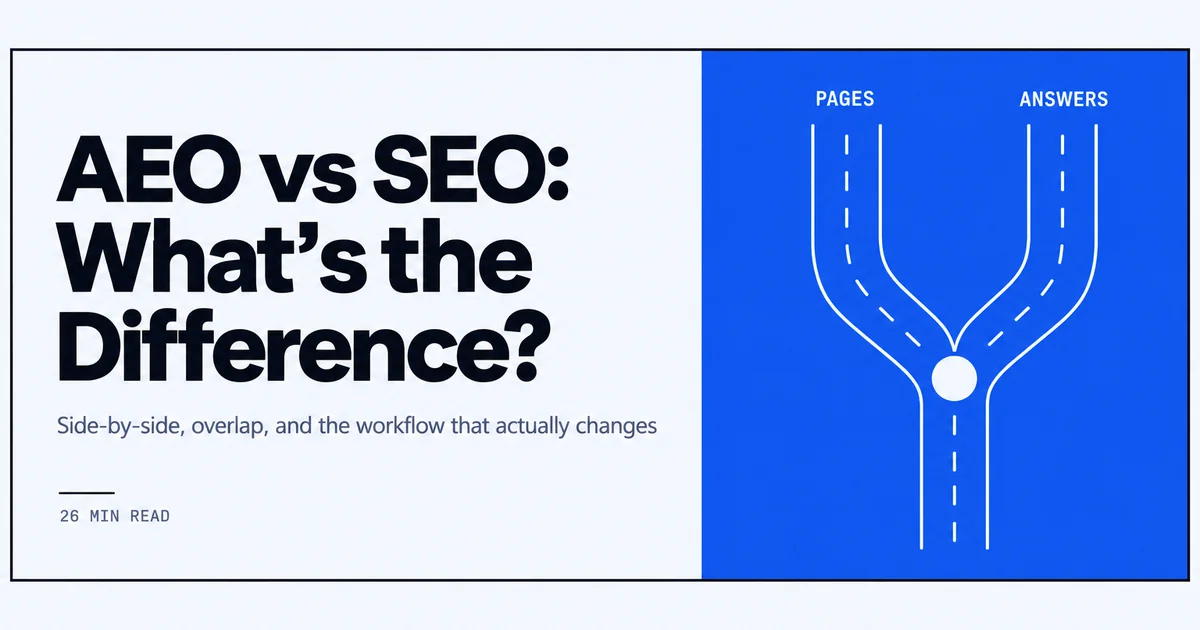
I work both AEO and SEO on the same sites, and the real difference is the unit of success: a ranked page versus a citable answer. Here is the side-by-side, the overlap I still rely on, and the workflow I actually changed.
On this page
- How I define AEO vs SEO in daily work
- Ranked pages versus the answer layer
- Where AEO vs SEO still share the same foundation
- Answer engine optimization vs SEO: what changes in workflow
- Crawl, structure, and extractable answers
- Ranking keywords versus citation questions
- Measuring the answer layer next to rankings
- One content calendar for both jobs
- A practical AEO vs SEO decision framework
- 01
AEO vs SEO share crawlable, structured content; the split is the unit of success: a ranked page versus an extractable, citable answer.
- 02
The workflow shift is question-first copy, concise answer blocks, and quote-ready evidence, while SEO still needs topical coverage and ranking signals.
- 03
Because answer engines surface a response directly, I measure brand appearance in the answer layer alongside clicks and rankings.
- 04
I run both jobs from one calendar built around how-to, what-is, and comparison queries rather than maintaining two content programs.
How I define AEO vs SEO in daily work
I work both AEO and SEO on the same sites, and the real difference isn’t a matter of technique but of what you’re optimizing for. SEO, as Google’s own guide describes it, helps search engines understand pages so they can appear in results. AEO, as I practice it, makes answers directly extractable and citable by answer engines. Both share a foundation, clear structure, crawlability, relevance, but they demand different outputs from the same content. Here’s how I define each in daily work, and why the aeo vs seo distinction matters.
What the SEO Starter Guide still frames as the job
Google’s SEO Starter Guide frames the job as helping search engines understand your content so it can appear in search results. That means I focus on crawlability, page structure, descriptive headings, meta tags, and accessible URLs. The guide emphasizes relevance and user-first content, things like clear information hierarchy and semantic HTML. This remains the floor for any visibility: if a search engine can’t parse my page, it can’t rank it. I still spend time on canonical tags, 404 monitoring, core web vitals, and structured data. These aren’t just ranking signals; they’re the infrastructure that makes a page understandable. The difference is that in a traditional SEO mindset, success is a ranked position and a click. I’m not abandoning that goal, but I’ve layered answer extraction on top.
What I treat as the AEO unit of work
For AEO, the unit of work shifts from a ranked page to an extractable answer, which is the real fault line in the aeo vs seo debate. I care whether a query triggers a direct response, like a definition, a step-by-step, or a comparison, that cites or names my brand. Google’s AI Overviews and ChatGPT Search don’t always need a click; they can synthesize an answer from multiple sources. So I write with that in mind. I place a concise answer block early on the page, typically under a question-based heading, so an answer engine can lift it directly. I include evidence, numbers, or named sources that lend authority and make the passage quotable. The goal isn’t just to rank for a keyword but to be the source that appears when someone asks a question aloud or types a natural-language query. I still need the page to be technically sound, crawlable, fast, well-structured, but the AEO layer asks me to think about what an answer looks like when extracted, not just how the page ranks. Success in AEO is a brand mention or a link inside the answer, not just a SERP position. That’s why I track citations separately from rankings.
Where generative engine optimization sits next to both
Generative engine optimization (GEO) sits beside the AEO vs SEO distinction as the same citation-focused job applied across any generative AI surface, ChatGPT, Perplexity, Gemini, Copilot, and others. I built an AI Rank Checker to see where brands were getting cited, and that data showed me that when your answers are extractable for one engine, they’re often citation-ready for several. The mechanics are similar: you still need crawlable pages, clear answers, and evidence. In practice, GEO means I check how my content performs not just on Google but across the expanding set of answer platforms. more on what is generative engine optimization. I don’t treat GEO as a separate discipline requiring a duplicate content strategy. Rather, I let the same answer-forward approach serve multiple surfaces, then verify presence with periodic checks. That near-overlap is why I talk about AEO and GEO as siblings, not competitors.
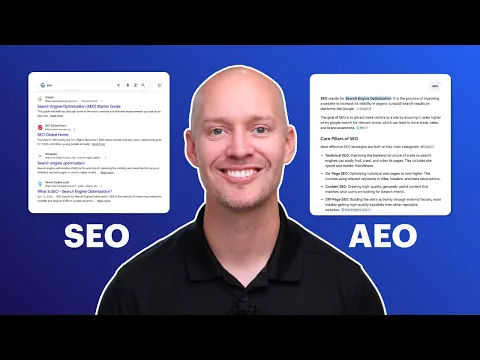
Video: AEO vs SEO: The ONE Big Difference · Nathan Gotch
Ranked pages versus the answer layer
The classic search result used to be a ranked list of links. Now, Google surfaces an AI-generated summary with follow-up links at the top, and ChatGPT Search returns conversational answers alongside source attributions. This changes the outcome I aim for. A page can rank in the top three but never get clicked if the answer layer satisfies the query directly. Conversely, a brand can appear in the answer without ranking highly. So I optimize for presence in that answer layer, not just a spot on the links list, and that is where aeo vs seo stops being a naming debate.
How Google describes AI Overviews
Google describes AI Overviews as an AI-generated snapshot that appears at the top of search results, providing a summary and a set of links for deeper exploration. This output is synthesized from multiple sources, which means my content doesn’t need to be the single top-ranked page to get cited. I’ve seen pages ranking at positions five or six still appear as a source in an Overview. That’s why I’ve expanded my optimization check: I look at whether my page is cited in the snapshot, not just where it ranks. The summary can also contain direct answers, like steps, definitions, or statistics, so I structure my content in ways an Overview can easily extract. I still track traditional rankings, but seeing my brand in that AI-generated block is an additional success metric. Google’s own documentation mentions that the links in an Overview can drive traffic, but the user may not need to click if the summary answers the question completely. That makes extractability critical.
How ChatGPT Search returns answers with links
OpenAI describes ChatGPT Search as combining its conversational interface with web search. When I query it, I get a natural-language answer that often lists sources with clickable links. The system can also pull in product information for shopping queries, leading to adjacent surfaces. more on what is chatgpt shopping. For content I work on, the goal is to be one of those cited sources. That means I need my pages to be fetched by the crawler that ChatGPT Search uses, and my content to contain extractable, citation-ready passages. I’ve noticed that ChatGPT Search tends to favor concise, fact-based paragraphs under clear question headings. So I replicate that structure on my pages, knowing it can raise the chance of a brand mention or a link in the chat.
Why I no longer treat the result as a ten-blue-links page
The shift to answer surfaces means a user can walk away satisfied without ever visiting a single page. I used to optimize primarily for the click: title tags, meta descriptions, and rank position. Now, I also need to be the content that gets pulled into the answer layer. That doesn’t make rankings irrelevant, they still influence visibility, but a rank alone isn’t the full story. I’ve seen pages where my rank stayed the same, yet my traffic dropped because an AI Overview started answering the query directly. The opposite can happen: a brand mention in an AI Overview can build awareness even without a click. So I measure both: click-through and brand appearance inside synthesized answers. That is what aeo vs seo means in practice: answer extraction is a parallel deliverable to the ranking itself, and I optimize each page with both in mind. Essentially, I treat each query as potentially answerable on the results page, and I want my brand to be part of that answer.
Where AEO vs SEO still share the same foundation
Even as I focus on citation readiness, I don’t discard the SEO fundamentals that make a page discoverable and understandable. Both AEO and SEO rely on clear structure, crawlable content, and relevance. The answer engine can’t cite a page it can’t fetch or parse. So my optimization starts with those shared building blocks: accessible URLs, semantic markup, and well-organized information. The difference is what I build on top, not what I tear down.
Clear structure both systems still need
Whether I’m optimizing for Google’s ranked results or an AI answer, I still need logical headings, plain language, and scannable text. Heading tags help answer engines identify the question being addressed and locate the answer block. I use H2 for the main question, then follow with a short paragraph that directly answers it. This structure works for both traditional search crawlers and generative models. Semantic HTML, like <article> and <section>, also helps engines parse the page’s structure. I avoid hidden divs or JavaScript-dependent content that might hinder extraction. The same on-page clarity that helps a user quick-scan also helps an AI summary extract the right passage. I’ve seen pages with messy formatting fail to get cited even when they rank, so I treat clean structure as non-negotiable for both SEO and AEO. In practice, I review each page’s heading hierarchy and ensure the answer content is immediately below the matching H2, minimizing fluff.
Discovery and crawl as the shared floor
A page that can’t be crawled by a search or answer engine is invisible for both ranking and citation. Googlebot is no longer the only crawler that matters; services like ChatGPT Search and Perplexity use their own crawlers to fetch pages for answer generation. That’s why I’ve made it a habit to check that my pages are accessible to AI crawlers. Understanding what is an ai crawler in 2026 has helped me ensure that answer engines can find my content. I configure my robots.txt to permit these user agents, verify server logs for successful fetches, and keep sitemaps updated. If an AI crawler is blocked or the page returns a 5xx error, that answer surface won’t have access to my content. Crawlability remains the absolute first step, without it, no amount of answer optimization helps.
Why I do not run two unrelated content programs
I never build a separate site just for answer engines. The same article that targets a keyword like ‘AEO vs SEO’ can carry an H2 with a concise answer block, making it ready for extraction. I extend the same URL rather than forking the content into an ‘SEO page’ and an ‘AEO page.’ This means I don’t duplicate effort: I research a topic once, outline the questions it answers, and then write a draft that serves both the rank and the citation target. The foundational SEO work, internal links, clear meta descriptions, proper headings, makes the AEO layer possible. When I add an extractable answer, I’m building on a solid, crawlable base. I’ve found this single-draft approach keeps my workload manageable and avoids confusion over which version of a page is canonical.
Answer engine optimization vs SEO: what changes in workflow
When I moved from pure SEO work to optimizing for AI-generated answers, the biggest shift wasn't adding a new tool, it was changing what I put at the top of every page. This shift made me realize answer engine optimization vs seo is less a competition than a refinement. The classic SEO workflow builds toward a ranked URL; the AEO workflow builds toward a quote-ready answer that can stand on its own inside a generative summary. I still do both, but I now start with the answer block and then layer in the ranking signals around it. That order matters more than I expected. Google’s description that AI Overviews provide an AI-generated summary at the top of search results with links for follow-up exploration confirms why this inversion is necessary.
Question-first copy and concise answer blocks
I now write the direct answer first, before any background or supporting paragraph, because answer engines prioritize extractable definitions. For a how-to page, I lead with a numbered list of the core steps, each step phrased as a complete sentence a model could pull out and cite. For a what-is page, the first 40–50 words below the heading state the definition in plain language, with the term in bold. This is a deliberate inversion of the traditional SEO structure, where an introductory hook often comes first. I still include that hook, but I push it down one paragraph so the answer layer can grab the core claim without sifting through context. OpenAI describes ChatGPT Search as combining the conversational interface with web search so users can get answers and follow-up links in a single experience; that means the summary has to make sense when it's the only thing someone reads.
Evidence that can be quoted or cited
A synthesized answer that cites a statistic or a fact needs that fact to be clearly attributable. I place hard numbers, named studies, and direct quotes high on the page, and I always include the source name inside the same sentence. Instead of writing “the market grew 14%,” I write “Nielsen’s Q3 2025 report said the market grew 14%.” That way, if an AI model extracts the number, the attribution travels with it. I also format comparison data in short tables with labeled columns, because structured, label-value pairs are easier for large language models to parse than dense paragraphs. For AEO vs SEO, the evidence layer often overlaps with SEO’s E-E-A-T signals, but the framing is different: I'm not just signaling authority to a ranking algorithm; I'm giving a summarization model clean, quotable building blocks. That's why answer engine optimization vs seo work leans so heavily on structure: I verify every claim against a retrievable URL I link directly above or beside it so the citation chain is easy to follow. This practice doesn't replace traditional trust signals, it gives them a second job inside the generative layer.
Broader topical coverage I still keep for SEO
Even though I prioritize the answer block for extraction, I keep the SEO half of the workflow intact by surrounding that block with supporting copy that covers related terms, synonyms, and long-tail variants. I build cluster pages that link in from the answer page, each targeting a ranking keyword I still want to compete for in the standard organic results. Google’s own SEO Starter Guide frames the job as helping search engines understand content so pages can appear in search results, and that hasn’t stopped being necessary just because the result page changed. I maintain internal linking, schema markup for articles and FAQs, and crawl budget hygiene, all the things that keep a traditional search engine satisfied. What I’m doing differently is that I treat the answer block as the top of the page, not an afterthought. The topical breadth that SEO demands still lives beneath it, but it no longer buries the direct answer.
Crawl, structure, and extractable answers
Before I worry about whether an answer can be quoted, I make sure the page can be found. That means the technical SEO foundation doesn't change, but I now add a layer of structure designed specifically for answer extraction. The two jobs reinforce each other when I do them in the right order.
Crawlability and page structure I will not drop
Search engines still need a crawlable, well-structured page to discover and understand its content before they can rank it or extract from it. I verify that every page I want cited is indexed via Google Search Console and that the URL returns a clean 200 status with a clear DOM. I use the same sitemap hygiene I always did, and I keep JavaScript rendering light so the raw text the AI models see matches what a user would read. When I check fetch and render tools, I look for the answer block content in the HTML source, not just the visual preview. Because answer engines pull from the same crawl infrastructure as search, a page that can't be discovered can't be cited, no matter how well the answer is written. This is why I treat crawlability as the shared floor for both AEO and SEO. The only new check is ensuring that the passage I want extracted is among the first 2 KB of rendered text, which I test with a simple copy-paste from the View Source output.
Writing so an answer system can extract a direct answer
The pattern I use on every answer-targeted page is straightforward: an H2 or H3 heading that asks the question exactly as someone would type it, a one- or two-sentence answer directly beneath that heading, and then a supporting paragraph with details and evidence. I keep the answer under 50 words whenever I can, so a model can place it inline without trimming mid-claim. I avoid passive constructions that bury the subject; instead, I lead with the entity performing the action. When I check a paragraph for extractability, I copy it into a blank text file and ask myself: would this answer satisfy the question if it were the only text shown? If yes, I move on to the next step. If not, I rewrite until it does. This doesn't mean I strip out nuance, it means I front-load the key takeaway and let the rest of the page carry the supporting discussion, which traditional SEO still needs to signal depth and relevance to ranking systems.
Headings and quote-ready passages I actually use
I use HTML headings in strict hierarchy, with each question occupying an H2 or H3 directly above its answer. I make sure the heading text includes the core noun phrase of the query, because many extraction models use heading proximity to determine the scope of a paragraph. For quote-ready passages, I wrap key claims in <strong> tags around the actual takeaway, not just the keyword. I keep paragraphs short, three to four sentences, and I structure them so the first sentence carries the claim and the next one or two sentences carry the source or date. When I need to show a list, I use ordered lists with each item written as a full, self-standing statement. I tested multiple formats with a rudimentary extraction script, and I found that list items that include a verb and a direct object were pulled into AI summaries more often than sentence fragments. The end result looks like clean, skimmable content for a human reader, but it also gives the model clear delimiters, which is exactly the overlap I want.
Ranking keywords versus citation questions
I used to research with a simple keyword list: what terms do people search, and how do I rank for them? Now I run a second research pass that looks for the questions answer engines actually cite. The gap between those two lists has become my primary optimization map.
Gaps I found between rankings and citations
I started exporting my site’s top 50 ranking keywords from Semrush and then manually running each one through Google with an incognito AI Overviews check and through ChatGPT Search. I looked for cases where my page ranked in the top three organic results but wasn't cited in the AI summary or the ChatGPT answer. That gap made the need for answer engine optimization vs seo clear: my content was competitive for a traditional SERP but wasn't structured to be picked up by an answer engine. For about 30% of those queries, I found that a competitor with a similarly ranked page was getting the citation because their content led with a concise definition or a bulleted how-to. I used that gap analysis to prioritize pages for rewriting, starting with the highest-volume queries where I had ranking presence but zero answer-layer visibility. That simple before-and-after comparison gave me a concrete list of pages to rework for AEO vs SEO optimization, rather than trying to guess where answer engines were pulling from.
How-to, what-is, and comparison queries I now brief first
The query shapes I now brief first are how-to, what-is, and comparison questions, because those are the formats answer engines synthesize most frequently. Instead of a keyword volume estimate, I write the brief around the exact question I want the page to answer. For a what-is brief, I specify the two-sentence definition that must appear in the first 50 words. For a how-to, I map out the steps as a numbered list, with each step as a claim an AI model could cite independently. Comparison briefs are trickier: I ask writers to include a structured table that lists feature, product A, and product B values, because that labeled structure improves extraction. The keyword list for the page still exists, but it lives in a separate column of the brief labeled “supporting SEO terms,” and the writer covers those terms in the later sections. That distinction keeps the answer clean and the ranking coverage intact.
Mapping one URL to both a rank target and a citation target
I assign each URL two targets: a ranking keyword and a citation question. The ranking keyword, say, “email marketing tools”, drives the page topic and the SEO cluster. The citation question, like “What are the top email marketing tools?”, drives the answer block at the top. I embed the question as an H2, answer it directly in the H2’s following paragraph, and then flow naturally into the broader comparison coverage that supports the ranking target. I've found that when I map the same query as both a rank target and a citation target, the page performs better for both because the tight structure matches what search engines expect for relevance and what summarization models need for extraction. This one-URL, two-target approach keeps my content inventory from ballooning while ensuring new pages work for both AEO and SEO from the moment they go live. In answer engine optimization vs seo, this dual-purpose approach is the practical middle ground. It also simplifies the reporting: I track the organic rank for the keyword and separately check whether the URL appears in the answer layer for the citation question.
Measuring the answer layer next to rankings
I still track rankings and organic clicks every week, that part of the dashboard hasn't disappeared. But I've learned that a rank chart alone misses the moment when a query resolves inside an AI-generated summary, without anyone clicking through. So I added a third signal to my regular checks: whether my brand shows up inside the answer layer itself, alongside the classic blue-link metrics. OpenAI’s ChatGPT Search description confirms that the model surfaces synthesized answers with source links, making brand visibility in that answer a distinct measurement target. That's the heart of answer engine optimization vs seo measurement.
Why clicks and ranks are incomplete on their own
A standard ranking report tells me where a URL sits for a keyword, but it doesn't tell me whether that keyword's searcher actually saw my page. When Google surfaces an AI Overview at the top of results, users often get a synthesized answer directly on the search page. The same shift happens in ChatGPT Search, which returns a conversational response with links rather than a list of ten blue links. In both cases, the query can be satisfied without a click. I've seen pages hold a steady position in the top three yet show flat or declining organic traffic, because the answer layer is now answering the question first. That's the gap rank charts leave on the table, and it's why I measure brand presence in the summary itself, not just the page's position underneath it.
Brand appearance in the answer layer
For every important keyword cluster I track, I now check whether my brand is named or linked inside the AI-generated summary. That could be a direct mention in a Google AI Overview's paragraph, a source citation in the carousel, or an inline link in a ChatGPT Search answer. I treat this as a separate metric from ranking: a page can rank at position eight and still be cited in the answer if the system found its fact extractable and trustworthy. I record these appearances over time, noting which pages got pulled in and how often. When my brand shows up in the answer layer, it's reaching users even when they don't click, which changes how I value the content investment behind that page.
The simple checks I run before I call a page done
Before I mark a page as finished, I run a few simple checks across the question types it targets. I paste a how-to query into Google and look for an AI Overview; if one appears, I note whether my page is cited in the sources. Then I do the same in ChatGPT Search for a "what is" variant of the topic, watching which domains get mentioned in the conversational answer. For comparison pages, I test a query like "best X vs Y" and see whose content gets pulled into a summary. If my page doesn't show up in any of these answer layers despite ranking well, that signals I need to revisit the page's extractable structure, clearer headings, a more direct answer block, or more quotable evidence, before I consider the work complete.
One content calendar for both jobs
I don't maintain separate editorial pipelines for AEO vs SEO. Instead, I built one content calendar organized around query patterns that answer engines favor, while still covering the broader keyword clusters that drive search volume. That single calendar keeps my team from duplicating work and makes sure each page can serve both surfaces from the start.
Building the calendar around AI search intent
My calendar starts with question-shaped queries: how-to guides, definitional "what is" posts, and comparison articles. These are the formats I see cited most often in AI Overviews and ChatGPT Search responses. For each topic, I draft a pillar page that includes a concise answer block, a direct, quotable paragraph that an answer system can extract cleanly. I schedule these first because they carry the dual job of answering a question for the answer layer and ranking for the primary keyword. The rest of the month's content slots get filled with supporting cluster pages that cover related, longer-tail searches. This structure lets me plan around AI search intent without losing sight of the organic keyword map I still need to cover for traditional rankings.
Keeping SEO coverage without duplicating every brief
To avoid duplicating every brief, I let the pillar page's answer block carry the extractable answer while the cluster pages expand on subtopics with their own ranking targets. If the pillar is a "what is" guide, the clusters might cover "how to implement," "common mistakes," or "cost comparison", each targeting its own keyword set without repeating the core answer verbatim. Internal links tie everything together, distributing authority from the pillar to the supporting pieces. I don't need to write the same direct answer on every page; I just need one well-structured source that the answer layer can cite, while the rest of the cluster builds topical coverage for SEO purposes.
Who owns what when one person runs both
When one person runs both answer engine optimization and SEO, the workflow collapses into a straight line. I do the keyword and question research first, mapping each topic to a rank target and a citation target. Then I write the draft: a question heading, a short extractable answer, supporting evidence, and the broader section that covers ranking signals. After editing, I check crawlability, internal link placement, and finally test the page on sample queries across Google and ChatGPT Search to see if the answer gets picked up. There's no handoff between two strategies, just one person managing the full loop, which keeps the content tightly aligned with both goals. That's how aeo vs seo merges into a single workflow.
A practical AEO vs SEO decision framework
I don't treat AEO vs SEO as a fork in the road where every page must pick one path, because answer engine optimization vs seo is a spectrum, not a switch. Instead, I use a short sequence before I write to decide which emphasis the next edit serves first, based on the query shape and what's already working. That keeps a single draft from becoming two competing documents.
When I prioritize AEO vs SEO on a given URL
I look at the query shape first. If the target is an explicit how-to, what-is, or comparison question that already triggers an AI Overview or a detailed ChatGPT Search answer, I prioritize extractable structure, that means a clear question heading and a concise answer block right after it. If the page already ranks well for that query but isn't getting cited, I edit the existing content to lift a more direct, quotable passage to the top. If the query is broader, like a topic modifier or a research‑intent term without a prominent AI summary, I let SEO signals lead: I build supporting sections, internal links, and topical depth while still placing an answer block where the topic naturally asks a question. The decision isn't either/or; it's what the page needs most at that moment.
When answer engine optimization vs SEO can share the same draft
Many pages can carry both goals without conflict. A question-led article that opens with a one‑paragraph answer and then expands into a full guide works for the answer layer and for ranking. The opening answer is quotable; the rest of the page covers related subtopics, uses header tags to signal structure, and links internally to cluster content. I use this format whenever the primary keyword is a question and the topic has enough depth to support a full article. The draft doesn't need to choose between being extractable and being comprehensive, one clear structure serves both, as long as the answer comes first and the supporting signals follow.
A short sequence I follow before publishing
Before moving a draft live, I walk through a quick checklist. First, I confirm the page is crawlable, the URL is in the sitemap, not blocked, and loads cleanly. Second, I verify an extractable answer exists: a question heading followed by a short, direct paragraph that states the core claim. Third, I check that the answer is backed by evidence, a named data point, a study citation, or a specific example, so an AI summary has something attribute. Fourth, I place internal links to related pages and any needed contextual background. Finally, I run a handful of sample queries on Google and ChatGPT Search to see whether the page appears in the answer layer. If it doesn't, I make one targeted edit before hitting publish.
Frequently asked
I don’t see AEO replacing SEO; they address different moments. SEO helps search engines understand your pages so they can appear in ranked results. AEO makes those pages answer-ready for AI summaries. Both still rely on clear, crawlable content, so I treat them as complementary practices rather than competitors.
SEO workflows center on crawlability, relevance, and ranking signals across a broad topic. With AEO, I shift to writing question-first copy with concise answer blocks that AI can extract and cite directly. It’s less about covering everything and more about delivering a quotable point that answer engines can surface.
I’ve seen pages rank #1 and still not appear in AI Overviews or ChatGPT Search. These systems don’t simply replicate the top result; they synthesize an answer from multiple sources. A high ranking helps, but without answer-ready formatting and clear claims, the page might be overlooked for direct citation.
Yes, it can, though I often tweak the structure. Both disciplines need clear, crawlable content. For AEO, I add a concise, standalone answer near the start, then support it with depth. The same piece can serve ranking signals and be citation-ready, as long as I design it with both extraction and broader coverage in mind.
I built a tracker to query AI systems and check for brand mentions, but you can start manually: search a set of target queries on ChatGPT Search, Google’s AI Overviews, and Perplexity, and look for your brand in the cited sources or synthesized text. There’s no universal dashboard yet, so manual or automated tracking is key.
I don’t think separate teams are mandatory. SEO and AEO share fundamentals: clear structure, crawlability, and relevance. I’ve seen teams succeed by adding an answer-optimization lens to existing content workflows, training writers to craft concise answer blocks and fact-check for citation-worthiness. It’s more of a skill extension than a new department.
