Core / Pillar 30 min read Published Updated
What Is Answer Engine Optimization (AEO)? (2026 Guide)
I use this definition every week when I rebuild pages so ChatGPT, Perplexity, and Google AI Overviews can cite them. Here is what is answer engine optimization in 2026, how engines pick answers, and where AEO stops being SEO.
On this page
- What Is Answer Engine Optimization in Practice
- AEO Meaning on a Live Website
- How Answer Engines Pick Answers
- AEO vs SEO Is Not a Rebrand
- What OpenAI and Google Have Actually Said
- How I Grew Citations by Restructuring 90 Pieces
- Listicles, Entities, and FAQs Engines Can Lift
- From Zero to 70 Percent AI Visibility
- What I Still Steal from SEO
- How I Tell Whether AEO Is Working
- 01
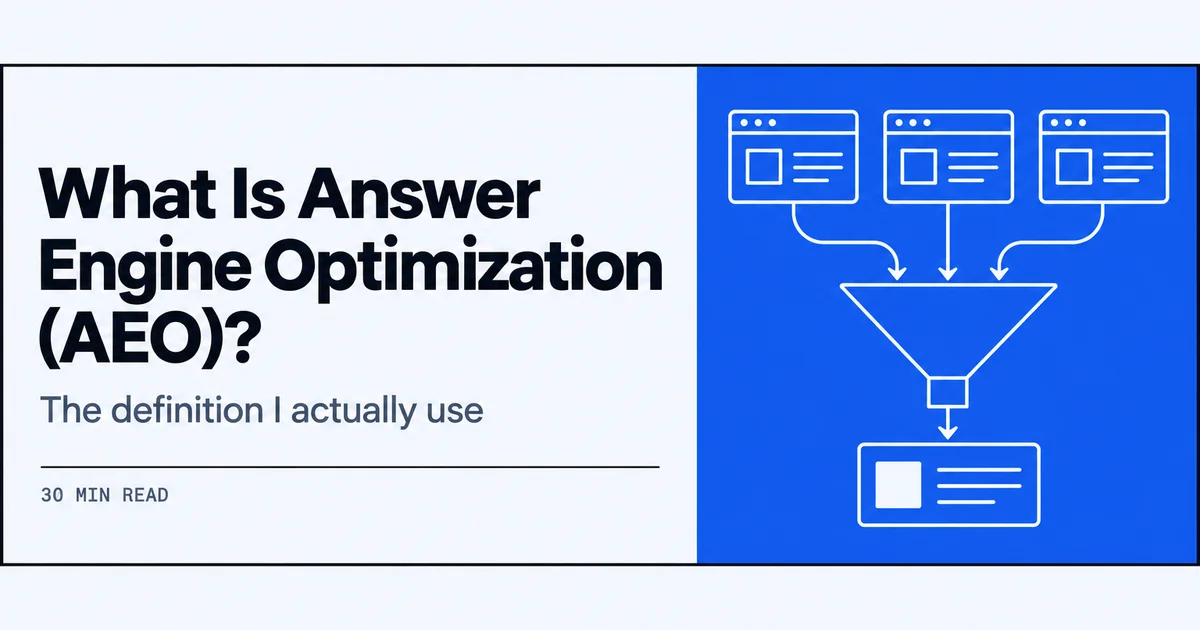
What is answer engine optimization, in the way I practice it, is making essential facts extractable so ChatGPT, Perplexity, and Google AI Overviews can cite you.
- 02
Answer engines pick clear, structured, corroborable statements, not automatically the URL that ranks first in classic search.
- 03
AEO meaning is not a rebrand of SEO: crawl and quality still matter, but the extra job is turning pages into answers.
- 04
I have seen citation gains when content is rebuilt around entities, FAQs, and listicles an engine can lift without guessing.
What Is Answer Engine Optimization in Practice
People still ask me what is answer engine optimization as if it were a glossary term. When I sit down with a page that never gets cited, I am not asking whether it ranks. I am asking whether an answer engine can lift a clean, attributable sentence from it. ChatGPT, Perplexity, and Google AI Overviews do not need a pretty URL in ten blue links. They need a fact they can quote without rewriting me into mush. I rebuilt that habit after watching well-ranked articles vanish from answers while thinner, structured pages got named. For more, see what is ai search. For more, see What Is an AI Visibility Score.
The working definition I use with clients
I tell clients that answer engine optimization is the practice of rebuilding a page so a model can extract a self-contained answer, attach it to the right entity, and cite the brand. Ranking still matters as a discovery path, but citation is the outcome I optimize for. I write the claim in one or two sentences that survive being lifted out of context. I put the entity names in the same form every time. I date the facts. I do not bury the answer under a 400-word preamble.
When a founder asks me what is answer engine optimization, I point at a paragraph that already contains the who, the what, and the constraint. If ChatGPT has to infer the product name from a metaphor, I have failed. If Perplexity has to stitch two H2s together to form a sentence, I have failed. The working definition is operational: make the page quotable, attributable, and hard to misread. Everything else is supporting work.
Why answer engines changed the job of a page
The job of a page used to be: earn a click from a list of ten titles. The job now is: survive as a cited fragment inside a generated answer. I still write titles and intros, but I no longer treat the first 150 words as a teaser. I treat them as the answer. If the model quotes me, the user may never hit the URL. That used to feel like a loss. It is the surface I am actually competing on. I plan the page for that fragment first.
I changed how I brief writers because of this. I ask for a one-sentence definition, a scoped claim, and a named entity in the opening block. I ask them to stop padding for dwell time. Answer engines reward pages that can be copied without apology, not pages that withhold the point until paragraph six. Ranking a URL and being extracted as a cited answer are related, but they are not the same brief.
Where ChatGPT, Perplexity, and Google AI Overviews fit
The engines I actually see citing brands are not a theoretical stack. ChatGPT cites when the statement is clean and the entity is locked. Perplexity cites when it can show a source card next to a short synthesis. Google AI Overviews cite when the snippet looks like an answer unit, not a blog lede. Gemini, Copilot, Grok, and Claude show up less often in my weekly checks, but when they do, they follow the same extractability pattern.
I do not treat them as one dashboard. I sample the same prompt across them and note who names the brand. That sampling is closer to what is ai visibility than to a classic rank tracker. If only Perplexity cites me, I still have a structure problem on the Google-shaped pages. If none cite me, the page is written for clicks, not for quotation. I keep a short log of which engine quoted which sentence so I can see whether the work is landing.
Video: Answer Engine Optimization (AEO): How to Rank #1 in AI Overviews & Dominate Search · Julia McCoy
AEO Meaning on a Live Website
On a live website, aeo meaning is unglamorous work. I open the CMS, I look at the first screen, and I ask whether a sentence there could be pasted into an answer engine as a complete claim. If it cannot, the page is still an SEO artifact dressed as thought leadership. I keep public field notes on this craft at rankusai.com. Nothing here is a tool pitch. It is the same checklist I run when a URL ranks and still never gets named, and on that URL what is answer engine optimization is whether the first screen already holds a complete claim.
AEO meaning is structure, not slogans
Most decks I am handed treat AEO as a vibe: be helpful, be expert, be cited. That is not a brief I can ship. The aeo meaning I actually work from is structural. Can a model isolate a fact? Can it attach that fact to one entity without guessing? Can it date the fact? If those three fail, slogans about thought leadership do not rescue the page.
I replace adjectives with constraints. "Industry-leading platform" becomes a sentence that names the product, the job it does, and the year it launched. I replace narrative arcs with answer blocks: a definition, a scope, and an exception. I replace a clever H2 with a question a user would actually type into ChatGPT. I also kill the throat-clearing intro that restates the title. Structure is the meaning. Everything I cut is the slogan layer that made the page pleasant to read and impossible to quote without inventing a subject. I keep a simple test: if I cover the brand name, does the sentence still parse?
What I change on a page when I am doing AEO
When I am doing AEO on a page, I change a short list of things. I rewrite the first paragraph into a self-contained answer. I add an FAQ block whose answers are full sentences, not fragments. I make the product, company, and category names identical in the title, H1, body, and any structured markup. I put a visible updated date near the claim. I turn mushy lists into numbered, labeled items a model can lift as a set. I cut the origin story that sits above the definition.
I also change what I refuse to change. I do not stuff synonyms for the sake of matching. I do not add an "in this article we will cover" block. I do not hide the answer behind a form. I do not split one fact across three pages so each can rank. Those edits are the whole on-page job: fewer obstacles between the model and a sentence it can cite with a straight face. That is the checklist I actually run.
How Answer Engines Pick Answers
I do not pretend I have the ranking formula. I have a pattern I see when a page starts getting cited and when it does not. Engines look for statements they can lift, entities they cannot confuse, facts they can date, and other sources that say the same thing. If I miss one of those, I can still rank and still be invisible in the answer. This section is that selection pattern, written the way I brief a rebuild: extractability first, then identity, then recency, then proof. That order is what is answer engine optimization from the engine's side of the table.
They look for extractable, self-contained statements
When I watch a model quote a page, it almost never quotes a paragraph that depends on the previous one. It lifts a sentence that already has a subject, a verb, and a constraint. "It reduces churn" has little value out of context. A sentence that names the product, the audience, and the mechanism can travel. I write that second shape on purpose, even when it sounds blunt in a browser.
I also keep the sentence short enough to survive summarization. If I need three clauses, I split them. I avoid pronouns that point off-page. I avoid "as mentioned above." I put the answer adjacent to the heading that asks the question, because that pairing is what gets extracted as a unit. Extractability is not a voice exercise. It is a test: cover the rest of the page, and the sentence should still be true and complete. If it is not, I rewrite before I touch meta tags. That is the first filter I apply.
Entities have to be unambiguous
If the model cannot tell which company I mean, it will not cite me. I learned this on pages that used a short brand name that also meant a city, a protocol, or a rival product. I now write the full name once, then the exact short form, and I never switch to a nickname mid-article. I repeat the same string in the H1, the first sentence, and the FAQ.
I also name the category in the same breath. "We help teams ship" is not an entity. A sentence that names the product, the job, and the audience is. I disambiguate people from products, versions from families, and locations from brands. When two entities share a word, I add a parenthetical or a "not to be confused with" line. It looks clumsy to a copywriter. It is how a model locks the citation to us instead of to a Wikipedia stub. I treat entity consistency as a selection factor, not as branding polish.
Freshness and machine-readable facts
I treat dates, locations, and other ticket-style details as first-class content, not as decorations in a hero banner. OpenAI frames practical AEO as making that essential information clearly structured so ChatGPT and similar tools can understand and surface it. I follow the same rule on pages that have nothing to do with events. I write "updated 4 March 2026" next to the claim. I write the city and the constraint in the same sentence. I never write "recently" or "coming soon."
I also put the fact in HTML a parser can read: a table, a definition list, or labeled fields, not a screenshot. I stole that dates-and-locations lens and apply it to pricing, eligibility, and coverage rules too. If a fact can go stale, I give it a label and a date, not a vibe word. I re-check dated statements on a cadence. A stale number is a reason not to cite me. Freshness here is not a blog timestamp. It is whether the extractable fact is still true when a model comes back.
Consensus, corroboration, and why one page is rarely enough
One good page is rarely enough. I watch engines cross-check. If my claim exists only on my domain, ChatGPT hedges or omits the brand. If the same scoped fact appears on a partner page, a docs site, and a third-party explainer, the citation becomes easier. I do not manufacture that consensus. I make the fact easy to repeat: same name, same number, same date, so other writers can copy it without distorting it.
When I cannot get off-site corroboration yet, I at least corroborate on-site: a definition page, a FAQ, and a comparison table that all say the same thing. Contradiction across my own URLs is a silent killer. I also avoid unique superlatives no one else will ever repeat. Consensus is not a popularity contest. It is whether an engine can verify the snippet without taking my word as the only word. I spend more time making one fact consistent in three places than writing a new essay that restates it with new adjectives.
AEO vs SEO Is Not a Rebrand
I keep hearing teams treat AEO as renamed SEO. That is not how the work lands on my desk. SEO still decides whether a crawler finds the URL. AEO decides whether an answer engine can lift a self-contained statement and attach the brand as a citation. Same site, two jobs. I do not drop crawl hygiene because I want ChatGPT or Perplexity to quote me. I add extractability on top of it. Treating AEO meaning as a rebrand hides the extra page work. I still have to explain what is answer engine optimization without calling it renamed SEO.
SEO still gets you crawled; AEO gets you quoted
When I brief a content team, I split the work this way. SEO is the pipeline: robots.txt, sitemaps, internal links, indexation, Core Web Vitals, canonicals. If Googlebot never fetches the HTML, no answer engine has a reliable source to quote. AEO starts after the fetch. I ask whether a model can pull one paragraph that answers the question without dragging in the rest of the page, and whether that sentence names the entity, the fact, and the qualifier in one breath.
I have watched pages rank in the top three for a head term and never appear in ChatGPT, Perplexity, or Google AI Overviews. The copy was written to win a click, not to survive extraction. Conversely, I have seen mid-ranking pages get cited because the definition sat in a short, labeled block the model could lift cleanly. Crawl is necessary. I still run both, in that order, on every rebuild. Ranking without a quotable block is a dead end for AEO.
Snippets versus ten blue links
Classic ranking copy hedges, teases, and saves the answer for after the fold so the user clicks. Answer-ready copy does the opposite. I put the definition, the number, or the comparison in the first two sentences of the relevant block. I write as if the engine will quote twenty words and nothing else.
Ten blue links rewarded pages that matched a query and earned a click. Snippets reward pages that already look like the answer. I stop using "everything you need to know" titles. I stop burying the method three H2s down. I write a self-contained claim, then the proof, then the caveat, in that order. Google AI Overviews, ChatGPT, and Perplexity all prefer that shape. If the page still needs to rank, I keep the traditional title and meta. I do not let those SEO wrappers eat the extractable core. My drafts now open with a one-sentence answer, then expand. I cut the click-bait lede first. That is ranking copy versus citation copy.
Where the two disciplines still share a spine
I do not throw out relevance or quality. Google's 2026 documentation on optimizing for AI features still treats those signals as the gate, while asking that they be adapted so generative systems can extract concise, answer-ready snippets. A page that is off-topic, thin, or contradictory will not be cited just because I added FAQ markup. The spine is the same: useful, accurate, crawlable content about a clear entity.
What changed is the unit of work. SEO optimized a URL. AEO optimizes the statements inside the URL. I still research intent, I still earn links, I still keep the page fast. I adapt those signals so a model can lift a snippet with confidence. If the page cannot be summarized without losing the claim, the SEO work is unfinished for 2026.
I use the same information architecture for both: one topic per URL, headings that match questions, facts that do not fight each other across the site. The disciplines share a spine. They do not share a deliverable.
What OpenAI and Google Have Actually Said
I do not define this work from Twitter threads. In 2026 I have two primary sources I actually use with clients: OpenAI's ATV Big Air Tour write-up, and Google's May 2026 Search blog on a dedicated guide for generative AI features. Both treat answer-like results as a surface you optimize on purpose, not as a side effect of classic SEO. I retell them here because teams keep asking me what is answer engine optimization according to the vendors, not according to agencies. Those two pages are the floor I start from, not a marketing slogan.
OpenAI's ATV Big Air Tour framing
OpenAI describes AEO as focusing website updates and automations on making essential information, such as event dates, locations, and ticket details, clearly structured and easy for AI-powered search tools and assistants like ChatGPT to understand and surface. In that ATV Big Air Tour case, practical work includes daily automated audits of a site's content to improve how reliably ChatGPT and other AI answer engines can find and present the brand's key information.
I do not run a concert tour. I still copy the pattern. I put the facts a model needs in a shape it can parse, then I audit whether those facts still parse after every publish. Dates, places, and named entities go in labeled, consistent blocks. I do not wait for a quarterly content refresh to notice a date drifted. That daily-audit habit is the part of OpenAI's framing I imported into my own rebuilds. I treat the audit as part of publishing, not as a separate project.
Google's May 2026 guide for generative AI features
Google's May 2026 Search blog explains that it has released a dedicated guide for optimizing websites for generative AI features in Google Search, which means answer-like AI results are now a distinct surface I optimize for on purpose. The 2026 guidance frames that work as making content easier for generative systems to understand, summarize, and integrate into AI-powered search experiences.
I read that as permission to stop pretending AI Overviews are just a SERP decoration. I now brief pages against two surfaces: classic results and generative features. I still follow Google's relevance and quality bar. I also write so a generative system can summarize without inventing a claim I never made. That is the part of the May 2026 guide I actually change pages for. When a client asks whether Google still wants traditional SEO, I point them at this guide and say both: keep the quality bar, then make the page summarizable. I do not treat the two as a choice.
Structure as the shared tactic both sources point to
OpenAI's AEO case study shows answer engines like ChatGPT relying on clear, machine-readable structure to interpret entities such as events and tickets. Google's 2026 guidance is the other half: make content easier for generative systems to understand, summarize, and integrate. I treat those as the same tactic with two vendor names.
On a live page that means labeled facts, consistent entity names, short self-contained statements, and headings that match the question a user would ask an assistant. I do not ship a wall of prose and hope the model finds the date. I put the date next to the event name in a block a parser can lift. Structure is not schema for its own sake. It is how I make the same fact readable to ChatGPT and to Google's generative features without writing two sites. That is the shared tactic I actually implement, whether the client cares more about Overviews or about ChatGPT citations. I start with structure.
How I Grew Citations by Restructuring 90 Pieces
In one quarter I restructured 90 existing URLs instead of commissioning new posts. Citations across the engines I track roughly doubled after that work landed. I am not packaging this as a case study. I am writing down what I changed on those pages, why citations then clustered on five platforms, and the mistake I would not repeat. The growth came from structure, not from a new publishing calendar. I already had the URLs. I needed them to be extractable. That rebuild is what is answer engine optimization when you will not commission ninety new posts.
What answer-engine logic meant on those 90 URLs
The pattern was repetitive on purpose. For each URL I wrote a one-sentence answer under the H1, then a short definition block, then a labeled list or comparison a model could lift without the surrounding essay. I named the primary entity the same way on every page. I moved dates, prices, and scope limits out of paragraphs and into facts a parser could isolate. I added FAQs that restated the claim in question form instead of introducing new topics.
I did not rewrite voice. I did not chase new keywords. I took long posts that already ranked and made every claim self-contained. Where two pages contradicted each other, I picked one version and aligned the rest. Answer-engine logic on those 90 URLs meant this: if an engine quoted only the opening block, the brand would still be right. Decorative H2s went first. Every heading had to be a question or a claim an assistant might echo. AEO meaning showed up as that structure.
Why citations clustered on five platforms after Q1
After Q1, the same 90 URLs started appearing as citations on five platforms I check every week: ChatGPT, Perplexity, Google AI Overviews, Gemini, and Copilot. I did not write five variants. I wrote one extractable structure and let each engine lift it in its own voice. Once entity names, facts, and opening answers matched across the set, corroboration got easier. The engines could see the same claim on the same URLs instead of five slightly different stories.
Clustering happened because I stopped treating each engine as a separate channel. A clean definition block is useful to all of them. The Q2 citations were not a traffic campaign. They were the same pages becoming quote-shaped. I still sample Grok and Claude; those five were where the structure showed up first. I did not buy placements and I did not pitch journalists. Consistency across the 90 pieces did the corroboration work that one hero article never could. That is the clustering I actually observed, not a dashboard I reverse-engineered.
What I would not repeat from that quarter
I batched all 90 rewrites before I sampled citations. That was the mistake. I spent weeks in the CMS without a mid-batch check, so I repeated the same weak FAQ pattern across early URLs before I noticed engines were flattening those answers. If I ran it again, I would restructure a small set, sample ChatGPT, Perplexity, and Google AI Overviews, then lock the pattern.
I also over-cleaned voice. A few pages became so clipped they lost the example that made the claim believable. Extractable does not mean sterile. I would keep one concrete example under each definition block. The engines still need a human-looking proof point they can quote next to the definition.
I would not announce the work as a ninety-URL program to the client team either. It sounded like a campaign. It was maintenance. Framing it as a campaign created pressure to invent new pages instead of finishing the structure on the ones we already had. I would call it a rebuild, not a launch.
Listicles, Entities, and FAQs Engines Can Lift
When I have to make AEO meaning show up in a CMS, I stop talking about engines and I start editing three blocks: numbered lists, named entities, and FAQs. Those are the units a model can lift without rewriting the whole article. I treat each as a lever, not a content type. If a page cannot hold a clean list, a disambiguated entity, and an answer that stands alone after summarization, I do not ship it. These three blocks are what get quoted. Inside the CMS, what is answer engine optimization is editing those three, not pitching a new content type.
Listicles as citation bait, not traffic bait
I used to write listicles to win a blue-link ranking for best X in 2026. That copy still gets crawled. It rarely gets cited. When I write a listicle for extraction, every item is a self-contained claim: the name, one distinguishing fact, and one constraint. I put the numbered list high and keep each item to a sentence or two that ChatGPT or Perplexity could speak without the surrounding paragraph. I cut and more padding and ranking language like our top pick. I write the item as a fact a model can quote: who it is, what it does, when it applies.
If two items could be swapped without changing meaning, the list is too vague to cite. I keep the list heading as a question people actually ask, not a teaser. I also refuse to mix comparison tables with narrative asides inside the same item, because engines flatten the aside and lose the claim. That is how I turn a list into citation bait.
Entity optimization that a model can resolve
Models do not know a brand the way a human reader does. They resolve strings to entities. If I write the platform, our product, and the legal name in three sentences, I give the model three candidates and no lock. I pick one canonical name and I repeat it next to a category and a unique fact. I disambiguate against near-names in the same industry. I put the entity in the heading, in the first sentence, and in any list item that is about it.
I write the relationship in plain language: X is a Y that does Z for W. That sentence is what ChatGPT, Gemini, and Claude can bind to when they decide whether to cite the page. If the entity only appears in a footer or an author bio, I treat the page as unoptimized for extraction. I keep aliases in one parenthetical the first time, then drop them.
FAQ structuring that survives summarization
Most FAQs I inherit are SEO leftovers: the question is a keyword string, the answer is a paragraph that restates the page. Those get flattened. When I restructure an FAQ for answer engines, each question is a full sentence a user would type into ChatGPT or Google AI Overviews. Each answer opens with the conclusion in one sentence, then one supporting fact, then a boundary. I do not start with It depends. I do not hide the answer after a definition. I keep the pair short enough that a summarizer cannot drop the claim while keeping the filler.
I also make sure the FAQ does not contradict the listicle or the entity sentence above it. Contradiction is how a page loses the citation even when the FAQ looks complete. If I cannot read the Q and A out loud as a standalone exchange, I rewrite it before I publish.
From Zero to 70 Percent AI Visibility
I ran a three-month stretch with one client who started with no citations in ChatGPT, Perplexity, or Google AI Overviews on their core questions. I did not launch a new site. I ran monthly GEO work on listicles, entities, and FAQs on pages that already existed. By month three, those questions cited the brand on most prompts I sampled. That is what I mean by zero to 70 percent AI visibility: consistent citations on a defined prompt set, not a dashboard trophy. For that client, what is answer engine optimization was monthly work on pages that already existed.
The monthly cadence I actually ran
I did not run a campaign. I ran a calendar. In month one I mapped the prompt set: the questions buyers asked ChatGPT and Perplexity that should have named the brand and did not. I tagged each URL for missing lists, fuzzy entities, or FAQs that restated the H1. In month two I rewrote those three blocks only. I did not refresh intros. I did not chase new keywords. I shipped the rewrites in batches of pages that shared an entity, so the model saw the same name and facts in more than one place.
In month three I sampled the same prompts again, logged which engines cited the brand, and patched the pairs that still got flattened. GEO here meant repeating extractable structure until the engines had something they could quote without inventing a sentence. I also kept a shared sheet of entity spellings so writers could not invent a fourth name mid-month. That sheet did more than any brief I wrote.
What 70 percent visibility looked like in practice
70 percent did not mean a score in a tool. It meant that on a fixed set of buyer questions, most sampled answers named the brand or cited the page across ChatGPT, Perplexity, and Google AI Overviews. Some prompts cited the brand on all three. I did not average engines into one number. I logged each prompt against each engine. Visibility here was a citation rate on a defined set, checked by hand, in the same week, with the same wording.
When a prompt flipped from zero mentions to a cited sentence that matched the FAQ, that counted. When the model used the entity but attributed it to a roundup, that also counted, because the entity had resolved. Vanity dashboards were not part of how I judged the quarter. I also ignored traffic deltas for those three months. Organic sessions did not move in lockstep with citations, and treating them as the same metric would have killed the work.
What I Still Steal from SEO
I do not throw SEO out when I do this work. I steal the parts that still gatekeep extraction and I drop the parts that only made sense for ten blue links. Relevance and quality still decide whether a page is even a candidate. Keyword stuffing and teaser titles do not. The job in 2026 is a filter on old habits: keep the spine, change the unit of work from a ranking URL to a quotable block. That filter is the work I do when someone asks what is answer engine optimization and expects me to throw SEO out.
Relevance and quality still gatekeep extraction
I still write for a relevant query. A clean FAQ on the wrong topic does not get extracted. Quality still means accurate, specific, and not spun. I no longer treat quality as word count or a long comprehensive guide. I treat it as whether a sentence can be lifted without becoming false. Thin pages still fail. So do long pages that never state the answer.
Google's 2026 guidance on generative AI features still assumes relevance and quality, adapted so a system can extract a concise snippet with confidence. I use that as a reminder, not a loophole: if the page would have been a poor SEO result, it will be a poor citation source too. I still kill duplicate angles that compete with each other in the same cluster, because engines corroborate and a self-contradicting site fails that check. Relevance now includes whether the claim is current enough for an engine to quote without hedging.
Keyword targeting that no longer matches how people ask
People do not type best CRM software 2026 into ChatGPT the way they typed it into Google. They ask a job: compare, decide, constrain. I still keep a seed term so the page is findable and crawlable. I no longer build the H1 around the exact-match string. I write the heading as the question, then I answer it in the first two sentences. Old keyword targeting trained me to repeat the phrase until density looked safe. Conversational matching trains me to cover the intent with named entities and constraints.
If the only way a page targets a query is by stuffing the noun phrase, I strip it. The engines I sample already rewrite the query. Matching the rewrite matters more than matching the old head term. I also stop making one URL per synonym. Synonyms belong in the FAQ, not in a thin doorway page that will never be cited. That is the targeting habit I dropped first.
Information architecture as the real ranking factor now
I used to treat information architecture as a navigation problem. For answer engines it is a facts problem. Isolated blog posts that restated the same claim in different metaphors never clustered into a citable entity. I now put the canonical facts on a hub: names, definitions, constraints, and dates. Supporting posts point back with the same wording, not a clever paraphrase. OpenAI's ATV Big Air Tour write-up treats machine-readable structure and organized information as the work that lets ChatGPT surface event dates, locations, and ticket details. I stole that pattern.
A post that cannot point to a structured parent is a leaf I do not expect to be quoted. Architecture beats a heroic article when I am trying to get cited, not just ranked. I also collapse overlapping category pages so one entity has one home. Duplicate homes split corroboration. That is the SEO habit I kept: one clear parent, many supporting URLs, no competing definitions on the same site.
How I Tell Whether AEO Is Working
I do not wait for organic traffic to tell me whether a rebuild worked. I sample the engines that cite brands and I watch page-level signals that move before a citation appears.
Rankings still get a URL crawled. The working test is whether ChatGPT, Perplexity, Google AI Overviews, Gemini, Copilot, Grok, or Claude will quote a sentence I put on the page. That is how I settle what is answer engine optimization on a live site: not a dashboard score, a citation I can screenshot.
Citation checks across engines, not one dashboard
I run the same prompt set across ChatGPT, Perplexity, Google AI Overviews, Gemini, Copilot, Grok, and Claude. Engines disagree, so I do not treat one surface as the score. I ask the questions the page was rebuilt to answer, then I record whether the brand is named, whether a URL is cited, and whether the lifted sentence matches what I wrote.
I built AI Rank Checker to speed that sampling for my own audits. I still do manual checks because a tool can miss a paraphrase or a citation that only appears in a follow-up turn.
I keep a log: engine, prompt, cited or not, and the sentence that got lifted. After a restructure I wait a few days and re-run the same prompts. A URL that ranks and never gets quoted is an SEO win and an AEO miss. Background use without a name is extractability, not a citation I can show.
Leading indicators I watch between citation spikes
Between citation spikes I watch three page-level signals. They do not prove a citation is coming. They tell me the page is extractable before I burn another sampling round.
I check structure coverage first. Every core question on the URL needs a self-contained answer under its own heading, not buried in a narrative. If I cannot lift the sentence with a copy-paste, an engine will not either.
I then check FAQ completeness. Each FAQ restates the question in natural language and answers it in one or two sentences that survive summarization. Incomplete FAQ sets are why a page gets used as background and never named.
I finish with entity consistency: the same product name, company name, and location spelling in the title, first paragraph, FAQ, and structured markup. When those drift, models hesitate. That is the practical AEO meaning I audit between engine checks. I use it as a preflight so I am not sampling engines against a page that still hides its answers.
Frequently asked
I treat traditional SEO as winning a ranked URL; AEO is winning a citation inside a generated answer. OpenAI frames AEO as structuring essential facts so ChatGPT can surface them, which is how they describe what is answer engine optimization. Google’s 2026 guidance still wants relevance and quality, but adapted so generative systems can extract concise snippets rather than just rank the page.
Schema helps, but OpenAI’s AEO work also covers daily automated content audits, site updates, and information architecture so entities like dates and tickets stay machine-readable. I also rewrite pages so generative systems can summarize them, not just parse JSON-LD, which is the part of what is answer engine optimization that schema never covers. Structure without extractable answers still fails in ChatGPT and Google AI features.
I have not seen a public ranking formula. OpenAI shows ChatGPT needs clear, machine-readable structure to interpret entities it later surfaces. Google’s 2026 AI-feature guidance still weights relevance and quality, then prefers pages it can summarize into answer-ready snippets. I optimize for extractability, not a secret score, which is how I operationalize what is answer engine optimization without a public formula.
I refuse a calendar promise. Citation lag is not in OpenAI’s ATV notes or Google’s 2026 AI-feature guide. I ship structured, extractable facts, then wait for each engine’s own refresh. Daily audits, like in OpenAI’s ATV Big Air Tour work, catch drift on my side; they do not buy a same-week citation or turn what is answer engine optimization into a dated promise.
Yes. Google’s 2026 documentation implies relevance and quality still matter, adapted so generative systems can extract answer-ready snippets. I keep classic SEO for crawl and trust, and layer AEO so ChatGPT and Google AI Overviews can actually pull those facts. I do not treat AEO as a replacement in 2026, and I do not treat what is answer engine optimization as a reason to drop crawl work.
I start with pages that already hold the facts people ask an assistant for. OpenAI’s AEO example focused on event dates, locations, and tickets, entity-heavy, answer-shaped content. I do the same with pricing, hours, specs, and definitions before blog posts. If a generative system cannot extract a clean snippet, that URL goes first, because what is answer engine optimization starts with the pages that already hold the answers.
