Core / Pillar 29 min read Published Updated
What Is AI Search? (2026 Guide)
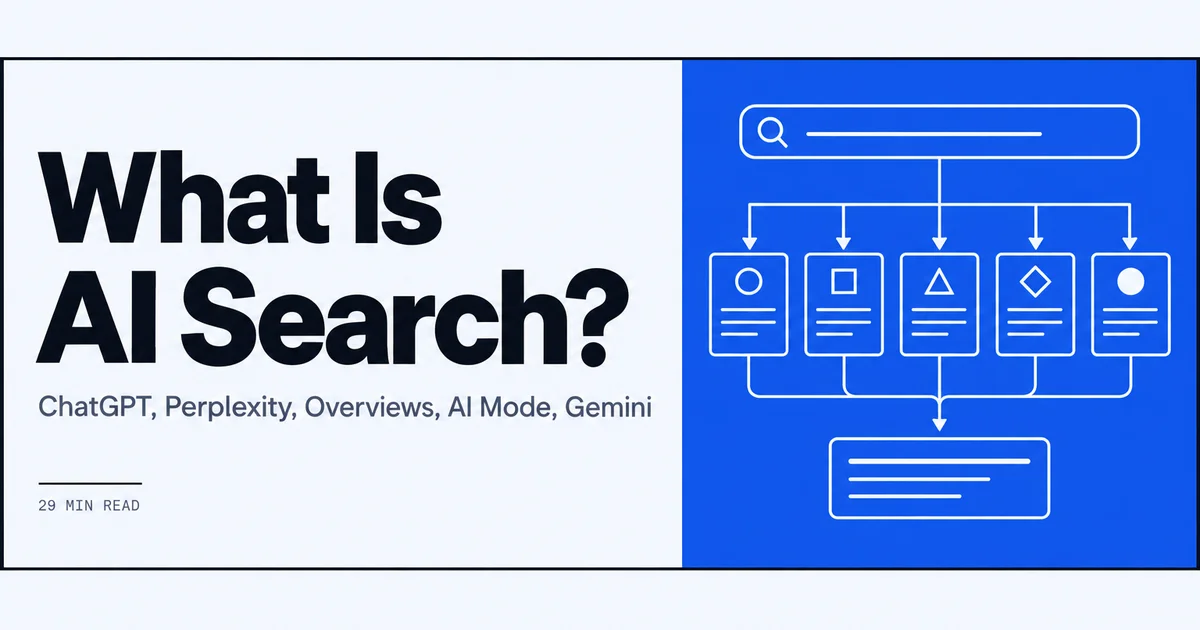
I use this piece as my working definition of AI search: retrieval plus a reasoning model that answers in ChatGPT, Perplexity, AI Overviews, AI Mode, and Gemini. I wrote it as field notes, not a product pitch.
On this page
- What I Mean by AI Search
- AI Search Engines Explained From the Query Out
- The Landscape I Work Across
- ChatGPT Search and Deep Research
- Perplexity's Answer Engine Stack
- Google AI Overviews on the SERP
- Google AI Mode Inside Search
- Gemini as Google's Search Reasoning Layer
- How I Track Presence Across These Engines
- What I Keep on the Watchlist
- 01
I treat AI search as live retrieval plus a reasoning model that writes an answer with inspectable sources.
- 02
ChatGPT, Perplexity, AI Overviews, AI Mode, and Gemini share that pattern and differ in interface, model, and retrieval stack.
- 03
The event I log for a brand is a mention or citation inside the answer, not a classic blue-link rank.
- 04
I run the same queries across each surface and date model defaults, because those changes move what gets said.
What I Mean by AI Search
I use a narrow definition. When a client asks me what is ai search, I mean live retrieval plus a reasoning model that writes a cited answer. I am not describing a static index of blue links. I am describing ChatGPT, Perplexity, AI Overviews, AI Mode, and Gemini composing a reply from pages they just fetched. Classic ranking still matters for those pages. The event I track is whether the brand is named or linked inside that reply. I keep this piece as field notes so the definition stays stable. For more, see what is google ai mode. For more, see what is perplexity ai.
From links to a synthesized answer
In classic search I type a query and I get a ranked list of links. I click, I read, I decide. On these products the pipeline still starts with retrieval, but the object I study is the generated answer. A reasoning model reads the fetched pages and writes a synthesized reply on the page itself. The links do not vanish. They sit as citations under or inside that reply. I still open them. I still check whether the cited URL supports the claim in the sentence. The practical difference is that a user can leave with an answer without clicking through. For my notes on what is ai search, that means the visibility event moved from a position in a list to presence in the prose. If a page is retrieved but never named or linked in the answer, I log a miss for that surface even when classic SEO would have counted a ranking. I keep both logs. One does not replace the other.
The five products in my working set
I do not test every chatbot on the market. I test five surfaces I can open on a normal workday: ChatGPT, Perplexity, Google AI Overviews, Google AI Mode, and Gemini. ChatGPT and Perplexity are conversational products. Overviews sit on a Google results page as an answer block. AI Mode is conversational asking inside Search. Gemini is the model family I also open as its own chat when I want a Google-side reply outside the SERP. I run the same query set through all five so I can compare wording, cited domains, and whether live web was indicated. Copilot, Grok, and Claude show up in industry conversations. I still keep this working set at the five I actually log week to week. When a sixth product becomes a weekly check, I add it as its own row rather than folding it into an average score. I treat each of those five as a distinct shell even when the model families overlap; that is AI search engines explained as five rows.
Citation as the ranking analog
Being ranked first on a SERP is not the analog I use. Being named or linked inside the answer is. I record a citation when the reply shows a URL I can open, and a mention when the brand name appears in the prose without a link. Both are visibility events. Neither is a classic rank. I built my notes this way because a synthesized answer can attribute a claim to one domain and skip another that still ranks well in blue links. That is the unit I act on. I do not collapse those events into a single rank number. I log them per engine and per query. I look for repeats. For the metric itself I keep more on what is ai visibility in a companion piece. Here I only need the mapping: retrieval feeds the model, the model writes, and the citation is the public trace of which page won the sentence.
Video: What is AI Search Optimisation (and How To Do It) · Exposure Ninja
AI Search Engines Explained From the Query Out
I walk every test from the query out. Retrieval happens first. A reasoning model then composes the reply. Attribution is part of the product, not a footer I ignore. That is my version of AI search engines explained: a sequence I can log, what was fetched, what was written, which domains were named. I start from a prompt I typed, the answer I got, and the sources I could open that day. Those three logged fields are the whole run.
Live web plus a reasoning model
The pattern I see across these products is two layers. First the system fetches current pages. Then a model composes a reply from what it read. I do not need an internal vendor diagram to use that split. I need to know whether the answer could include a page published this week. When live web is in the loop, a new article can appear in citations the same day I publish it. When live web is not in the loop, I am looking at parametric memory and I log that run separately. ChatGPT can pull the internet into a conversation. Perplexity pairs models with its own retrieval. Google writes Overviews and AI Mode answers from retrieval plus Gemini. The chrome differs. The two-layer shape does not. I write pages so they can be fetched. I structure them so a model can quote a clean sentence from the page. That is the working pattern I keep across every engine I test for what is ai search.
Source attribution as part of the product
I treat visible citations as a designed part of these products, not as an extra. OpenAI tells users to look for a globe icon next to a ChatGPT response and to click citation links to inspect the underlying sources. I do the same on every engine I test. Perplexity places sources next to the answer. Google attaches links to AI Overviews and to AI Mode replies. I do not treat those links as decoration. They are the inspectable trace of retrieval. When I log a run I open the cited URLs. I check the domain, the path, and whether the sentence in the answer is actually on that page. If a product shows no sources, I still record the wording, but I mark attribution as not inspectable in that row. That flag matters because the work is about being the page a model is willing to name. A reply without a public source is a different object in my sheet.
Where LLM optimization shows up in answers
The compose layer is where page writing shows up in the answer. If a page buries the claim in a metaphor, the model often paraphrases past it. If I put a clear definition, a date, and a concrete noun near the top, I see those fragments reused more often in the reply. That is not a ranking factor I can prove from a public spec. It is a pattern I act on after enough side-by-side logs. Structure matters in the same way. Headings, short paragraphs, and a table that states a fact in a cell are easier to lift than a long undifferentiated block. I use what is llm optimization as the label for that page-side work. Here I only need the junction: retrieval can find the URL and still fail to quote it if the sentence is not extractable. I edit for extractable sentences before I chase another backlink. I keep a short checklist for definition, date, and noun as the page-side half of AI search engines explained.
The Landscape I Work Across
I map the landscape as related products with different shells, not as one engine with five skins. ChatGPT and Perplexity are chat. AI Overviews and AI Mode live inside Google Search. Gemini is the reasoning line behind Google's AI search products and a chat I can open on its own. I log them together because a brand can win one shell and miss another on the same query. I refuse a blended score. This section is how I keep those shells distinct while still sitting GEO next to classic SEO, without collapsing what is ai search into one name.
Chat surfaces versus search-page surfaces
I split the five into two UI families. Chat surfaces are ChatGPT, Perplexity, and Gemini as a standalone chat. I type, I get a thread, I can follow up. Search-page surfaces are AI Overviews on the SERP and AI Mode inside Search. Overviews appear as a generated block on a results page. AI Mode is conversational asking inside the Search interface, which Google presents as a way to just ask anything without leaving Search. I do not collapse those families. A citation in a chat thread is a different screenshot from a citation above blue links. Click paths differ. So does how I explain the result to a stakeholder. When I brief a team I show one chat capture and one SERP capture for the same prompt. That pair is more honest than a single dashboard tile. I also note whether the Overview sat above classic results or whether AI Mode took the session. They do not share a layout, and I keep that split in any briefing of AI search engines explained.
Why GEO sits next to classic SEO in my notes
Classic SEO is how I get a URL retrieved: crawl, index, relevance, links, technical health. GEO is how I get that URL used in the synthesized answer. I do not merge the two into one tactic list. A page can rank and still never be cited. A page can be cited from a passage that never ranked in the top three. I keep separate checklists. On the SEO side I still ship sitemaps, titles, and internal links. On the GEO side I ship extractable claims, clear entities, and pages that answer the follow-up a chat will ask. I point people to What Is Generative Engine Optimization (GEO) when they want the label. In my notes GEO sits next to SEO because retrieval still depends on being findable, and the answer still depends on being quotable. I do not drop crawl work because a model writes the answer. I also do not assume a ranking page will be the one named.
What I keep as separate surfaces
I log each engine on its own row. I do not average ChatGPT, Perplexity, Overviews, AI Mode, and Gemini into one visibility number. Wording drifts. Citation sets drift. Live-web indicators drift. A blended score hides which shell moved. When I change a page I want to know whether Perplexity started citing the new URL while Overviews still named a partner domain. That contrast is something I can act on. A single blended number is not. I keep the same query set, but the fields stay per surface: mention, citation URL, model cue, and whether web retrieval was indicated. If a stakeholder asks for one number I show five. If they ask why, I show two answers to the same prompt that do not name the same brands. That is enough to keep the rows unmerged in my sheet. I would rather ship a slower table than a fast average that I cannot defend when an engine changes its default model.
ChatGPT Search and Deep Research
I treat ChatGPT as two related retrieval modes, not one chat box. Search is the live-web turn: the model pulls current pages into the conversation. Deep Research is the longer pass that searches, reads, and writes a report. OpenAI documents both as ways to bring internet information into chat. I log which mode ran, whether citations appeared, and which domains they pointed at. That is the unit I compare against Perplexity and Google for what is ai search on this product.
When ChatGPT pulls the live web
When a question needs current data, or when I explicitly activate Web Search, ChatGPT can pull the latest information from the internet directly into the conversation. That is how OpenAI defines ChatGPT search in its Research with ChatGPT documentation. I do not assume every reply used the web. I look at the question type first: recency, prices, news, shipping cutoffs, live product specs. Then I check whether retrieval actually ran.
A frozen model answer and a cited live-web answer are different events in my spreadsheet. I mark the trigger as implicit when the question looked like it needed current pages, or explicit when I turned Web Search on. I also note if the reply still read like training-data synthesis with no sources attached. For brand work, that split decides whether I am looking at model memory or at retrieval. The pages I publish only compete on the retrieval path.
The globe icon and citation links
OpenAI instructs users to look for a globe icon next to a ChatGPT response to verify that web search was used, and to click citation links to inspect the underlying sources. I follow that check on every test query. The globe is my first signal that live retrieval ran. The links are the visibility event I score: was the brand named, was a URL shown, which domain sat next to the claim.
I open every citation. I record the URL, the surrounding sentence, and whether the model's wording matches what the page actually says. A globe with no usable link is still a web turn in my log, but it is not a citation I can attribute to a brand. I treat inspectable sources as a designed part of ChatGPT search, not an extra. That coupling of retrieval and attribution is what I copy into the log for AI search engines explained on ChatGPT.
Deep Research as multi-step gathering
OpenAI's guide positions ChatGPT search and Deep Research as tools for multi-step, report-style information gathering: the system runs multiple searches, reads external sources, then synthesizes a structured answer tailored to follow-up prompts. I use Deep Research when I need that longer pass, not when I only want a single cited reply.
I do not collapse the two in my logs. A Search turn is one retrieval plus one composed answer. A Deep Research run accumulates sources across steps, and the write-up is usually longer and more report-like. I still score the same fields, brand mention, citation URL, whether live web was indicated, but I tag the session as multi-step. Follow-up prompts inside that run can change which domains appear later. For GEO work, that means a page can enter on step three even if it missed the first query.
Perplexity's Answer Engine Stack
Perplexity is the other chat-style answer engine I keep in the working set. I log it separately because the stack is not only a third-party search API plus a model. Their February 2026 changelog describes Deep Research as pairing available models with Perplexity's own search engine and sandbox. That is the pattern I care about: live retrieval they operate, then a reasoning model that writes a cited answer. I treat one-shot replies and Deep Research runs as different rows.
A proprietary search engine and sandbox
Perplexity's February 2026 changelog states that Deep Research pairs models with Perplexity's proprietary search engine and sandbox infrastructure. I read that as an answer-engine stack: they run retrieval, browsing, and an environment layer that can support longer research workflows, not only a third-party search API.
When I test, I am watching what that stack returns: which pages get fetched, how the sandbox is used to browse, and which domains survive into the cited answer. I do not have access to their internal crawler, so I infer from the citations and from the changelog wording. The practical point for my notes is simple. If an engine runs its own search and sandbox, the pages I structure for citation have to survive that retrieval path, not only a generic web API. That is why I keep Perplexity on its own row instead of merging it with ChatGPT search when I log what is ai search.
Opus and model upgrades on Deep Research
Perplexity reports that Deep Research now runs on Opus 4.5 for Max and Pro users, and that it will move to top reasoning models as they become available. I date that in my notes the same way I date a Google default-model change. The retrieval layer can stay while the composer changes, and answer wording can shift even if cited URLs look familiar.
I record the configuration: which plan I was on, which model the changelog named, and the date of the run. When I compare a January log to a February log, a model swap is one candidate explanation for a different sentence or a different cited domain. That is why I re-run the same query set after a published upgrade instead of assuming last month's citations still hold. I also note Max versus Pro when the changelog ties the model to those tiers.
Agentic research versus a one-shot answer
A one-shot Perplexity answer is still retrieval plus a reasoning model that writes a cited reply. Deep Research is a different workflow: the stack can browse inside the sandbox, run more than one search, then write. I keep those as separate rows even though both show sources.
The short answer is what I see first on a normal query. The agentic run is closer to ChatGPT Deep Research: multiple fetches, reading, then a longer synthesis. I do not average them into one score. I look at whether my page was cited in the short answer, whether it appeared in the research run, and whether follow-up browsing changed the source list. Pages written so a model can quote a clean sentence still help both paths. The research path just has more steps where that sentence can be picked up, so I keep both paths in AI search engines explained for this stack.
Google AI Overviews on the SERP
AI Overviews sit on the Google results page, not in a separate chat app. A Gemini model writes an AI response directly on the SERP for queries where Google describes it as helpful. I log Overviews as their own surface: the answer block, the cited domains, and the classic results still underneath. That placement is why I do not average Overviews with ChatGPT or Perplexity. I still open the cited links the same way I do on chat surfaces, and I still score what is ai search as a name or link in that block.
An AI response on the results page
Google describes AI Overviews as an experience where a Gemini model generates an AI response directly on the search results page for queries where it is helpful. The Overview is not a side panel I treat as optional. It is a first-class block on the results page, sitting above or among the classic links.
I capture the generated wording, every visible citation, and whether the rest of the SERP still showed organic results I would have ranked in a classic SEO pass. I do not collapse those two layers. A brand can be cited in the Overview and absent from the blue links, or the reverse. I use the same working definition of what is ai search here: retrieval plus a reasoning model, except the answer sits on the SERP. I only count an Overview when I actually saw the block, not when I assume every query gets one.
Gemini 3 as the default in January 2026
In January 2026, Google made Gemini 3 the default model powering AI Overviews globally. I logged that date as a tracking event, not as trivia. The retrieval can look the same while the composer changes, and the sentences I copy into the spreadsheet can shift.
I record the model family when Google publishes it, because Overviews and AI Mode share that line even though I keep the two surfaces separate. A global default means my old screenshots are from a different composer. I re-run the query set after a change like that. I do not claim I can see the model from the SERP itself; I rely on Google's own post. What I can see is the answer text, the cited domains, and whether the block still appeared. Those three fields are what I compare before and after the switch.
Queries where I actually see Overviews
I do not see an Overview on every Google query I run. I note the query shape when the block appears: explanatory questions, comparisons, how-to phrasing, and topics where a short synthesis would be useful. I also note when I get a classic results-only page, navigational lookups, very thin queries, or cases where the SERP stays ten blue links.
Google's language, in its Search product updates, is that Overviews show for queries where it is helpful. I cannot see that classifier, so I keep a column for Overview present and another for query type. Over time I trust repeating patterns enough to prioritize pages that answer those explanatory shapes with clean, citable sentences. I still check the live SERP. A query that drew an Overview last month can come back as results-only after a layout or model change, so I never treat a single screenshot as the product.
Google AI Mode Inside Search
I treat Google AI Mode as its own surface, not as a renamed Overview. Overviews sit on a results page. AI Mode is the conversational path inside Search. I open it on purpose, run the query there, and keep the thread so a follow-up is not mixed with a one-shot SERP block. That split is how I keep Google's AI products comparable in my logs without averaging two shells into one score. I label the surface in the sheet first so what is ai search is not logged as one Google row.
Just ask anything inside Search
Google presents AI Mode as a more conversational way to just ask anything in Search. I take that as the product contract I test against. The user remains in Search, but the interaction looks like chat rather than a classic ten-blue-links page. Google's notes on AI Mode and AI Overviews describe that conversational path as sitting inside the same interface, not as an app I have to leave Search to use.
In the field I open AI Mode, paste the same prompt I run on ChatGPT and Perplexity, and wait for a generated reply with citations. That reply is the artifact I save. I do not treat the classic results column as the answer. I treat the composed text, plus any linked sources, as the visibility event. If the session offers follow-ups, I stay in that thread so the next prompt is not a new Overview on a fresh results page. I copy the wording before I click away.
How I tell AI Mode apart from Overviews
I keep Overviews and AI Mode as two logged surfaces even though both can show Gemini-written text. An Overview appears on a Google results page for queries where Google shows that block. AI Mode is the chat-style experience I enter inside Search. Mixing them would hide which shell actually named the brand.
When I capture an Overview, I screenshot the SERP, copy the Overview wording, and list the cited domains. When I capture AI Mode, I record that I opened the conversational surface, copy the reply, and keep the thread. The same model family can sit behind both; the placement is different. For GEO, placement is the ranking analog I care about: was the brand named on the results page, or only after I entered AI Mode? I also note whether organic results sat beside the Overview. In AI Mode that column is not the object I score. A one-shot SERP block and a multi-turn Search chat are not the same measurement.
Follow-ups inside the same Google session
A thread of follow-ups changes what I record. A single Overview is one generated block on one SERP. In AI Mode I can ask a clarifying question, tighten the audience, or request a comparison, and the model answers in the same session. That second turn is not a new Overview. It is a continuation, and the citations can shift.
I log each turn: the prompt I added, whether the brand still appeared, which URLs were cited, and whether the model leaned on earlier context. If I average those turns into one row, I lose the moment the brand dropped out. For content work, that drop is the signal. I want to know if the page I published can survive a follow-up that asks for proof, pricing, or an alternative. I also keep the session inside Google rather than restarting on a clean results page, because a restarted query is a different surface in my sheet.
Gemini as Google's Search Reasoning Layer
I map Gemini as the reasoning system behind Google's AI-driven search products, not as a third engine I average with ChatGPT. Overviews and AI Mode are the shells I open. Gemini is the model family that writes the reply. When the default model changes, I date it in my notes, because wording and citations can move even if my query set stays fixed. That dated writer is how I keep what is ai search concrete on Google.
One model family across Overviews and AI Mode
I tie Overviews and AI Mode to one model family so the landscape stays products plus a shared reasoning line. Google describes AI Overviews as an experience where a Gemini model generates an AI response directly on the search results page for queries where it is helpful. That is the same family I see behind AI Mode's conversational turns. I do not log “Google AI” as one row of what is ai search.
In January 2026 Google made Gemini 3 the default model powering AI Overviews globally and positioned Gemini as the core reasoning system behind its AI-driven search experience. I read that as a product fact I can date. When I capture an Overview or an AI Mode reply after that date, I label the run as Gemini 3 default unless the UI shows another model. The shell still matters: SERP block versus chat inside Search. The writer behind both is the line I keep in the same column.
Why the default model is a tracking event
A global default-model change is something I date because answers can shift. I logged January 2026 as the week Google made Gemini 3 the default model powering AI Overviews globally. I do not claim every query changed overnight. I claim the writer behind the product changed, so I cannot treat a capture from before that switch as the same system as a capture after it.
In my sheet the date sits next to the engine name. If citations move, or if the Overview wording gets tighter, I check whether the default flipped before I rewrite a page. GEO work that ignores the model line treats two different writers as one ranking. I will not do that. The query set stays fixed; the model column is what I update. I screenshot the UI when it exposes a model name, so I am not guessing later. A missing model label still gets the dated default I recorded from Google's post.
What I capture from a Gemini-backed answer
From a Gemini-backed answer I save three fields before I leave the page: the wording of the reply, the cited domains, and whether the reply sat on a SERP as an Overview or in AI Mode. I copy the prose as it appeared, not a paraphrase. I list every visible citation URL I can open. I mark the surface so I do not merge a results-page block with a chat turn.
I also note if live web use was obvious from links, and if a follow-up in AI Mode changed the source list. I do not invent a quality score. Presence is binary in my sheet: named, cited, or absent. The model column gets Gemini 3 when that is the dated default. Those fields are enough to compare one week to the next without collapsing Google into a blended score. Mention and citation stay separate columns. I save the capture date beside them so AI search engines explained stays dated on the Google side.
How I Track Presence Across These Engines
I use one method so AI search engines explained stay comparable week to week. The work is boring on purpose: one query set, the same window, logged field by field. ChatGPT, Perplexity, AI Overviews, AI Mode, and Gemini each get their own rows. If a brand shows up in two of five, that is two events, not a blended rank I invented. I do not publish a single visibility index from those rows. That is the protocol.
The same query set on every engine
I run one prompt list through ChatGPT, Perplexity, Overviews, AI Mode, and Gemini. The prompts are the questions a buyer would type, not slogan variants I wrote to game a model. I keep the wording identical. I do not optimize the query per engine. If ChatGPT needs current data, I let it pull the live web the way OpenAI describes: when the question needs current information or when Web Search is on. I still type the same string.
I run the set in one sitting, so a news event does not hit engine A on Monday and engine B on Friday. For Overviews I use a clean results page. For AI Mode I enter the conversational surface. For Gemini I use the Gemini product when I want that shell, not a proxy. ChatGPT and Perplexity get the prompt in a new thread with no extra files attached. That is the only way I trust a cross-engine comparison of what is ai search.
Fields I log from each response
For each response I log brand mention, citation URL, model cues, and whether live web was indicated. Mention is a yes if the brand name appears in the generated prose. Citation is a yes if a URL I can open points at a domain I care about. Those are separate columns. A mention without a link is still a mention. A link without the brand name in the prose is still a citation.
Model cues are whatever the UI shows: a model name, a Deep Research label, Gemini 3 as the dated default, or ChatGPT's globe icon next to a reply. OpenAI tells users to look for that globe to verify web search was used, and to click citation links to inspect sources. I do the same on every engine that exposes a similar tell. If I cannot see a live-web cue, I write “not indicated” rather than guessing. I paste the first sentence so I can diff wording.
Repeating patterns I trust enough to act on
The patterns I act on are the ones that repeat across engines, not a one-off screenshot. Pages that put a definition or a comparison in a short, self-contained sentence are the pages I see quoted with less rewriting. Pages that bury the claim in a long anecdote are the pages I see skipped or heavily paraphrased. That is why I still write for retrieval and for a model that has to lift a span.
I also see the same query name a brand on one surface and omit it on another in the same sitting. That is why I refuse a blended score. When a follow-up asks for proof, the citation list often shifts toward pages that show a method, a date, or a worked example. When Google's default model changes, I re-run before I rewrite. Those three habits, quotable spans, per-engine logs, and dated model notes, are how I keep what is ai search operational in a spreadsheet.
What I Keep on the Watchlist
I keep a dated watchlist because these products can change the reasoning layer without changing the shell. In January 2026, Google made Gemini 3 the default model powering AI Overviews globally; I log that as a tracking event. Same results-page placement, different model composing the reply. I also watch AI Mode in the same Google session, because a follow-up thread is not the same surface as a one-shot Overview.
Perplexity’s February 2026 changelog states that Deep Research pairs the best available models with Perplexity's proprietary search engine and sandbox, now runs on Opus 4.5 for Max and Pro, and will upgrade to top reasoning models as they become available. I date those upgrades and re-run the same queries.
On ChatGPT I still verify web use with the globe icon and citation links, as OpenAI’s search docs describe. I watch Deep Research the same way. After any documented default-model change I recapture wording, cited domains, and whether live web was indicated. That is how I keep my working definition of what is ai search current: retrieval plus a reasoning model that writes a cited answer.
Frequently asked
Classic web search ranks pages and shows ten blue links. AI search synthesizes an answer from a model plus retrieved sources. Google puts that generated response directly on the results page for queries where it's helpful, so the answer sits inside search rather than in a separate chat product. I use both: links to verify, the overview to orient, which is how I hold what is ai search next to classic search.
I treat ChatGPT as a chatbot with a search mode, not a standalone search engine. OpenAI’s documentation says the model pulls live internet data into the conversation when a question needs current facts or when you turn on Web Search. The chat interface stays primary; retrieval is an optional layer.
AI Overviews sit on the classic results page: a Gemini model writes a response there when Google judges it helpful. As of January 2026, Gemini 3 powers that globally. I treat AI Mode as the conversational overlay in Search itself, you just ask anything, so the same interface mixes ranked links with chat-style answering rather than a one-shot overview.
A single cited answer is one retrieval pass plus a short synthesis. Perplexity’s Deep Research, per its February 2026 changelog, pairs a reasoning model with Perplexity’s own search engine and sandbox, then runs a longer research loop. Max and Pro users get Opus 4.5. I treat it as agentic report-building, not a one-shot snippet.
I start with OpenAI’s own cues: a globe icon next to the ChatGPT reply means Web Search ran, and the citation links let me open the underlying pages. Without those, I treat the answer as conversation, not live retrieval. Other engines vary; I still demand clickable sources before I trust a claim.
I start with a short query set the brand already ranks for in classic search, then check whether those URLs show up as citations in ChatGPT, Perplexity, and Google AI Overviews. I record the engine, the cited page, and the date as my first pass at what is ai search for that brand. Until I can reproduce that, I do not treat any score as real.
