Core / Pillar 26 min read Published Updated
AEO vs GEO: What's the Difference? (2026 Guide)
I get asked aeo vs geo on almost every AI-search brief. Here is how I split the terms in practice, and which one I use when.
On this page
- Why I settle aeo vs geo before I write the brief
- How I keep AEO and GEO next to SEO without mixing the jobs
- What I mean by answer engine optimization
- What I mean by generative engine optimization
- Answer engine optimization vs generative engine optimization on a real brief
- Which term I use when: titles, decks, and Slack
- Why ChatGPT search updates make aeo vs geo messier
- Trust, attribution, and why I still name the work
- How I run aeo vs geo on a content calendar
- 01
I use AEO when the job is to be retrieved and cited, and GEO when the job is to be synthesized into generated prose.
- 02
Answer engine optimization vs generative engine optimization share sources, entities, and structure; they differ in whether I am briefing for a ranked answer or for inclusion in generated text.
- 03
I pick the term that matches the surface in the brief, and I keep SEO as a separate layer rather than a synonym.
- 04
I still write for visible attribution, because many readers leave the generated answer to check the original page.
Why I settle aeo vs geo before I write the brief
I settle the aeo vs geo question before a single tactic hits the brief. Answer engine optimization vs generative engine optimization isn't just terminology; it's about which surface I'm optimizing for. If I don’t, the writer gets two different jobs welded into one page, and the surface I’m optimizing for gets blurry. I’ve learned to pick a label early, much like how I think about more on aeo vs seo, so the brief has one job: either appear as a cited source in an answer engine, or land inside the generative engine’s synthesized prose. The moment I name the surface, the whole approach snaps into focus.
The two questions I ask before I pick a term
Before I pick, I ask two questions. First: Is the win a visible citation in a chat UI, or is it seeing my brand’s phrasing embedded in the generated answer? AEO targets the former, the clickable link inside an AI Overviews or ChatGPT answer. GEO targets the latter, where the model weaves my facts into its own wording without always linking. Second: Does the query ask for a direct fact I can extract, like “what is X,” or does it ask for a comparison or synthesis the model will write? The first is AEO territory; the second leans GEO. These questions force me to name the surface before I outline a single on-page move. If I can’t answer them, the brief isn’t ready. I never skip this because when the page ships, the model’s output tells me whether I guessed right. Starting with the answer I want to see keeps me honest about which term I’m actually doing work for.
Why teams use both labels for the same page
I often see a team brief the same page for both AEO and GEO without naming which surface is primary. A how-to article gets tagged “AI overviews” and “ChatGPT inclusion,” and the writer doesn’t know whether to write for a snippet-like extraction or for nuanced paragraphs the model can paraphrase. This happens when the content brief conflates answer engine optimization vs generative engine optimization into a single “AI search” bucket. The result is a page that tries to be both a quick fact extract and a deep synthesis, and it ends up thin on both. I refuse to let a page carry both labels without declaring a lead surface. If the primary win is a citation, I structure the page so the answer sits in an extractable block and the source gets named. If it’s a generated paragraph, I trade extractability for semantic depth and entity coverage. Without that clarity, the page ships with no clear win condition, and I lose the chance to measure what worked. For me, naming the surface first is the whole game.
What I refuse to collapse into one acronym
I never fold AEO, GEO, and SEO into one umbrella. Even when a single page does work for all three, I keep the distinction on my brief because the success signal is different. A citation link needs on-page source structure, visible authorship, extractable definitions, and clean entity markup. A paragraph inclusion inside a generated answer needs the model to trust the page’s semantics enough to paraphrase it without linking. Both build on SEO fundamentals, but the finish line isn’t the same. Calling it all “AI optimization” would blur my checksheets and leave my team guessing which signal to chase. The distinction between answer engine optimization vs generative engine optimization matters because a citation slot and a paraphrase are different wins. Instead, I treat the page as one base that can feed multiple surfaces, each with its own label. I’ll brief it as SEO first for crawl and index, then add an AEO note if I’m chasing a citation slot, or a GEO annotation if the goal is to show up in the model’s wording. That refusal to collapse labels keeps my briefs precise and the feedback loop clean, I can look at a ChatGPT output and know which part of my work the model actually used.
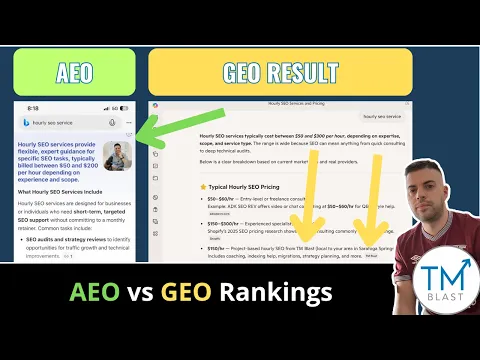
Video: AEO vs GEO SEO Ranking Results - What's the Difference? · TM Blast
How I keep AEO and GEO next to SEO without mixing the jobs
I keep AEO and GEO right next to SEO in my audits, but I never let the lines blur. SEO still owns crawl, index, and link authority, the foundation any AI surface needs. I see AEO and GEO as a third layer that kicks in after the page is fetchable. Skipping that separation leads teams to treat these labels as a rename of classic search work, and I’ve had to clean up that confusion more than once. Answer engine optimization vs generative engine optimization is not an either/or; they're both layers on top of SEO.
What still belongs to SEO in my audits
In my audits, SEO still owns crawl budget, indexation, internal linking, and backlink authority. These are non‑negotiable because if a page isn’t crawlable or doesn’t rank in Google’s classic index, it rarely surfaces in a chat answer either, the models often pull from the same indexed corpus. I treat all snippet-eligible markup (FAQ, HowTo, Article structured data) as SEO work, because Google’s AI Overviews reads those signals directly. Page speed, mobile rendering, and content pruning also sit in the SEO column. When I hand a brief to a writer, the SEO box covers these basics before I mention geo vs seo in 2026 or any AI‑specific layer. I never skip this step, even when the main goal is a generative engine win. The retrieval pipeline still depends on a solid crawl footprint, and I’ve seen pages that were brilliantly optimized for ChatGPT’s search feature miss entirely because a noindex tag blacked out the source. Keeping SEO’s domain clear prevents those basic leaks.
Where AEO and GEO start after the crawl is done
Once the page is indexed and fetchable, I switch vocabulary. AEO starts where answer extraction begins: I look at whether the page can surface as a cited source in AI Overviews, Copilot, or ChatGPT’s search answers. That means checking if the answer is extractable in a tight, attribution‑friendly paragraph. GEO starts where the page’s ideas are likely to be absorbed into the model’s generated text, even without a link. I draw this line because the on‑page work diverges. For AEO, I want a clear “source‑shaped” block, a definition, a how‑to, a named entity, that the retrieval layer can grab and cite. For GEO, I care about semantic completeness, entity connections, and the page’s ability to fill the gaps in a model’s training cut‑off. After the crawl, I stop asking “can Google find this?” and start asking “will an answer engine cite this?” or “will a generative model paraphrase it?” That switch is where the labels earn their keep. I’ve learned to note it right in the audit column so no one confuses a crawl fix with a GEO adjustment.
The brief line I add so this is not a rename of SEO
I paste one sentence into every brief that touches AI surfaces: “This page must first serve classic search users; AEO and GEO annotations describe a secondary surface, not a replacement for ranking.” That line has saved me from stakeholders who assume “optimizing for ChatGPT” means abandoning keywords. In reality, the fundamentals don’t change. OpenAI’s 2026 release notes describe ChatGPT search improvements that blend retrieval and generation, not replace Google’s index. So when I hear a client say “we’re pivoting to AEO,” I show them that line. The core work, crawlability, relevance, authority, still belongs to SEO. AEO and GEO add surface‑specific tweaks: citation formatting for answer slots, entity depth for generated prose. By naming them as extensions, not a rename, I keep the team from abandoning what already works. That little sentence has stopped more bad briefs than any tactical checklist I’ve ever written, because it forces everyone to see the pyramid: SEO at the base, AEO on one corner, GEO on the other.
What I mean by answer engine optimization
When I brief for AEO, I’m chasing a single outcome: the page becomes the source an answer engine cites inside a conversational UI. That means retrieval first, can the model find the page, then ranking inside the answer set, and finally attribution with a visible link. I don’t care about being paraphrased into an uncited paragraph; that’s GEO’s job. AEO is about being the named source the user can click, and everything on the page must serve that.
Retrieval, citations, and the answer slot I chase
For AEO, the hierarchy is retrieval, ranking, and then the answer slot. Retrieval means the page surfaces in the candidate set when a user asks a question, OpenAI’s 2026 enhancements to ChatGPT search underscore that retrieval accuracy is still being refined, so I make sure the page is indexable, rich in entity references, and answers a specific query compactly. Ranking means the page gets picked from that candidate set ahead of competitors; I optimize for relevance signals like query‑answer alignment and source authority signals that answer engines learn from user clicks. The answer slot is where the model displays a direct snippet with a citation link. I check that the page’s extractable block, often a definition, a how‑to step, or a named fact, matches the likely answer format. If the page doesn’t contain a tight, standalone answer that a model can pluck out, it rarely wins the slot. I’ve seen pages rank well in search but fail in ChatGPT simply because the answer was buried in a narrative paragraph. AEO forces me to package the answer in a way the retrieval layer can grab, cite, and display without chewing on context.
The query types I file under AEO
In my content calendar, I tag certain query types as AEO leads. Straight how‑to questions,“how to change a tire”, are the classic AEO intent because the answer is a series of steps the UI can list with a citation. What‑is and definition queries also fit: “what is a backlink?” calls for a concise factual sentence that an answer engine can quote. Short factual asks like “who won the world series in 2024” or “calories in an avocado” are pure retrieval wins. I file these under AEO because the user wants a direct answer, not a rich comparative paragraph. When I see a query that expects an answer box, I brief the page to deliver that answer in an extractable format, with source signals like an author name and published date prominently positioned. I don’t try to weave a story around a calorie count; I give the number up front. Those pages rarely need the deep semantic layering I’d build for a GEO comparison article. The key is matching the page structure to the query’s intent, if the intent is “tell me fast and cite the source,” I’m doing AEO work.
The on-page checks I run for an AEO brief
Before I finalize an AEO brief, I run a short checklist on the page template. First, I look for an extractable definition or answer block, usually a tight paragraph under the H1 that answers the target question without preamble. Next, I check that the page names key entities and links them to authoritative sources (like Wikipedia or schema‑marked databases), because answer engines prize entity disambiguation. I verify that the page uses structured data where appropriate, FAQ or HowTo markup can help Google’s AI Overviews parse the answer, but I don’t rely on it alone. I also look for source‑shaped signals: a visible author byline, a last‑updated date, and references to credible external sources. These signals feed the citation‑ranking layer. Finally, I test the answer extraction manually by copy‑pasting the target answer into a plain text view: if it reads as a coherent, standalone fact, it’s likely retrieve‑ready. If I have to read the whole page to get the point, I rewrite the extractable block. That quick check has turned more pages into cited sources than any keyword strategy I’ve tried. For AEO, I care far less about semantic richness and far more about grab‑and‑cite readability.
What I mean by generative engine optimization
When I speak about generative engine optimization, I’m not talking about citation links. I mean the work that gets a page’s perspective woven into the actual wording of an AI’s answer. A GEO win is when the model writes a comparison paragraph that echoes my structure, or when its phrasing reflects my product’s definition without a hyperlink. This is a higher bar than being listed as a source, it means my page is now part of the model’s verbal memory for that query. I separate this from answer‑engine work because the signals differ: I’m chasing synthesis, not just retrieval. Answer engine optimization vs generative engine optimization sharpens the difference between being cited and being paraphrased.
Being inside the generated paragraph, not only the citation list
I consider a page inside the generated paragraph when the AI output does not copy my snippet verbatim but still uses my framing. For example, if a model writes a summary that combines my statistics with a competitor’s wording and structures the answer around my four‑point breakdown, I count that as inside the paragraph. I see this often when the citations are at the bottom and my brand never appears in the links, yet my article’s logic controls the prose. This is the layer I explore in depth in our guide to what is generative engine optimization. For a quick brief, I measure it by running the query in the target model and asking, ‘Would this answer be different if I deleted my page?’ If yes, the page is inside.
Comparison pages and the GEO intent I see in logs
When I look at the queries driving sessions under a GEO lens, the intent that dominates is comparative. Not ‘what is X,’ but ‘X vs Y’ or ‘best alternative to Z.’ These are queries where the AI’s job is to synthesize a stance, not just recite facts. I file these under GEO because my page needs to be the ghostwriter behind the AI’s verdict. In practice, I run the target comparison queries, see how the model structures its response, then fact‑check whether my own page’s contrast points appear in the prose. If the answer reads like a compressed version of my ‘versus’ table or my ranking criteria, I have a GEO signal. I log those findings separately from standard answer retrievals because I’m measuring editorial influence, not source visibility.
Citation versus paraphrase: what I count as a GEO win
I draw a sharp line between a citation and a paraphrase. When the AI output shows a clickable link to my page or names my domain as a source, I log that as an AEO event, it’s a retrieval and ranking success. But when the output paraphrases my content, even accurately, without attributing me, I log it as a GEO signal. For example, if the answer reproduces my four reasons why a product is better but mentions only the product, not my authorship, that’s a GEO win. I sometimes see both in the same response: a citation at the bottom and my phrasing in the body. In my reporting, those are two separate rows, different columns, because they measure different kinds of surface presence. This distinction keeps me from celebrating a link when the real influence was textual.
Answer engine optimization vs generative engine optimization on a real brief
When I open a brief, I don’t start with a glossary debate. I list the AI surfaces where the brand needs to appear, then I assign the label, AEO, GEO, or both, to each surface. The point of aeo vs geo is not to split hairs; it’s to make the brief actionable by tying each surface to one success signal. Answer engine optimization vs generative engine optimization isn't just semantics; it's the difference between tracking a link and tracking phrasing. This section shows exactly what ends up in my client briefs: which surfaces I label AEO, which ones get GEO, where overlap happens, and the one‑sheet matrix I paste in so everyone knows what we’re measuring.
Surfaces I label AEO in the brief
I put ChatGPT search at the top of my AEO list. OpenAI’s 2026 release notes confirm that search inside ChatGPT is being tuned for accuracy and retrieval, so when a user triggers a search in a chat, the answer engine shows direct source citations. I also label Perplexity, Google AI Overviews, and Microsoft Copilot as AEO surfaces because they display answer cards and clickable links. For each, the signal I track is a visible citation: my brand name or URL appears in the linked sources. These surfaces care about being the primary answer engine finding and ranking my page for a query. My AEO brief always lists the specific models and their citation formats, then I run checks to see if we’re appearing in the source list.
Surfaces I label GEO in the brief
I reserve the GEO label for surfaces where the output is primarily a generated paragraph, even if citations are optional. This includes long‑form answers from Claude, Gemini’s synthesized prose in a non‑search context, and the body text of ChatGPT’s search responses when it paraphrases without linking. I also apply GEO to voice‑assistant reads where there is no screen link at all: the assistant says something like ‘many users recommend…’ and that wording needs to reflect my brand’s take. On these surfaces, the success signal is not a hyperlink; it’s that my page’s ideas, ordering, or specific language appears inside the model’s output, credited or not. I log each occurrence by running the prompt and checking whether my content can be felt in the summarized text.
The overlap I document instead of forcing a split
Pages built for answer retrieval often end up feeding generative synthesis, too. I don’t pretend the split is clean. When I audit, I document the overlap explicitly: a well‑structured entity block that ranks for AI Overviews can also be the raw material that ChatGPT paraphrases. I still label the surface goals separately, but I add a third column for ‘shared work.’ That column captures the entity extraction, the definition‑first paragraph, and the source citations that help both. For instance, a compact answer block with tagged key terms aids retrieval scoring and also gives a model the building blocks for paraphrase. Calling out that shared layer in the brief keeps the team from over‑segmenting. The entity mapping and structured data we build once support both labels, so I note that overlap to avoid double‑charging the effort.
The one-page matrix I paste into the brief
I keep a one‑page matrix in every AI‑search brief to stop the aeo vs geo conversation from turning into a taxonomy war. The columns are simple: Surface, Term, Success Signal, and Query Class. For ChatGPT Search, I write AEO, citation link visible, and ‘how‑to’ queries. For ChatGPT long‑form prose without search trigger, I write GEO, paraphrased phrasing appears, and ‘vs’ comparison queries. I also add rows for AI Overviews (AEO), Copilot (AEO), Claude (GEO), and Gemini summary (GEO). By keeping each surface tied to one primary term and a single measurable signal, the matrix forces clarity. My team can look at the sheet and immediately know whether they’re tracking a blue link or a synthesized idea. I later replace placeholder rows with actual query examples from our log data. I’ve learned that when I skip the matrix, someone eventually calls everything AEO and the brief loses its sharpness.
Which term I use when: titles, decks, and Slack
When the deliverable is a page title, a slide deck, or a Slack thread, the label I use is not about ideology, it’s about surface. I treat AEO and GEO as a task checklist to prevent my stakeholders from asking ‘What kind of AI optimization?’ I need them to see the term and immediately know if we’re chasing citations or generated wording. This rule of thumb is what I’ve come to after too many briefs where a generic ‘AI SEO’ label meant nobody knew what to measure. So here's my working rule for where to put AEO, where to put GEO, and when to use both or neither.
When I put AEO in a title or H1
I use AEO in a title or H1 when the page’s primary value is teaching someone how to get their content into the answer engine’s source list. A guide on ‘How to Rank in ChatGPT Search’ gets AEO, not GEO, because the reader wants a citation. I also put AEO on pages that audit AI Overviews appearances, or break down Perplexity’s source‑ranking signals. The common thread: the success metric I’m teaching is a visible, clickable source, the kind a user would notice and click. When a page explains how to appear in Copilot’s reference pane, I use AEO as well. The word ‘answer’ in AEO signals the retrieval‑and‑show step, so I lean on it whenever the lesson is about positioning yourself as the cited voice. If a page is about voice‑search visibility on smart speakers, I still use AEO because the answer engine picks a source, even if spoken. That consistency keeps my content library navigable for a reader who might otherwise confuse AEO with GEO.
When I put GEO in a title or H1
I put GEO in a title or H1 when the page is about inclusion in generated text, synthesis, comparison, or paraphrasing. A piece called ‘How to Get Your Brand Woven Into ChatGPT Comparisons’ earns GEO, because the win condition is that the model’s own words reflect your point of view. I also use GEO on pages that explore how to influence long‑form answers in Claude, or how to ensure your product’s definition shapes Gemini’s summaries. The pivot: the reader isn’t looking for a hyperlink; they want their page to be the invisible source behind the words. If the success signal is a paraphrase count rather than a link impression, the headline says GEO. In my experience, when I label correctly, the page attracts the right practitioner audience, the ones who worry about influence, not just indexing. I might also use GEO on pages about generative AI prompts: if I’m teaching someone to write content that ends up as a model’s default response, I name it GEO because the result is an uncited phrasing echo.
When I write both, and when I write neither
I write both terms on comparison pages that explicitly weigh AEO against GEO, like this article. The H1 ‘AEO vs GEO’ tells a searcher they’ll get a split‑screen view. But on pages that discuss a single AI platform without splitting signals, I drop both and just name the platform. For instance, a page about ‘ChatGPT Search Visibility’ can cover both retrieval and generation under a unified label, because separating them would confuse the reader. I also write neither when the tactic I’m describing is just SEO work that happens to appear in AI: if I’m talking about indexing and crawl budget, I keep it as SEO regardless of surface. My test: if I can’t answer ‘Which metric, citations or paraphrases, is this page driving?’ without flipping a coin, I strip the acronyms and describe the work plainly. That’s how I avoid jargon creep. A training doc on ‘AI‑assisted content briefing’ may mention AEO and GEO in the body, but its title stays acronym‑free because the goal is not to choose between them.
Why ChatGPT search updates make aeo vs geo messier
OpenAI’s 2026 release notes describe steady improvements to search inside ChatGPT that aim for more accurate, reliable results. Those updates mean one product now blends retrieval-based answers with generated prose, so the same surface demands both an answer-engine and a generative-engine lens. My briefs can no longer choose one label; I have to document which outcome I am chasing on each query, because what used to be a clean aeo vs geo split now overlaps on the same interface.
Search inside ChatGPT is now part of the product I brief against
When ChatGPT search first appeared, I treated it mainly as a generative surface, the model wrote paragraphs, and citations felt secondary. The 2026 release notes changed that: they detail ongoing work to make results more accurate and reliable by improving how ChatGPT finds and surfaces information (source). Now I brief against ChatGPT as a surface that can return an answer slot with a clickable source link (what I file under AEO) and embed my brand’s wording inside its generated answer (what I file under GEO). A single URL can land in both places, so I no longer assign one acronym to the whole product.
Adoption is wider, so more stakeholders use both labels
OpenAI’s Signals data, cited in their mid‑2026 adoption report, shows ChatGPT usage deepening globally across wider, more diverse user bases (source). That adoption surge brought more stakeholders into the room, content leads, product owners, execs, all asking me to “optimize for ChatGPT.” Because the product itself blends search and generation, the aeo vs geo naming debate landed in more teams simultaneously. I now spend part of every kickoff clarifying that ChatGPT requires both retrieval work and generative text work, not a single tactic.
What I changed in audits after search and generation sat in one UI
Before search lived inside the ChatGPT UI, I filed citations under AEO and paraphrases under GEO, with clear boundaries. After the updates, I added two audit columns per URL: “cited source” (did the engine name and link to the page?) and “generated wording” (did the model paraphrase facts from the page without a visible citation?). A single row can get a check in both. That small change stopped team members from asking whether ChatGPT work was “AEO or GEO.” Now we track both signals, and the term used in the brief depends on which success signal matters more for the query.
Trust, attribution, and why I still name the work
When I present aeo vs geo frameworks to a brand team, trust data from 2026 usually carries more weight than any glossary I offer. A TechCrunch‑reported survey gives me three numbers I use to explain why I still write pages people can open and check, and why I keep our AI‑search labels internal.
Readers still want the original source after an AI answer
The survey finds that 86% of U.S. consumers do not fully trust AI‑generated results and want to explore original sources after seeing a summary (source). That number anchors why I still prioritize the answer-engine side of the split: a clickable citation that leads back to a transparent, verifiable page. Even when I am doing GEO work for a comparison query, I make sure the underlying page can stand up to a reader who opens it, because most of them still want to.
Unattributed answers sit where trust is thinnest
The same survey ranks AI answers without clear attribution as the content type U.S. consumers trust least, at 42%, below confusing privacy policies and airline fees (source). For me, that makes unattributed generative text a thin win. A brand mentioned inside a ChatGPT paragraph without a source link shows up, but the trust gap is wide. On high‑stakes queries, I tilt the brief toward AEO tactics, entity‑linked definitions, source‑shaped paragraphs, so the answer engine can cite us visibly.
Why I do not brand the page as AI messaging
Sixty percent of U.S. consumers say that seeing “AI” in brand messaging is a turnoff (source). That is why I keep answer engine optimization and generative engine optimization as desk‑side labels, never as on‑page slogans or visible content badges. I do not write “AI‑optimized” in a meta description, and I do not stamp a page as “GEO‑ready.” I brief the work, apply the structural changes, and let the output surface do the talking. The reader distrust is measurable, so I avoid making the tactic a brand signal.
How I run aeo vs geo on a content calendar
I keep a dedicated AI‑intent calendar separate from the organic search calendar. Every row gets a label, AEO, GEO, or BOTH, before I write the brief. That small convention stops the aeo vs geo question from becoming a philosophical debate and turns it into a scheduling decision I can act on each week.
How-to, what-is, and comparison rows I actually schedule
How‑to and what‑is queries go into rows tagged AEO because I am aiming for the cited answer slot, a featured snippet in an AI Overview, a named source in ChatGPT. Those pages get extractable definitions, entity markup, and quick‑scan structure. Comparison pages, versus pages, and best‑for lists get tagged GEO because I want the model to synthesize our brand into its generated paragraph, with or without a blue link. I add columns for the target surface and a success signal so whoever picks up the brief knows whether we are chasing a citation or an inclusion in prose.
A listicle I wrote that showed up inside ChatGPT
I once built a listicle comparing tools for tracking AI‑search visibility, structured with clear entity names, use‑case headers, and short verdicts. The row was tagged GEO. Weeks later, a user asked ChatGPT for a tool to check AI Overviews presence, and ChatGPT’s generated answer paraphrased my roundup, naming AI Rank Checker as a recommended option. The page was not just cited; its wording and recommendation logic appeared right inside the paragraph. That is exactly what I log as a GEO win, and I only got there because I briefed the page for generative synthesis, not for a citation list.
The naming convention I leave on the calendar
In the sheet, I use “A” for AEO (answer‑slot intent), “G” for GEO (generative‑text intent), and “B” when a page is designed to serve both. Next to each code, I write a four‑word note like “cited source + paraphrase” so the distinction doesn’t drift when someone else updates the row. This tiny key stops the aeo vs geo label from becoming a stray acronym that loses meaning after I hand off the calendar. It is the simplest thing I have done that keeps the work clean across sprints.
Frequently asked
In audits, I find tactical differences. AEO focuses on being the direct answer source for answer engines like ChatGPT Search, often optimizing for citation and snippet precision. GEO targets generative responses where the AI synthesizes multiple sources, so tactics lean toward rich contextual structure and entity associations that help the model weave your information into its generated output.
I'd avoid acronyms in page titles; they don't help users or models. Instead, I phrase the title around the user's intent, like "How to Get Cited by AI Answer Engines." If I must label a methodology page internally, I pick the term that matches what I'm actually doing, answer optimization vs. generative visibility, but that's for report naming, not SEO.
I see AEO and GEO as extensions of SEO, where AEO focuses on direct citations and GEO on being woven into generated text. Both build on SEO’s foundation. I still apply core SEO, then layer citation signals, structured data, and entity clarity to influence what models cite or synthesize.
In practice, I don't label them differently; I look at their retrieval behavior. Perplexity leans heavily on real-time web retrieval and citation, much like an answer engine, while ChatGPT and Gemini blend generative synthesis. Google AI Overviews sit somewhere in between. I adjust tactics per platform rather than worry about labeling each one.
I wouldn't force a terminology shift if the team is aligned and productive. What matters is distinguishing tasks that require direct citation strategies from those that are about generative inclusion. If calling everything GEO works but you need precision, I'd introduce AEO as a sub-category for citation-focused work rather than renaming the whole effort.
I measure whether the page gets cited as a source in answer engine results (AEO win) or if its information appears in a generated response without a direct citation (GEO win). I track impressions in tools like Google Search Console for AI Overviews, and use manual spot-checks on ChatGPT, Perplexity, and Gemini to see citation links.
