Core / Pillar 28 min read Published Updated
GEO vs SEO: What's the Difference? (2026 Guide)
I run both jobs on the same brands, so this is the geo vs seo side-by-side I actually use: overlap, the new answer layer, and what changes in the weekly workflow.
On this page
- What geo vs seo actually measures
- Generative engine optimization vs seo on shared foundations
- Ranking a page versus earning a citation
- How the answer layer changed geo vs seo
- The overlap I still treat as one stack
- What changes in the geo vs seo workflow
- Content I write for citation, not only rank
- Measuring generative engine optimization vs seo
- How I run geo vs seo for the same brand
- 01
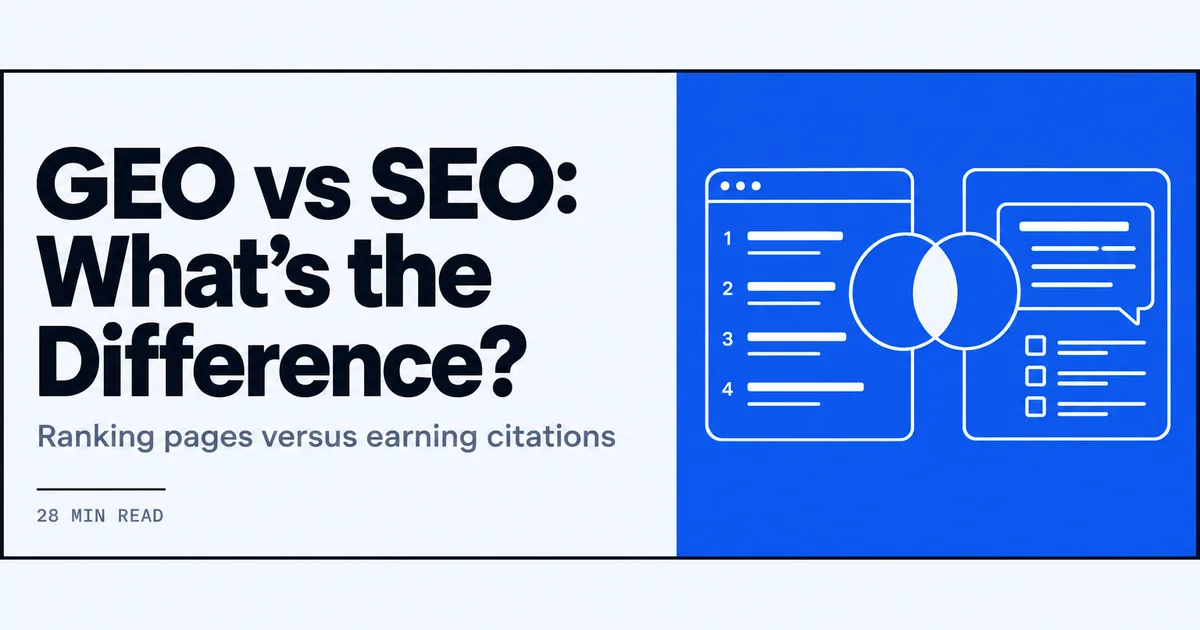
GEO vs SEO is a workflow split: classic SEO still ranks pages, while GEO aims to get those pages cited inside synthesized answers.
- 02
The overlap is the same stack I already maintain, crawl access, technical health, entities, and authority.
- 03
The weekly change is answer-shaped research, sourceable briefs, and cross-engine answer audits on top of rank tracking.
- 04
Google still treats optimizing for AI Overviews as SEO, so I keep one operating model rather than two rival programs.
What geo vs seo actually measures
I treat geo vs seo as two outcomes on one brief, not two teams. Ranking still means a URL that earns the click. Citation means an answer engine lifts a passage with our name attached. I keep both on the same assignment because the crawl path, the entity map, and the page itself are shared. For the wider answer-engine map, see aeo vs seo in 2026. That nested map is the one I use below.
Two jobs I now put on the same brief
The classic SEO job is to get a URL to rank high for a query so that searchers click through. The GEO job, as Google describes in its AI Overview documentation, is to be one of the cited sources inside the answer block that appears above those organic results. Google also notes that those overviews cite multiple sources and link to them, so selection is the outcome I track. I now hand the same content team a brief that asks both: rank this page for these terms, and structure the content so that an AI answer can lift a clear, quotable summary with our brand name attached. Both goals sit on the same page because the same technical and entity foundations support them. I do not ship two URLs for the two jobs. Separating ownership of these two outcomes inside a team often creates more friction than it solves, so I keep them as two checkboxes on one assignment.
Why geo vs seo is a workflow question
I do not treat this comparison as a marketing rebrand. It is a workflow question because every new piece of GEO work I do either adds a step to an existing SEO process or introduces a new monitoring surface. Keyword research now includes the answer shape an engine returns for a query: definition, comparison, or list. Briefs now ask for a short extractable summary I can lift into an answer block. My monthly audits check whether the brand appears as a cited source across Google AI Overviews, ChatGPT, and Perplexity. None of this replaces crawl optimization, link building, or rank tracking. It layers on top of those jobs. When I write generative engine optimization vs seo on the weekly plan, I mean those extra tasks are on the calendar, not that I have replaced the stack. I still run the same rank-tracking sheet; I just added a citation column beside it. Those columns sit on one calendar.
Where AEO sits next to both labels
AEO, answer-engine optimization, covers a broader set of platforms than what I mean by GEO on most briefs. When I talk about GEO, I am usually focused on Google's AI Overviews, and sometimes Bing Copilot, because Google's own 2026 guidance still files this work as SEO. AEO pulls in engines that are not search-first, like ChatGPT, Perplexity, Claude, and Grok, where the interface is chat and the citation model differs. On my desk, GEO sits as a subset of AEO, and both sit next to classic SEO as overlapping disciplines. I will keep that map for the rest of this article: GEO for the Google-centric generative layer, AEO for the cross-engine answer work. I do not split the labels into separate owners either; the same brief still carries both checkboxes. Readers comparing the labels can treat them as nested names for adjacent jobs on the same page, not as competing programs with two owners. That is the map I use below.
Video: What is Generative Engine Optimisation (GEO vs SEO) | Web Wonks · @webwonks
Generative engine optimization vs seo on shared foundations
The shared stack is why I still start with crawl, index, and authority even when the brief asks for a citation. Answer engines cannot use a page they cannot fetch, and they still lean on trust signals we already build for rankings. I wrote a closer look at what is generative engine optimization for that side of the work. Here, generative engine optimization vs seo is just the overlap: the same foundations decide whether either job can run.
Crawl, index, and rendering still come first
Every testing cycle I run starts with the same crawl check: can Googlebot fetch and render the page without errors, and are all important assets allowed in robots.txt? That is true whether I am aiming for a classic ranking or a citation in an AI Overview. OpenAI's Search also relies on a generative model plus live browsing, so its bot needs to access the same HTML. I have seen pages left out of answer sources because they carried noindex or heavy JavaScript that did not render. I treat the crawl path as the foundation. I verify indexing in Search Console, confirm that sitemaps are current, and test rendering in rich results testing tools. Without that baseline, no amount of answer-shaped copy can get the brand cited. I run that check before I touch summaries or FAQ blocks, because citation work on an uncrawlable URL never ships. The fetch is the gate for both pipelines.
Authority signals both engines still use
McKinsey's analysis of generative AI in search notes that these experiences blend traditional ranking signals with new model-driven relevance and trust. That means the same authority work I have done for years, earning quality backlinks, maintaining clean entity associations, and publishing expert-authored content, still feeds into whether a model treats the page as trustworthy enough to cite. I keep link-building programs running and I still optimize author pages and About sections. The extra pass is how the brand appears in knowledge-graph and entity patterns, but the underlying signal is shared across both pipelines. I do not treat expertise, links, or entity clarity as GEO-only extras; they are inputs both jobs already consume. When I review a domain that earns citations, I still find the same authority pages, author bios, and inbound links that I would expect to support a ranking. That is why I refuse to pause classic authority work for a GEO sprint.
Why I still ship classic SEO before GEO sprints
I have learned that trying to optimize for answer citations on a site with broken canonical tags or thin authority does not pay off. My monthly cadence always starts with a technical SEO health pass: I fix crawl issues, patch orphan pages, and ensure that key category and entity pages are properly linked. Only after that does the GEO work begin, adding structured FAQ blocks, refining summaries, and building the listicles that answer engines often reference. This sequencing means that when I ask for a citation, the site is already a candidate I would also expect to rank. I can then attribute visibility changes to the GEO-specific moves rather than to catching up on basic SEO debt. I do not start a citation sprint on a URL I would not yet ship for classic ranking. Week one is always the health pass; the answer-shaped edits wait until that list is clear.
Ranking a page versus earning a citation
Ranking a URL and earning an inline citation are different outcomes, even when they share a crawl. A classic ranking still buys the click and the on-site session. A citation buys being named inside the synthesized block above those results. I track both: geo vs seo is position in the listings versus selection as a source. The same fetch can feed either pipeline. I still measure clicks under the answer layer, and I still measure whether our name appears inside it.
What a classic ranking still buys a brand
A top-three organic ranking still delivers measurable traffic, even with AI Overviews above the blue links. For transactional and many commercial queries, users still scroll past the answer block to compare options. I keep tracking rank positions and organic sessions, and I continue optimizing title tags and meta descriptions to improve click-through. The classic playbook also buys a brand the kind of top-of-funnel discovery that a single citation cannot replace: a user who lands on the site can browse deeper, consume multiple pages, and convert. That asset has not disappeared. I still write titles for humans who will click, because that session is a different asset from being named in a block they may never leave. Discovery through a ranked URL still compounds: one landing can lead to a second page, a signup, or a bookmark in a way an inline mention often does not. Rank and sessions stay on my Monday dashboard.
What an inline citation inside an answer buys
When an AI Overview or ChatGPT answer includes our brand as an inline source with a link, we get a different outcome: the model treated our page as a reliable explanation. Google's notes on AI Overviews confirm that those blocks cite multiple sources and link to them, so being selected is the GEO result I log. I have watched the brand name show up repeatedly in answers even when click-through stayed modest. McKinsey's audit advice aligns: it is not only the link, but how the brand is represented inside the answer. I now track citation share across engines as a core KPI alongside traditional rank. That endorsement sits above the organic listings, which is why I treat citation as visibility even when the session never starts. I also read the surrounding sentence: if the model misstates what we do, the citation is only half a win.
How AI crawlers feed both pipelines
The same page fetch that powers Google's traditional index can also serve as a live source for AI Overviews, and OpenAI's GPTBot similarly pulls content that may be used for answer generation. Crawl access is the common gateway. I ensure that these AI crawlers are not blocked via robots.txt for the content I want to be citable, while still disallowing sensitive or thin pages. A well-crawled, fast-rendering page feeds both the ranking index and the citation pipeline. I treat any improvement to server response or page speed as an investment in both outcomes, and I monitor crawler activity across Googlebot and OpenAI's user agents to confirm that high-value content is being fetched. For the bot list I actually check, see more on what is an ai crawler. I do not treat crawler access as a GEO-only toggle. If Googlebot cannot render the page, I do not expect a citation either.
How the answer layer changed geo vs seo
The answer layer is what changed the comparison for me. Google now synthesizes a block above the blue links, and OpenAI Search answers in the chat itself. Classic ranking still matters, but it is no longer the only surface I plan for. I still write for click-through; I also write so a model can lift a sentence with our name on it. That is the practical shift: same URL, two outcomes, one extra layer sitting on top of the listings I already track. I plan both surfaces on the same page.
Google AI Overviews above the organic listings
Google's AI Overviews sit above the traditional organic results, synthesizing answers from multiple sources and citing them inline. According to Google's own explanation of AI Overviews, these summaries are generated by its core ranking and quality systems, meaning I cannot treat them as a separate engine; I need to make my content easy to quote and cite within that answer block. That shifts my optimization from crafting the perfect meta description to ensuring my page's first paragraph can stand alone as a concise answer. I still aim for a high organic ranking, but I also track whether my page gets pulled into the overview as one of the cited sources, because that is where the immediate visibility, and trust, now sit. Selection inside that block is the outcome I log, not a bonus. Those overviews cite multiple sources and link to them, so I do not expect a single-source monopoly. I write the lead so it can be quoted without rewriting.
OpenAI Search as a synthesize-and-cite product
OpenAI Search operates as a synthesize-and-cite product, not a list of ranked links. The Search announcement describes it as a system that directly answers queries by synthesizing web information and citing sources, with a strong emphasis on high-quality, verifiable content. For my work, that means every page I ship must include clearly attributable claims and outbound citations so the model has unambiguous signals of trustworthiness. I cannot rely solely on keyword density or inbound links; I structure content with short answer blocks, date-stamped data, and named expert references. I add a last-reviewed date at the top so freshness is visible in the HTML, not only in a CMS field. OpenAI also notes Search is powered by a generative model plus live browsing, so the same crawlable HTML feeds both pipelines. When the model can lift a clean summary without rewriting it, the page has a better chance of being selected as a source.
Why Google still files this work under SEO
I was prepared to call this a new discipline entirely until I read Google's 2026 guidance, which explicitly states that optimizing for AI Overviews and other generative search features is still considered SEO. That matters because it reframes geo vs seo as an extension rather than a replacement. I do not need a separate team or a parallel content strategy; I need to expand my existing SEO workflows to include answer-shaped briefs, cross-engine audit checks, and entity alignment. The fundamentals, crawl accessibility, page speed, authoritative linking, remain the same base. The new layer sits on top, and Google's own framing keeps the entire stack under one roof. I keep one owner on the brief because splitting the labels created a sequencing lag: citation work waited on crawl fixes the other desk had not finished. Google filing this under SEO is why I refuse that split. The same person who checks Search Console on Monday also checks whether we were cited on Friday.
The overlap I still treat as one stack
The overlap is the reason I still treat this as one stack. Crawl, index, rendering, internal links, and authority are not GEO extras; they are the path both jobs already walk. I do not stand up a second site program for citations. I extend the same technical and entity work I already ship, then add the answer-shaped layer on top. That is how I still run generative engine optimization vs seo: one stack, two checkboxes. If that foundation is missing, citation work has nothing to attach to.
Technical health and information architecture
All the crawl, index, and rendering work I do for classic SEO directly serves generative engines too. If a page does not load fast, returns 5xx errors, or sits orphaned in the site architecture, no answer engine can fetch it. Google's AI Overviews rely on the same core ranking systems, and OpenAI's crawler needs clean, indexable HTML. That is why I never start a GEO sprint before I have confirmed the site passes Core Web Vitals, that internal links flow logically, and that technical health remains the foundation, as the McKinsey analysis of generative AI in search underscored. I treat sitemaps, render integrity, and information architecture as shared assets between the two jobs, and any improvement helps both. I run that health pass in week one, before I touch summaries or FAQ blocks. Citation work on an uncrawlable URL never ships. I verify indexing in Search Console and confirm sitemaps are current before any answer-shaped edit.
Entities, expertise, and canonical explanations
I build entity-rich pages and canonical explanations because they help both ranking and citation. According to the report on generative search, answer engines add requirements around structured data, clear summaries, and demonstrable expertise, the very signals I already embed in well-organized entity hubs and author-verified content. When I map a topic to a definitive entity page, I am giving the model a clean target to reference. I include first-person experience where possible, because that signals expertise the model can trust. The work feels like advanced on-page SEO, but with an added layer: I am designing pages that can serve as the single source an engine lifts a paragraph from. I still optimize author pages and About sections so the brand, the product, and the category sit in one place a model can resolve. I do not treat expertise or entity clarity as GEO-only extras; they are inputs both jobs already consume. Those bios still support ranking as well.
Ranking signals plus model-driven trust
Classic ranking signals like backlinks and domain authority have not disappeared; they are now blended with model-driven trust signals that weigh content reliability and factual grounding. McKinsey's research notes that generative search experiences combine traditional ranking factors with new relevance and trust mechanisms. So when I run link-building outreach or strengthen EEAT signals, I am not just chasing a blue-link position; I am also increasing the likelihood that a model will treat my page as a high-confidence source. The key difference is that I now also monitor fewer vanity signals and more citation-worthiness: outbound links to primary data, date freshness, and authorship transparency. That is the bridge between ranking and being cited. I keep link-building programs running. I do not pause classic authority work for a citation sprint, because the underlying signal is shared across both pipelines. When a page earns a citation, I still find the inbound links I would expect to support a ranking. That is why the two jobs stay on one calendar.
What changes in the geo vs seo workflow
What changes is the weekly list, not the stack. Keyword research now includes the answer shape an engine returns. Briefs ask for an extractable summary. Monthly audits check citations across Google AI Overviews, ChatGPT, and Perplexity. None of that replaces crawl work, links, or rank tracking. It layers on top. When I write geo vs seo on the weekly plan, I mean those extra tasks are on the calendar. I still run the same rank-tracking sheet; I added a citation column beside it.
Query research becomes answer-shape research
Instead of starting with a keyword list, I now map queries to the shapes that AI Overviews and OpenAI Search answer in one block: definitions, comparisons, step-by-step guides, and list-based completions. I watch the specific formats Google and ChatGPT deploy for a query, sometimes a numbered list, sometimes a summary definition with bullet points, and I design my content to match that answer pattern. That means I research not only search volume but the question templates that trigger a synthesized answer. For a comparison query like geo vs seo, I structure the page to deliver a clear definitional split and a table of differences that a model can lift. The goal is to anticipate the answer format so the page becomes the source the engine reaches for without having to reformat it on its own. I log that shape next to volume on the same research sheet, so the brief already knows whether it is writing a definition, a comparison, or a list.
Briefs add summaries, FAQs, and sourceability
I now add three components to every content brief I used to write for SEO. First, an extractable summary at the top, three to four sentences that a model can lift verbatim as a standalone answer. Second, an FAQ block with questions written in the language users ask voice assistants and chatbots, because answer engines often pull from FAQ sections. Third, a sourceability checklist: I require every key claim to be backed by a linked primary source and a date, because OpenAI emphasizes verifiable sources. When I write a page on a technical topic, I now include a why this is reliable note citing the methodology, making the content easier for models to trust and cite. The result is a page that reads like an answer, not just a ranked document. Those three additions sit on the same brief as the keyword targets. I do not open a second document for the citation job. Both checkboxes stay on one assignment.
Listicles and entity passes enter the monthly cycle
I have adopted a monthly cycle of refreshing listicles and running entity passes because answer engines gravitate toward structured, expert-backed lists. McKinsey's guidance to serve as a canonical explanation solidified this for me. Each month, I update top-ranking listicles with current data, reorder items by relevance, and add linked entity pages for each major topic mentioned. I also audit entity associations: if ChatGPT frequently cites a competitor's glossary for a term, I will publish a tight definition page with author credentials and schema to compete for that spot. These small, consistent passes compound into a web of pages that answer engines can lean on as a trusted reference layer. I do not rebuild the site for this. I refresh the lists that already rank, attach entity URLs, and keep the FAQ structure current. Week two of my month is this pass; week three is new or refreshed long-form. The loop stays on the same calendar as the technical health work from week one.
Monitoring expands to cross-engine answer audits
On top of rank tracking and organic traffic, I now run monthly answer audits across Google AI Overviews, ChatGPT, Perplexity, and Copilot. I check not only whether my brand is cited but also how it is described inside the answer text, whether the model attributes expertise correctly or misstates the offering. McKinsey's recommendation to audit brand appearance inside AI-generated answers confirmed what I had already started: I keep a shared spreadsheet of brand-in-answer mentions, the accuracy of the framing, and the source URL the model used. If I see a misattribution, I will adjust the source page's summary to make the correct claim clearer. That feedback loop is now as routine as checking rankings. I still keep rank and sessions on the Monday dashboard. The citation column sits beside them. When a description is wrong, the fix is on-page copy, not a request to the engine. That is the workflow change I actually run.
Content I write for citation, not only rank
I write pages that a model can quote without rewriting them. Rank still matters, but citation is a different on-page job: a lead a crawler can lift, claims a model can verify, and question-answer pairs that match how engines complete a prompt. I do not ship a second URL for that job. The same page has to rank and be selectable. The patterns below are what I reuse when I want both outcomes from one document.
Clear summaries machines can lift
I start every long-form page with a tight, declarative summary: two to four sentences that state the core answer. Right below the headline I place a block that reads like a direct response to the query. A model can grab that block and surface it as a synthesized answer, instead of condensing the rest of the page itself. I then repeat the same point in an H2, often phrased as a question, so the extractable answer and the heading form a pair. After I applied this structure across a 140-page help center, those lead summaries started showing up as the inline answer text in Google AI Overviews. I still write the rest of the page for readers who click through. The lead is for the machine. I keep the summary self-contained: no pronouns that need earlier context, and no backward references. If the first paragraph cannot stand alone, I rewrite it before I ship.
Verifiable claims and outbound citations
OpenAI's Search notes make explicit that the system prioritizes high-quality, verifiable sources. For me that means every data point or directional claim I publish has to be traceable to a primary, dated source. I link to original research, official documentation, or public datasets in the body, not in a buried footnote. I also put a last-reviewed date at the top of the page so freshness is visible in the HTML, not only in a CMS field. During a six-week refresh for a B2B brand I rewired 28 pages this way, embedding outbound citations and audit timestamps. Models that had been citing aggregator pages for those claims started pointing at our URLs instead, because the claim and the source sat next to each other. I do not treat this as decoration. If I cannot name the source and the date, I cut the sentence. That is the sourceability bar I now put on every brief.
FAQ and heading patterns I reuse
I used to treat FAQ sections as afterthoughts. Now they are the scaffolding. On a large content set of product comparison pages, I restructured every page so the primary audience question sits in an H2, followed by its answer in a short, standalone paragraph. Then I stacked related sub-questions as H3s with equally concise answers, using the exact phrasing I observed in People Also Ask boxes and ChatGPT prompt completions. What I watched happen over three months: the number of queries for which our pages appeared as a cited source inside AI Overviews doubled, and several long-tail questions began generating referral traffic from ChatGPT and Perplexity. The heading pattern gave engines a predictable map of question-answer pairs they could cut from directly, without rewriting. I do not bury that block at the footer. It sits under the lead summary, where a crawler actually reads. I keep the answers short enough to lift without a rewrite.
Measuring generative engine optimization vs seo
When I write about measuring generative engine optimization vs seo, I keep two dashboards on the same sheet. Rank and organic sessions still tell me whether a URL is discoverable. Citation share and brand wording inside the answer tell me whether an engine selected us as a source. I do not treat those as competing scorecards. A page can rank and still never get cited, and a citation can land with almost no click. Both columns get reviewed on Monday.
Rankings and organic traffic still matter
I do not drop rank tracking just because an answer box appears above the blue links. Google's AI Overview documentation places those synthesized answers at the top of the results page, above traditional organic listings, and for many commercial queries users still scroll past that block to compare options. I keep daily position checks for priority keywords and I segment organic sessions by landing-page intent. When an informational page lost its top-five ranking after a core update, the corresponding AI Overview citation disappeared within a week; the two are not independent. Crawl status, Core Web Vitals, and organic sessions are still the first numbers I open on Monday. They are the early warning when the foundation is cracking. I still write titles and meta descriptions for humans who will click, because that session is a different asset from being named in a block they may never leave. Rank and sessions stay on the dashboard even when citation work is the new column.
Citation share across answer engines
The GEO KPI I care about most is citation share: how often my domain appears as a linked source when I run a fixed question set across Google AI Overviews, ChatGPT with browse, Perplexity, and Copilot. Each month I audit 30 questions per engine and record which URLs are cited and whether the link is inline or footnoted. I built a simple tracker, the tool I call AI Rank Checker, to flag when those citations drop off in favor of another domain. Google notes that AI Overviews cite multiple sources and link to them, so I do not expect a single-source monopoly. I aim for consistent presence across 20 to 30 percent of the question set rather than first place. That is the visibility I log next to rank. I still keep the rank-tracking sheet; I just added a citation column beside it. Those two columns are the measurement pair I actually use. Selection is the outcome I log, not a bonus.
Brand representation inside the answer text
McKinsey's 2026 analysis of generative AI in search recommends auditing not only whether an engine cites you, but what it says about the brand when it synthesizes from multiple sources. I now do that. For a handful of unbranded, category-defining questions I prompt each engine and read the full answer as a user would. I check whether our terminology or data appears even when the URL is not cited, because those fingerprints show influence underneath the link. In one fintech case, the brand showed up in over half the answer-text descriptions despite being cited in only one engine. That told me entity association was doing work the citation column did not capture. If the model misstates what we do, the citation is only half a win. The fix is on-page copy, not a request to the engine. I log the wording next to the URL so the next brief can correct the claim.
How I run geo vs seo for the same brand
I run geo vs seo on the same desk because the stack is shared. Week one is crawl health. Week two is entities and FAQs. Week three is content with extractable summaries. Week four is the answer audit. I keep one owner on that calendar so citation work does not wait on a crawl fix sitting on another desk. After ninety days I hand over rank, citation share, and how the brand is described inside the answers. That is the operating loop.
A monthly cadence that covers both jobs
Week one is always technical SEO: crawl health, index coverage, Core Web Vitals. Week two I run entity and FAQ passes, expanding author bios, adding structured data, and checking how we show up in entity patterns. Week three I produce or refresh content; every brief includes an extractable summary and verifiable claims alongside the keyword targets. Week four is the answer-layer audit: I check citation share and brand representation across engines, then I adjust pages that under-performed. This cadence works because the first three weeks feed the foundation that ranking and model-driven relevance both rely on. McKinsey notes that generative search blends traditional ranking signals with new model-driven trust signals, which maps onto this sequence. Without a crawlable, authoritative site, no engine can use the page. I do not start week-three summaries until the week-one health list is clear. Citation work on an uncrawlable URL never ships. The same calendar holds both jobs. That is the month I actually run.
When I keep one team on geo vs seo
I default to a single owner, often the same person who writes the content briefs. Splitting the citation job into a separate specialty too early creates a sequencing problem: that person arrives to optimize for selection before the site is crawlable or entity-mapped. Google's 2026 guidance still files AI Overview work as SEO, which is why I refuse the split. I treat the answer layer as formatting and monitoring that I teach the existing SEO operator to run. When I did split the roles on one project, the citation lead spent the first sprint waiting for technical tasks the other desk had not finished. Keeping one team means the Monday crawl report and the Friday answer audit sit with someone who sees both columns. I do not need two owners for geo vs seo on the same page. The same person who checks Search Console also checks whether we were cited. That is the staffing choice I default to.
What I hand a client after ninety days
After a quarter I deliver a before-and-after snapshot of three things: organic visibility for the agreed keyword set, citation share across the engines I track, and a qualitative note on how the brand's terminology appears inside AI answers. For one SaaS brand, listicles and entity-FAQ passes moved citation share from two engines to four, and branded terms began appearing in answers where the site was not even linked. Organic sessions held steady while the answer-layer presence grew. That is the outcome I report: not a replacement of one channel with another, but an expansion of how the brand surfaces, whether a user clicks or only reads the block at the top of the page. I do not promise a citation monopoly. I show the sheet: rank, citation, and wording. If the model still misstates the offering, that page goes back into week three. Ninety days is long enough to see whether the extra checkboxes on the brief actually moved selection.
Frequently asked
I don’t see GEO replacing SEO, Google’s own 2026 guidance treats optimizing for AI Overviews as part of SEO. My experience mirrors McKinsey’s finding that traditional ranking signals still underpin model-driven answers. You need both: classic organic traffic from blue links and presence inside AI-generated answers across platforms. They reinforce each other.
Google’s 2026 guidance says optimizing for AI Overviews remains SEO. In practice, I see GEO as an extension, not a rival discipline, it adds citation tracking to the same foundational work. Both live under the SEO umbrella, just with new tactics.
The biggest shift I’ve seen is adding cross-engine AI answer monitoring to my weekly routine. Instead of only checking keyword rankings and organic traffic, I now manually query ChatGPT, Perplexity, and Google’s AI Overviews to see if, and how, my brand’s content is cited. That new layer of answer-auditing changes content priorities.
I check manually at first by querying the engines for my target topics and recording which URLs appear in the citations. Then, to scale, I use citation-tracking tools like the one I built, AI Rank Checker, which logs when my pages are cited across models. It’s a new KPI: citation rate.
I’ve found that keeping GEO under the same SEO team works best because the foundational work, technical health, authority, structured data, feeds both. Splitting them risks duplicating efforts. One person or team can own the full cycle, adding answer-engine monitoring to existing workflows rather than creating a separate silo.
Yes, they do. McKinsey’s 2026 analysis notes that answer engines blend traditional ranking signals like backlinks with new trust signals. In my work, I’ve seen that strong technical health and quality inbound links still correlate with being cited. They’re not obsolete; they’re now table stakes for appearing in AI answers.
