Core / Pillar 27 min read Published Updated
How to Get Cited by Perplexity (2026 Guide)
I use this playbook when a team asks how to get cited by Perplexity: match retrieval, write a page the engine can quote, then check the citation chips every week. It is field notes, not a ranking-hack list.
On this page
- How Perplexity retrieves pages and attaches citations
- Why I do not treat Perplexity like a Google SERP
- What I reuse from ChatGPT citation work
- Step 1: Specialize until retrieval can trust the domain
- Step 2: Write the passage Perplexity can lift
- Step 3: Put a name, a date, and one topic on the URL
- Step 4: Ship FAQs, how-tos, and sourced explainers first
- Step 5: Earn retrieval with references and time-on-page
- Step 6: Audit citations every week and rewrite
- 01
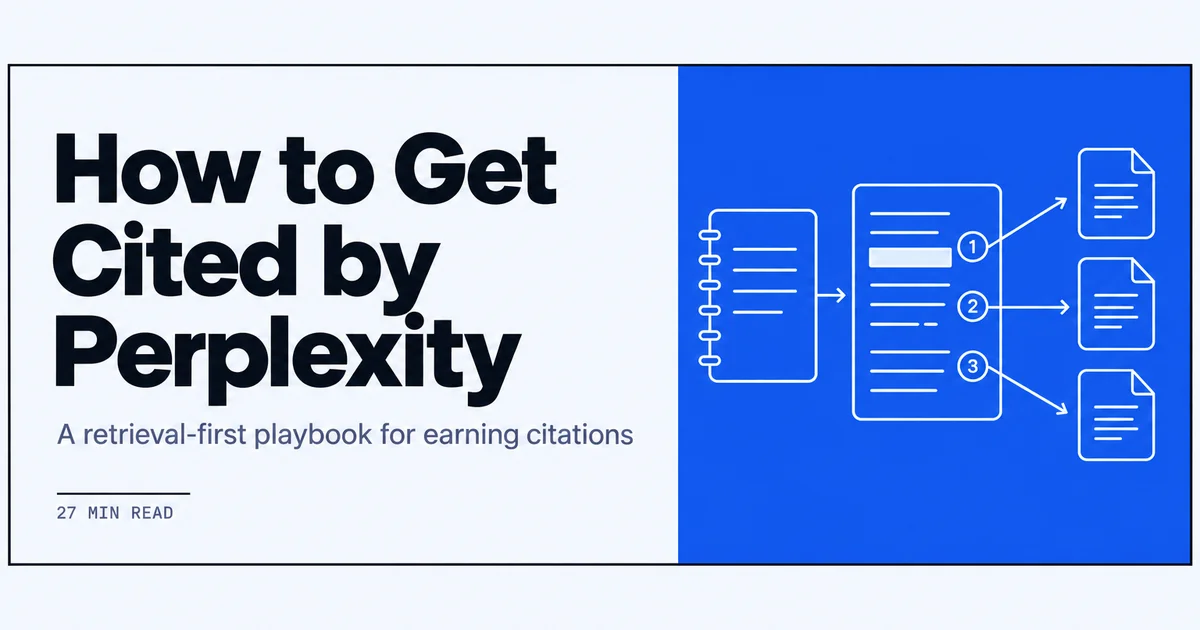
I treat Perplexity as a retrieval-first engine, so the job is to be the document it can select and name as a citation.
- 02
Clear authorship, a visible date, and one topical job per URL are the selection traits I match to Perplexity’s 2026 guide.
- 03
I ship FAQs, how-tos, and sourced explainers first because those formats map to the questions people type into answer engines.
- 04
I run the same queries every week, log which of my URLs appear as citation chips, and rewrite any page that is retrieved but not cited.
How Perplexity retrieves pages and attaches citations
<p>I treat how to get cited by Perplexity as a retrieval problem, not a ranking contest. Perplexity’s 2026 search guide describes a retrieval-first loop: it issues web queries, selects documents, then generates an answer grounded in those sources and exposes them as clickable citations. The rest of this playbook is how I match a page to that loop. For a product primer, I keep our guide to what is perplexity ai beside these notes so the mechanics stay separate from the brand story. That loop is the mechanical foundation for everything that follows.</p>
Retrieval, selection, then a grounded answer
<p>I walk teams through four beats, in order. A user types a question. Perplexity issues web queries against that question. It selects a set of documents from what came back. Then it generates an answer grounded in those retrieved pages and attaches those pages as named citations in the interface. That sequence is the whole job. If my URL is not in the retrieved set, it cannot be cited. If it is retrieved but the passage is hard to lift, the generator often uses a neighbor page with a short, direct answer.</p>
<p>I do not invent a hidden ranking score behind the chips. The Perplexity search documentation for 2026 is explicit about retrieval, then selection, then a grounded answer. My check is mechanical: did we enter the retrieved set, and did a sentence on the page survive into the citation chip? Everything later in this guide is in service of those two gates.</p>
Citations are named sources, not a position-one prize
<p>A Perplexity citation is a named source chip, not a position-one listing. On a classic SERP I could chase a slot. Here the interface names the pages that supported the answer. Several URLs can sit on the same answer. None of them occupy a numbered rank in the way a blue link does. When I say I want a citation, I mean my URL appears as one of those named sources for a given query, on a given day.</p>
<p>That change of object is why I refuse to paste a ten-blue-link checklist onto this work. I still care whether we were retrieved at all. I do not treat the chip as a prize for the best title tag. The chip is evidence that a passage was selected as support. If the chip is missing, I look at retrieval and quotation first, not at an unpublished Perplexity rank.</p>
Where I start when a brand asks how to get cited by perplexity
<p>When a brand asks me how to get cited by Perplexity, I do not start with a score. I start with two questions: which queries should retrieve us, and which passage on which URL is clean enough to quote. Then I map one primary question to each URL I care about, and I write the first block under that heading as a standalone answer. Authorship, a visible date, and a single topic on the URL come next, because Perplexity’s notes on supporting sources flag those as selection preferences.</p>
<p>I measure later. Weekly I rerun a fixed query set and log whether our URL was named, retrieved nearby, or absent. The playbook is that loop: match retrieval, write a quotable page, then check the chips. I am not chasing an unpublished ranking formula. I am making the page easy to select as a source and easy to attribute.</p>

Video: How to Get More Leads With Technical SEO & AEO in 2026 · @momentum360
Why I do not treat Perplexity like a Google SERP
<p>I do not treat Perplexity like a Google SERP. Classic ranking tactics assume ten blue links, a snippet slot, and a position you can climb. How to get cited by Perplexity assumes a retrieved set and a named source. I still use headings and evidence. Crawl hygiene still matters. Title-tag wars and rank-one reporting do not. For the split between those jobs I keep more on ai visibility vs seo in a separate note so the dashboards stay distinct.</p>
Signals I still use from search, and the ones I drop
<p>I keep the parts of search that help a crawler and a snippet extractor. The URL must be crawlable and indexable. Headings must name the question the page answers. Claims need evidence on the same page. Google’s 2027 note for web content creators says answer engines that synthesize from multiple documents tend to prioritize writing that is clear, factually supported, and easy to segment into short, quotable passages. I write to that bar because the passage still has to stand alone.</p>
<p>I drop tactics that only pay on a ten-blue-link page. I do not write for a pixel-perfect meta description. I do not chase a featured-snippet character count as if a box were waiting. I do not treat internal links as a ranking trick. I use them so a specialist cluster is obvious. If a tactic only exists to win a SERP slot, I leave it off this citation list.</p>
Why rank on perplexity is a retrieval problem
<p>When people ask me how we rank on Perplexity, I translate the phrase. Rank here means two gates: the page was selected into the retrieved set for that query, and then it was chosen as a supporting source. There is no stable position-one to report. A URL can be retrieved and unnamed. A URL can be named beside three other domains. Both outcomes are data. Neither is a SERP rank I can climb.</p>
<p>I therefore measure retrieval first, every week. If we never appear among the sources Perplexity used, I fix crawl, focus, and whether the page actually answers the question. If we appear nearby but the chip names someone else, I fix the liftable passage. That is the entire definition I use with clients. Wanting to rank on Perplexity is wanting to be retrieved, then quoted. I do not pretend there is a third, unpublished ranking layer I can hack.</p>
Map each URL to a question, not a keyword cluster
<p>I assign one primary question to each URL, not a keyword cluster. The H1 or the first H2 states that question in plain language. The first paragraph answers it in two or three sentences that could be quoted without cleanup. Subheads cover the follow-up questions I have already seen, not a dump of related terms. Perplexity’s notes on snippet alignment say it prefers concise explanations, structured sections, and direct answers because those help the system align a snippet to a query and attach an accurate citation.</p>
<p>The same pattern shows up in Google’s AI Overviews guidance for publishers: explicit headings and question-based subtopics help an answer system detect the right section and attribute it. I use that on Perplexity pages for the same reason. Retrieval can only line a snippet up with a query if the page makes the question and the answer obvious.</p>
What I reuse from ChatGPT citation work
<p>I reuse ChatGPT citation habits for the writing, then I stop. The engines share a need for quotable passages and they do not select sources the same way. ChatGPT can mention a brand from training data. Perplexity issues live web queries against the current web. I still run both playbooks on the same URLs. The ChatGPT half lives in how to rank in chatgpt in 2026; here I only name the overlap and the split I refuse to blur.</p>
Shared habits: short passages and a direct answer
<p>I write a direct answer in the first block, then the proof. I keep passages short enough to lift without surgery. I put the fact and the source on the same page. Google’s 2027 Search blog on AI Overviews makes the same request of publishers: clearly written, factually supported copy that segments into short, quotable passages. I already do that for ChatGPT-oriented pages, so I reuse the answer-first block, the evidence, and the refusal to bury the point in a throat-clearing intro.</p>
<p>What I also carry over is restraint. One claim per paragraph. Numbers with units and dates. No adjective where a figure would do. If I cannot quote my own paragraph into an answer without adding context, I cut it. I keep that cut list on every citable URL. It is also the part of how to get cited by Perplexity that I already practiced on ChatGPT pages.</p>
Live retrieval versus a training-data mention
<p>Perplexity is live retrieval. It issues web queries, selects documents, and grounds the answer in what it just fetched. A training-data mention is a different event entirely. A model can name a brand from pretraining, with no chip and no visit to my URL that day. I do not log a ChatGPT mention as a Perplexity citation. I also do not assume a well-known domain will be retrieved for a niche question if the page does not match.</p>
<p>That split changes the daily work. For Perplexity I care whether the URL is fetchable today, whether the date is real, and whether the passage still answers the question the user typed. For a training mention I care whether the entity is described consistently across the web. I can do both on one page. I cannot use one dashboard for both jobs. When I check how to get cited by Perplexity, I am checking live source chips, not recalled names.</p>
Why I still run both playbooks in parallel
<p>I keep one set of URLs. Each URL still has one primary question, a byline, a real date, and a passage I can lift. That page can serve ChatGPT work and Perplexity work at the same time. The editorial standard does not fork. The measurement does. Weekly I run Perplexity queries and log chips. Separately I check whether ChatGPT names the brand or the URL. I do not average them into one AI rank.</p>
<p>I do not pause one engine to chase the other. A page ready for live retrieval is usually ready for a model that likes short, supported passages. The reverse is not automatic: a ChatGPT mention does not mean we rank on Perplexity tomorrow. So I run both playbooks in parallel, with two logs. I need that dual log if I care about how to get cited by Perplexity without dropping ChatGPT work on the same pages.</p>
Step 1: Specialize until retrieval can trust the domain
<p>When a team asks me how to get cited by perplexity, I do not start with a title tag. I start with whether the domain looks like a specialist for one category of questions. Retrieval has to trust the site before it keeps selecting our URLs as supporting sources. Scattered posts across unrelated topics give it no pattern. I pick the category, then I refuse work that sits outside it. That fence is the whole job of this step.</p>
Pick one category of questions and cover it completely
<p>I do not start with a keyword list. I write down the questions a practitioner actually types when they want an answer in that niche. Then I map which of those we already answer, which we answer badly, and which we ignore. The work is filling the ignored ones and tightening the weak ones until the category is complete.</p>
<p>A category is something retrieval can name: industrial pump maintenance, B2B invoice factoring, not “manufacturing” or “finance.” I decline topics that sit outside that fence even when they would be easy to publish. Completeness inside a small set beats a thin presence across a wide one.</p>
<p>When I audit a site, I list a year of URLs and sort them by question. If they scatter across three industries, I keep the densest set and freeze the rest. New drafts have to answer a question in that set or they do not ship. That list is the brief I use for how to get cited by Perplexity.</p>
Cluster pages so retrieval sees a specialist domain
<p>Once the question set is fixed, I cluster pages so a crawler walking internal links stays inside the same topic. Hub pages point to the how-tos and explainers; those pages point back and to each other. I use descriptive anchor text that names the question, not a vague “read more.” This is evidence of depth, not a ranking trick.</p>
<p>I keep terminology consistent. If one page says “citation chip” and another says “source card,” retrieval has a harder time treating the domain as one specialist. I pick the terms the engine’s interface uses where I can, and I stick to them.</p>
<p>Coverage means every adjacent question has a URL. If I publish a page on dating content for recency, the next drafts cover bylines, topical focus, and the weekly audit. Gaps look like a generalist. Adjacent pages look like a specialist. Orphan pages do not count as coverage.</p>
How niche depth helps you rank on perplexity over time
<p>I treat niche depth as a confidence problem for retrieval, not a branding line. McKinsey’s 2026 report on AI answer engines observes that systems like Perplexity reward sites that specialize in well-defined niches, because topical depth and consistent coverage give ranking and retrieval algorithms more confidence to treat those domains as authoritative sources for specific categories of questions.</p>
<p>That matches my citation logs. The first named citation on a new domain takes time. Once the cluster is dense, the same domain starts appearing on adjacent queries it never targeted. Retrieval has a pattern it can reuse. I have seen this on industrial sites and on SaaS help centers alike.</p>
<p>I do not wait for a public authority score. I keep covering the category until the citation chips name us on the questions we chose. That is how niche depth helps you rank on perplexity over a quarter, not a week.</p>
Step 2: Write the passage Perplexity can lift
<p>Retrieval gets you into the candidate set. The citation chip attaches to a passage the engine can quote without rewriting. Perplexity’s official 2026 guide notes that it prefers concise explanations, structured sections, and direct answers, because those make it easier to align snippets with queries. I write every citable page as if one paragraph will be lifted. This step is that writing method for how to get cited by Perplexity.</p>
Lead with the direct answer, then the proof
<p>Under every question heading I put a two-to-four sentence block that answers the question on its own. No setup paragraph. The first sentence is the claim. The next sentences are the mechanism, the constraint, or a named example. Proof follows: a table, a primary source, a dated case. I keep that lead under a short paragraph so it can be quoted as-is.</p>
<p>Google’s 2027 Search blog on AI Overviews explains that answer engines which synthesize responses from multiple documents tend to prioritize content that is clearly written, factually supported, and easy to segment into short, quotable passages. I write the lead block to that spec.</p>
<p>If the answer cannot stand alone, I rewrite it. A snippet that needs the introduction to make sense will not be cited cleanly. I paste the block into a blank document and ask whether I would still stand behind it. If it fails that test, the heading is wrong or the claim is still buried.</p>
Explicit headings and question-based subtopics
<p>I title sections as questions or as named objects, never as clever labels. “Lead with the direct answer” is usable. “A better way to write” is not. Google’s 2027 guidance for web publishers advises explicit headings, question-based subtopics, and descriptive anchor text, noting that these practices help AI answer systems detect relevant sections and attribute citations to the most appropriate pages.</p>
<p>Perplexity’s 2026 hub guide prefers structured sections and direct answers for the same reason: they make it easier to align a retrieved snippet with the query and attach an accurate citation.</p>
<p>On a page I want cited, every H2 is a question I have seen typed into the engine or a close paraphrase. H3s break that question into units an answer might need: definition, steps, exceptions, sources. I do not bury the quotable sentence three paragraphs under a vague heading. If a heading could apply to any article on the site, I rewrite it until it cannot.</p>
Snippets I rewrite until they are citation-ready
<p>A draft paragraph often opens with context the engine does not need. I cut the first sentence if it is setup. I replace adjectives with names, dates, and figures I can source. I put the primary source next to the claim, not in a footer a snippet will miss. I also split compound sentences so each one carries a single fact.</p>
<p>I keep rewriting until a stranger could quote the paragraph without cleanup. That means no off-page pronouns, no “as mentioned above,” and no hedge that empties the claim. If I cannot support a figure, I delete the figure. A cited sentence has to stand true out of context.</p>
<p>This is slow. One page can take several passes. The pass that matters is the last one, where I paste the answer block into a blank document and check whether it still answers the heading on its own. If it does not, I go back to the heading and the first sentence.</p>
Step 3: Put a name, a date, and one topic on the URL
<p>Perplexity’s 2026 documentation emphasizes that pages with clear authorship, recent publication dates, and unambiguous topical focus are more likely to be selected as supporting sources and surfaced as citations. I treat that as an operations checklist for how to get cited by Perplexity: a byline, a visible date that matches a real revision, and one job per URL. This step is how I put those three things on every page I want named.</p>
Bylines, bios, and a name on every citable URL
<p>I put a human name above the fold on every URL I want selected as a supporting source. The byline links to a bio that states who the person is and what they have shipped in this niche. Anonymous “team” pages stay in the set I do not expect to be cited.</p>
<p>The bio is short and specific: role, years in the category, one piece of work retrieval could treat as evidence. I do not write a novel. I do not use a brand name as the author. A logo next to a department name is not the authorship pattern I use.</p>
<p>When several people edit a page, I keep the original byline and name later editors in a note. If the named person leaves, I update the bio and keep the historical byline unless we rewrite the page. The point is a stable identity the system can attach to the document.</p>
Visible dates without fake republishing
<p>I show a published date and, when I make a material change, an updated date. I do not bump the date for a typo or a meta-title tweak. Recency has to be observable: a new figure, a rewritten answer block, a source added because the old one aged out.</p>
<p>If I cannot point to what changed, the date stays. I have watched whole categories get a new date in one afternoon with no change to the answer blocks. The snippets were the same, so I do not expect the citation chips to move.</p>
<p>My revision note is a sentence at the top or bottom: what changed and why. That sentence is for me as much as for the engine. I want a reviewer to see the recency without guessing. I keep old dates on pages I have not actually revised, even when a campaign wants everything to look new.</p>
One page, one job: unambiguous topical focus
<p>If a URL tries to answer two unrelated questions, I split it. Retrieval has to attach a citation to a page. A mixed URL makes that attachment ambiguous. Unambiguous topical focus is a selection preference I take from Perplexity’s documented guidance; I operationalize it as one primary question per URL.</p>
<p>I check this by reading the title, H1, and first answer block. If they do not name the same question, I retitle or I split. Side topics become their own pages and get a descriptive internal link. Descriptive anchor text on those links names the question, not the file.</p>
<p>I also strip product stories and campaign copy out of explainers I want cited. Those belong on different URLs, not in the explainer. A page that tries to be a hub, a how-to, and a launch note at once is harder to quote as a supporting source than the single-job URL.</p>
Step 4: Ship FAQs, how-tos, and sourced explainers first
<p>I ship FAQs, how-tos, and sourced explainers first. McKinsey's 2026 findings on structured assets treat those formats as core inventory because they map to the question-and-answer patterns systems such as Perplexity issue. I fill the Step 1 question set with pages that already look like answers: a question, a short block, a next step. That is the inventory I want retrieval to land on. Opinion waits until those answer pages exist. I start there every time I work on how to get cited by Perplexity.</p>
FAQ blocks that map to real Perplexity queries
<p>I do not invent FAQs in a workshop. I paste questions I have already typed into Perplexity for that niche, the same set I reuse in the weekly audit, and I write one FAQ unit per question. Each unit is a heading that restates the query in plain language, then two to four sentences that answer it without a throat-clearing intro. The 2026 Perplexity search guide notes a preference for concise explanations, structured sections, and direct answers to common questions, which makes it easier to align a snippet and attach a citation.</p>
<p>I keep every unit self-contained. If the answer needs a number, I put the number in the first sentence. If it needs a condition, I name the condition in the same sentence. I write the default case, then one exception. I match the FAQ heading to the wording I will type in the weekly check so I can see whether that block is named as a source.</p>
How-to guides as pages the engine can step through
<p>I write how-tos as a sequence of headed steps, not as a narrative. Each step is its own H3 or H4 with a verb-first title, then a short paragraph that a model can lift without the surrounding page. Google's 2027 guidance for AI Overviews advises explicit headings and question-based subtopics so an answer system can detect the right section and attribute the citation to that page.</p>
<p>I number the steps in the heading because that numbering survives when a snippet is cut. I put the action in sentence one and the caveat in sentence two. If a step needs a tool, I name the tool and what I do with it. If a step needs a check, I write the check as a yes/no. I do not bury the method in a backstory. Each step is one quotable unit. The page should work as a checklist even if only one step is quoted.</p>
Data, tables, and primary sources inside explainers
<p>I put figures, tables, and outbound primary sources inside explainers so the page is easier to treat as reliable. Google's 2027 Search blog highlights that consistently including trustworthy references, data, and primary sources in an article improves its perceived reliability, making it more likely to be surfaced and cited by AI Overviews and similar answer engines.</p>
<p>When I write an explainer, I add one table a model can quote as a row: a named metric, a period, a source column. I do not dump a spreadsheet. I keep one small table. I add two or three outbound links to primary documents, a standard, a dataset, a paper, not to other blogs. I write the claim in my own words, then the source in the same paragraph. I caption every table in a full sentence that could stand as a snippet. If the number will go stale, I put the as-of date in the cell, not only in the byline.</p>
Step 5: Earn retrieval with references and time-on-page
<p>Retrieval still has to find the page. I treat outbound references and time-on-page as part of how to get cited by Perplexity, not vanity metrics. McKinsey's note on engagement signals says answer engines increasingly factor in dwell time and repeat visits when choosing which sources to retrieve and cite. I design the page so a reader stays because the next fact is useful, and I put sources in the body so both a crawler and a human can verify the claim.</p>
Cite primary sources so you become a source
<p>I cite primary sources so the page carries verifiable support instead of unsourced claims. If I state a date, a threshold, or a method, I link the document I used in that same paragraph. Google's 2027 note on web content for AI Overviews highlights that consistently including trustworthy references, data, and primary sources improves perceived reliability, which raises the chance a page is surfaced and cited.</p>
<p>I prefer sources a retrieval system can fetch: official documentation, datasets, papers, and standards. I put the link on the specific claim, not in a footer dump. I name the source in the sentence so a lifted snippet still carries the attribution. I keep a short list at the end for human readers, but the link next to the claim is the one I care about when I want the page treated as a source. I link originals, not roundups. That is how a page becomes a citable source.</p>
Write for dwell time without padding the word count
<p>I write for dwell time without padding the word count. Extra paragraphs that restate the same idea do not keep anyone. Specific examples do. After the answer-first block, I add one worked case: the query, what I published, and what the citation chip showed the following week. Then I name the next question a practitioner would ask and answer it under the following heading. That is how I keep a reader moving without stuffing.</p>
<p>The 2026 McKinsey analysis of dwell time notes that answer engines factor in dwell time when evaluating which sources to retrieve and cite. I treat that as a reason to be useful, not a reason to add a recap. I cut any sentence that does not change a decision. I keep tables, examples, and the next question. If people bounce after the first block, the example is too thin, not too short.</p>
Repeat visits as a signal I actually design for
<p>I design for repeat visits instead of treating them as a dashboard accident. I plan living pages: a method I update when the weekly audit shows a new failure, a table I refresh when a number changes, a FAQ I add when a new query appears in the log. People return because the page is still the shortest path to the current answer.</p>
<p>McKinsey's observation on repeat visits notes that content which keeps visitors reading and returning has a better chance of being featured in AI answers. I put a visible last-revised line and a short changelog of what changed, so a returning reader can scan. I revise when the facts or the citation log say I should, not to decorate a date. The engagement I want is a byproduct of a page people bookmark. If nobody returns, I rewrite the example. Usefulness is the lever I pull; the metric is a byproduct.</p>
Step 6: Audit citations every week and rewrite
<p>I do not wait a quarter to see if a page gets cited. I run a weekly loop: same queries, log the chips, rewrite the pages that were retrieved but not named. That is the measurement I trust for how to get cited by Perplexity, not an unpublished score. If the chip never shows my URL, the page is not doing the job yet. I log every chip.</p>
Queries I run weekly to see if we rank on perplexity
<p>I keep a fixed prompt set so week-to-week checks are comparable. I do not improvise a new question every Monday. For each URL I want cited, I store three prompts: the primary question the page answers, a close paraphrase a practitioner would type, and one how-to or what-is variant. I run them in Perplexity in the same mode each week, usually the default web-grounded answer, not a specialized collection I cannot reproduce.</p>
<p>I type every prompt myself. I do not batch them through an unofficial wrapper. I record the exact string, including punctuation. If I change a prompt, I mark the change in the log so I do not compare two different questions. This is how I tell whether we rank on Perplexity on the same jobs, not whether I got lucky with a one-off phrasing. I keep the set small enough that I finish the run the same morning. I run the same strings in the same order.</p>
Logging which URLs get the citation chip
<p>Every run, I log four fields: the query string, the date, the URLs on the citation chips, and a status for my page, named, retrieved but not named, or absent. Named means my URL is a clickable source. Retrieved but not named means I saw a competitor or a nearby URL from my domain without my chip. Absent means none of my URLs appear.</p>
<p>I paste the source list as I see it, not as I remember it. I note the answer's first sentence so I can compare it to my answer-first block later. I do not score share of voice with a formula I cannot defend. After four weeks I can see which URLs never appear, which appear on one paraphrase only, and which hold as named sources. I store one row per query per week. That log is the input to the edit cycle for how to get cited by Perplexity. I do not tidy rows later.</p>
The edit cycle when a page is retrieved but not cited
<p>When a page is nearby but not named, I do not add more keywords. I tighten the passage the engine would have to lift. I rewrite the answer-first block so it can stand as the first sentence of Perplexity's reply. I match the heading to the query string. I refresh the visible date only if I genuinely revised the facts. I add or replace a primary source next to the claim.</p>
<p>I check the page still has one job. If two questions live on it, I split them. I shorten any sentence I would not want quoted. I wait for the next weekly run. One cycle per week is enough to see if the chip moves. If after three cycles the URL is still only retrieved, I treat the page as the wrong format and rebuild it as an FAQ or a stepped how-to. That is the whole cycle.</p>
Frequently asked
I have not seen a published SLA from Perplexity on citation lag. In my work, retrieval-first engines issue web queries and select documents after they are crawlable, so timing depends on crawl access, recency signals, and whether the page already matches a live query. I treat publication as the start of observation, not an instant citation event.
No. McKinsey’s 2026 research on AI answer engines observes that systems like Perplexity reward sites that specialize in well-defined niches, because topical depth and consistent coverage give retrieval more confidence. In my audits, a focused domain with clear authorship and recent dates is selected as a supporting source without needing mass page count.
Yes. Perplexity is a retrieval-first engine: it issues web queries, selects documents, then grounds answers in those sources as clickable citations. If my robots rules block that retrieval, the page never enters the candidate set. I allow crawl access on pages I want cited and keep those URLs reachable without login walls.
Schema was not documented as a citation requirement in Perplexity’s 2026 search guide. The guide prefers concise explanations, structured sections, and direct answers. I still mark up FAQs and how-tos when they match the page, because McKinsey notes those formats map to answer-engine question patterns, but visible structure is what I optimize first.
Perplexity’s 2026 guide describes a retrieval-first loop: web queries, document selection, then answers grounded in those sources as clickable citations. Google’s 2027 AI Overviews guidance describes synthesis across multiple documents, favoring short quotable passages. I treat Perplexity as source-grounded retrieval and Overviews as multi-document summary, so I write both extractable answers and citable passages.
Yes. Perplexity selects documents that contain structured sections and direct answers to common questions, then attaches citations to aligned snippets. Google’s 2027 guidance similarly notes question-based subtopics help systems attribute the most appropriate page. I put several related questions on one URL only when each section can stand alone as a quotable answer.
