Core / Pillar 28 min read Published Updated
AEO Checklist: 25 Things to Do (2026 Guide)
I use this AEO checklist on every page I want cited by ChatGPT, Perplexity, Gemini, Copilot, Grok, Claude, or Google AI Overviews. These are the 25 moves I actually run, in the order I run them.
On this page
- How I run this AEO checklist
- Make the page retrievable before I rewrite a word
- One canonical URL and a quotable opening
- Headings, extractable blocks, and schema I actually ship
- Paragraph length and a single entity name
- Mentions, credentials, and persistent identifiers
- Timestamps, pricing, and retrieval position
- Cadence, original measurements, and primary sources
- Integrity steps on the answer engine optimization checklist
- 01
I run the AEO checklist as retrieval first, then quotable structure, then integrity, not as a pile of on-page extras.
- 02
Unique content, topical relevance, visible timestamps, and explicit pricing are the signals I refuse to skip.
- 03
I put primary sources and method limits on the same page I want an engine to cite.
- 04
After I ship changes, I re-read the live answers, not only the HTML.
How I run this AEO checklist
<p>I run this aeo checklist of 25 items in order on a live URL, not on a draft sitting in a CMS. I fetch the page, confirm it returns, then walk the list before I rewrite a sentence. A pass does not mean I ship copy; it means I know whether the page can be retrieved, quoted, and attributed. I keep a companion ai visibility audit checklist in 2026 next to this sequence so I can score the same URL after I change it.</p>
What I use this AEO checklist to decide
<p>A pass on this list is a shipping decision, not a writing prompt. If crawl, canonical, and unique-content checks fail, I do not touch the body. I fix retrieval first. If those pass and the opening, headings, and extractable blocks fail, I rewrite those blocks and leave the rest of the URL alone. If identity, timestamps, and integrity items fail, I add credentials, dates, and sources without changing the argument. A fail on unverifiable claims means I cut the sentence before publish. I use the same three buckets every time: ship as-is, fix then recheck, or leave the URL out of the prompt map. That keeps me from rewriting pages that engines cannot retrieve. I also mark which items I will recheck after deploy so I do not treat a CMS save as the end of the job.</p>
Why I still keep an answer engine optimization checklist
<p>Ad-hoc prompt testing tells me what one engine returned today. It does not tell me why two of my URLs diverged, and it does not travel with the page. I keep a written answer engine optimization checklist so I can compare the same 25 checks across URLs, dates, and engines without relying on memory. When ChatGPT cites page A and Perplexity cites page B, I walk both pages against the list and write down which items differ. That record is what I bring back to the next edit. Prompt tests still happen; they sit after the list, not instead of it. I need a stable sequence so a change I make for Grok does not silently undo a heading I wrote for Gemini. I log the date I ran the list so I can see whether a citation shift followed a content change or an engine update.</p>
How I grouped the 25 items
<p>I grouped the 25 items into the order I actually run them. Retrieval comes first: crawl, search fundamentals, unique content, one canonical URL, and a sitemap that matches live pages. Quote-readiness comes next: a lift-ready opening, prompt-shaped headings, extractable blocks, schema that matches the HTML, short paragraphs, one entity name, and a topical cluster. Then I handle mentions, credentials, identifiers, timestamps, pricing, and retrieved-set position. Cadence, original measurements, and primary sources sit after that. Integrity closes the list: methods versus opinion, unverifiable claims, data limits, and a live-answer recheck. I do not skip ahead to copy edits when the URL is not retrievable. That sequence keeps later items from masking an earlier failure. If I polish a definition block on a page that is not in the sitemap, I have spent time on a quote engines will not fetch. I run the groups in that order on every live URL.</p>
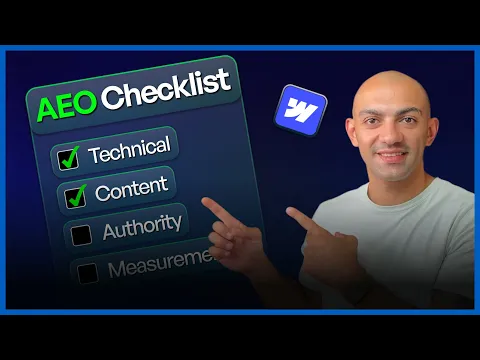
Video: Webflow’s AEO Checklist: Do THIS to Rank in AI Search · Yar
Make the page retrievable before I rewrite a word
<p>I do not rewrite a page until I know engines can fetch it and until I know the URL deserves the rest of this aeo checklist. Items 1-3 are that gate. They cover crawl, search fundamentals, and unique content. I use the same three checks when I compare this work to GEO; I keep a closer look at aeo vs geo beside the sequence. Google's 2026 guidance is the source I follow here, not a separate playbook.</p>
1. Confirm the URL can be crawled and retrieved
<p>Before I edit copy I fetch the live URL myself. I check the HTTP status, the robots directive, and whether a noindex or a blocked resource would keep the HTML out of a crawler. I then search for the exact URL and for a distinctive sentence from the page. If neither returns the URL, I do not start an AEO pass. Retrieval is not the same as ranking; I only need evidence that the page can be fetched and that a distinctive string is findable. I also fetch the page as a plain GET so I see what a bot sees, not what my logged-in CMS preview shows. If the URL redirects through a chain, I treat the final 200 as the page I will optimize. I record that fetch date, status, and final URL so later citation checks refer to the same HTML. That log is the baseline I reuse.</p>
2. Treat AEO as search fundamentals, not a parallel system
<p>I do not run a second optimization system beside SEO. Google presents its generative-AI search guidance as an extension of established search fundamentals rather than a separate track, which matches how I work. Crawlability, indexability, useful content, and clear URLs still decide whether a page can be cited. I apply those first, then I add quote-ready structure. When a stakeholder asks for an AEO-only rewrite, I point them at that 2026 note and keep the same fundamentals on the page. The extra work in this list is extractability and integrity, not a replacement for search hygiene. I still write title tags, I still fix thin templates, and I still resolve duplicate URLs. Those jobs do not become optional because an answer engine will generate a paragraph. If the page would fail an ordinary search review, I do not expect a citation to save it. I treat AEO as that extension.</p>
3. Prioritize unique content over commodity pages
<p>I use unique content as the filter for which URLs get the rest of this list. I follow the instruction in Google's May 2026 search guidance to prioritize valuable, unique content rather than commodity content. I take that as a go/no-go. If the page restates a specification anyone can scrape, I do not spend the remaining 22 items on it. I look for a measurement I ran, a method I can name, or a decision a reader cannot get from a vendor feature grid. Commodity pages can still appear in classic results; I do not put them on my citation map. When two URLs cover the same prompt, I keep the one with original evidence and leave the other out. That filter keeps the rest of the sequence short: I only run items 4-25 on pages that already carry something an engine cannot reconstruct from other sites.</p>
One canonical URL and a quotable opening
<p>Once the URL is retrievable and unique, I lock three things on this aeo checklist before I rewrite the body: one page per prompt, a sitemap that matches live URLs, and a first paragraph an engine can lift. These three sit on ordinary search hygiene; I keep our guide to aeo vs seo for the overlap, and I run the checks below on the live HTML. I do not split a prompt across two similar posts and hope the engine picks the better one.</p>
4. Map each prompt to one canonical URL
<p>I write the prompt I want the page to own, then I pick one canonical URL for it. I search my own site for that prompt and for close variants. If two posts both try to answer it, I choose one owner and point the other at it with a canonical tag or an internal link that states the relationship. I do not leave two 200-status pages competing for the same question. The owner is the page with the unique evidence from item 3, not the newest draft. I record the prompt-to-URL map in a sheet so later edits do not spawn a third variant. Engines that retrieve both copies have to choose; I remove that choice before I write the opening. If a hub and a deep page both fit the same phrasing, I assign the hub the category prompt and the deep page the specific one.</p>
5. Keep the sitemap matched to live URLs
<p>I fetch the sitemap the site actually serves, not the file in the repo. I count the URLs it lists, then I request each URL that should be in the prompt map. I keep a row for listed versus live: URL in sitemap, HTTP status, final URL after redirects, and whether the canonical tag agrees. If the sitemap lists a URL that returns 404, I remove that listing. If a live 200 URL I care about is missing from the sitemap, I add it. I do not assume the CMS sitemap job is current. I re-fetch after deploy and compare the two files. The check is mechanical: listed URLs should be the URLs that return 200 and that I still want retrieved. When the counts differ, I fix the sitemap before I edit the opening paragraph, because a quotable page that is not listed is still a retrieval risk.</p>
6. Open with a direct answer engines can lift
<p>I write the first paragraph so it can stand as a citation without the rest of the page. The pattern I use is: name the entity, answer the prompt in one or two sentences, then add the constraint or number that makes the answer specific. I do not open with a teaser or a table of contents. I do not bury the answer under a story. If I cannot lift that paragraph into a ChatGPT or Perplexity-style answer and have it remain true, I rewrite it. Short is the point: one claim, one qualifier, no second topic. The rest of the page supports that opening; it does not delay it. I also keep names and numbers in that paragraph identical to the names and numbers I will use in headings later, so a lifted sentence does not contradict a later H2. I check that match before I ship.</p>
Headings, extractable blocks, and schema I actually ship
<p>Once the URL is retrievable, I treat headings, blocks, and schema as one extraction surface. Items 7 through 9 on this AEO checklist are the parts I ship together: prompt-shaped H2s, lift-ready definitions or tables, and JSON-LD that restates the HTML. A heading without a clean block still forces a model to splice. Schema that describes a type the page does not represent is work I have to undo after deploy. I run this pass before I rewrite body copy.</p>
7. Write headings in the language people prompt
<p>I pull the prompt set I already mapped to this URL and rewrite every H2 and H3 so it could stand in as the query. If people type 'how I check if ChatGPT cited my page,' that string becomes the heading. I do not swap it for a brand slogan, and I do not invent a question heading for a section that is not answering a question.</p>
<p>I keep one idea per heading. A combined H2 that mixes crawl rules with schema forces an engine to lift a fragment. After I draft, I read the heading list as a table of contents a human would use. If a heading only exists to catch a prompt and has no real block under it, I cut it. When I built AI Rank Checker, I listed the prompts those pages actually answer, then matched H2s to those strings instead of internal feature names.</p>
8. Add definitions, steps, and tables that extract cleanly
<p>I add three block types I have watched engines lift without rewriting: a one-sentence definition, a short step sequence, and a comparison table with a labeled header row. Each block has to stand if the rest of the page is stripped. I place the definition in the first paragraph under the heading that names the term. Steps stay as short imperative sentences, one action each. Table headers state the comparison, not a vague 'Overview.'</p>
<p>I keep the HTML boring on purpose. Definitions live in ordinary paragraphs. Steps live in an ordered list. Comparisons live in a real table. I do not bury them inside cards or accordions that flatten into one undifferentiated blob when a crawler fetches the URL. If I cannot copy the block into a blank document and still understand it, I rewrite the block before I touch schema. That copy test is the only extractability check I trust on this answer engine optimization checklist.</p>
9. Ship the structured data the page actually represents
<p>I only ship structured data for types the visible HTML already represents. An article with a byline and a date can carry Article markup with the same headline, author, and dateModified strings. I add FAQPage only when the page contains real question-and-answer pairs a reader can see. I add HowTo only when the steps are on the page. I do not add Organization or Product properties the body never states.</p>
<p>After deploy I fetch the live URL, confirm the JSON-LD parses, and check every property against visible text. A name in schema that does not appear in the body is a mismatch I created. I also confirm the canonical URL in the markup matches the URL I mapped in item 4. If a validator flags a type I cannot justify from the HTML, I remove that type rather than pad the page to fit the schema.</p>
Paragraph length and a single entity name
<p>Headings and blocks get the page extractable. Items 10 through 12 on this aeo checklist decide whether the extract stays coherent. I keep paragraphs short enough that a citation does not glue two claims together, I lock one string for the entity, and I park the URL inside a cluster of pages on the same topic. Topical neighborhood is not decoration; it is how I raise the odds the page is even in the retrieved set. I do this before I hunt for extra mentions.</p>
10. Keep paragraphs short enough to quote intact
<p>I write body paragraphs so a model can lift one of them as a complete answer fragment. In practice that means two to four sentences and one claim. If a paragraph starts on crawl rules and ends on schema, a citation will splice them. I split. I also avoid stacking hedges and asides in the same block; the sentence an engine takes should still be true without the next sentence.</p>
<p>I check this by highlighting each paragraph and asking whether I would be comfortable seeing only that highlight in ChatGPT or Perplexity. If the highlight needs the paragraph before it to make sense, I move the missing fact up or I split the thought. I do not chase a magic word count. I chase a unit that can stand. Long narrative sections still exist on my pages; they just come after the quotable units, not instead of them.</p>
11. Use one consistent name for the entity
<p>I pick one official string for the brand, the product, and the person, and I reuse it in the title, H1, first paragraph, byline, and schema. I do not alternate short nicknames and legal names in the same article unless I am distinguishing two entities. Retrieval splits on those variants. If a knowledge panel already uses a string, I match that string.</p>
<p>I keep a one-line name sheet beside the draft: entity, product, author. Before publish I search the HTML for near-duplicates. An abbreviation appears once, in parentheses, then I return to the official name. When I built AI Rank Checker I used that three-word product name every time so mentions and markup would not fragment the same tool. I apply the same lock to author names: the byline, bio, and later sameAs fields use one string, not a handle mid-page. That sheet is the source of truth for items 13 through 15.</p>
12. Place the page inside a topically relevant cluster
<p>I do not publish an orphan URL and hope an engine finds it. I place the page inside a cluster of related URLs I already control: a hub, sibling guides, and glossary pages that share the same entity and topic. Internal links go both ways, with anchor text that names the destination’s actual subject. This is the neighborhood I want retrieved together.</p>
<p>Research on citation prominence identified topical relevance as one of the strongest drivers of which pages AI answer engines cite. I use that as a filter, not a slogan: if this URL does not sit next to other pages on the same topic, I write or relink those pages before I spend time on schema polish. The cluster has to be real content I would keep for readers, not a ring of thin satellites. I check the hub links to this URL and that this URL links back with a descriptive anchor.</p>
Mentions, credentials, and persistent identifiers
<p>A consistent name on my page is not enough if the rest of the web uses a different string, or if the author is a blank byline. Items 13 through 15 on this aeo checklist are the identity layer: third-party mentions that corroborate the same entity, on-page credentials an engine can attribute, and official names plus sameAs identifiers I can open. I run them after the cluster exists, because a mention of a page with no topical neighborhood still has nowhere to attach. This is identity work, not link building.</p>
13. Earn mentions that corroborate the same entity
<p>I search for the locked entity name on properties I do not control: articles, directories, GitHub profiles, conference pages, and other publisher bios. I want the same string, not a cousin brand. If other sites use a different official name, I either align my page to the dominant verified string or I request a correction on that listing. I do not treat my own blog posts as corroboration.</p>
<p>A mention only helps if it points at the same entity I named in item 11. I keep a short log of URL, the exact name used, and the date I fetched it. When the strings match, I leave them. When they drift, I fix the drift before I add more sameAs links. I also check that the mention is about the thing the page is about, not a coincidental overlap of a common word. Unrelated homonyms stay out of the log.</p>
14. Publish author and organization credentials
<p>I put author and organization facts on the page, not only in a site-wide footer a crawler might skip. For myself that means a visible byline, a short bio with the work I actually did, and an organization name that matches the entity string from item 11. I include a role, a way to verify me (a homepage or a profile URL), and the organization that publishes the page.</p>
<p>I publish a visible byline for Furkan Yaman, a short bio of the AEO and GEO work I actually do, and the note that I built AI Rank Checker as a firsthand credential, not a pitch. Those strings match the Person markup from item 9. If a fact is not true on publish day, I leave it off. I would rather ship a short checkable bio than an empty author box. Credentials I cannot verify stay off the page.</p>
15. Align official names and sameAs identifiers
<p>I reconcile the official name across the site, the sameAs URLs, and any knowledge-panel string I can load myself. sameAs only includes identifiers I can fetch today: Wikipedia, Wikidata, LinkedIn, Crunchbase, GitHub, or a company homepage. I do not add a sameAs URL that 404s or that names a different entity. I compare the display name on each of those profiles to the string I locked in item 11.</p>
<p>If a knowledge panel I can load uses a different legal name, I record the string I observed and decide whether the on-page name should match it. I do not guess at motives. After I update sameAs, I re-fetch the live JSON-LD and click every identifier. A dead sameAs link is a mismatch I introduced. I would rather ship three working identifiers than a long list I have not opened. I repeat the fetch when a profile URL changes.</p>
Timestamps, pricing, and retrieval position
<p>Items 16 through 18 on this aeo checklist are on-page facts and internal-link work, not copy tricks. I date the page only when I reviewed it, I publish a price only when the number is current, and I try to make this URL the hub a retriever would surface among related peers. I skip any of the three when I cannot verify it on the day I ship. These three come after identity and mentions because a fresh stamp on a page I cannot retrieve does not help.</p>
16. Put a recent timestamp where readers can see it
<p>I put a visible last-updated date in the article header, not only in the HTML head. Readers and crawlers both have to see the same string. I write it as plain text next to the byline, for example “Updated” plus the review day, and I keep dateModified in JSON-LD matched to that string. If the two disagree, I correct the HTML first.</p>
<p>I only advance the stamp when I change a fact, a price, an example, or a method. A CSS tweak or a heading rewrite does not get a new date. I never backdate, and I never leave last year's stamp on a page I reviewed this week.</p>
<p>Competitive GEO experiments reported that a recent timestamp can consistently improve citation performance. I treat that finding as a reason to show an honest date, not as a reason to manufacture freshness. If I have not reviewed the page, the old date stays.</p>
17. Include explicit pricing when the number is real
<p>I add a price only when it is current and I can point to the source, a public plan page, an invoice I paid, or a quote dated on the page. If a vendor does not publish pricing, I write that pricing is not published on their site as of my review date, and I leave the cell blank.</p>
<p>The same GEO experiments found that explicit pricing information can improve citation performance. I use that as a filter: if I have a real number, I put it on the page; if I do not, I skip the field.</p>
<p>I place the figure next to the product name in the opening answer and again in a comparison table when I compare plans. Currency and the as-of date sit in the same sentence so a citation cannot lift a number without the unit. When the number changes, I update the price and the visible timestamp together.</p>
18. Improve the page's position in retrieved material
<p>I cannot control how an engine ranks its retrieved set. I can control whether this URL is the hub for the topic, how many in-cluster pages point to it with descriptive anchors, and whether a thinner sibling still competes for the same prompt, item 4 already mapped one canonical URL.</p>
<p>Position in retrieved material was identified as a major factor associated with being cited first. I treat that as a retrieval problem, not a prose problem. I fetch the cluster index and the related how-tos, confirm this URL returns 200, and check that a crawler landing on the hub reaches it in one click. If it does not, I add that internal link.</p>
<p>I keep anchors specific to the prompt the page owns. I do not repeat the same phrase on every sibling. When two live URLs still cover the same question, I consolidate before I add more links. Raising position means making this page the obvious retrieved peer, not multiplying URLs.</p>
Cadence, original measurements, and primary sources
<p>Items 19 through 21 keep dated facts honest after the first ship. A timestamp with no review calendar is decoration. I put original measurements I actually ran on the page, then I place primary-source URLs beside the claims they support. I set the refresh cadence before I write the first draft, because I will not remember which numbers expire unless they are on a calendar. These three belong on the aeo checklist only after I already decided the URL is worth keeping.</p>
19. Refresh dated facts on a fixed cadence
<p>I keep a written review calendar per URL on this answer engine optimization checklist, not a memory of when I last looked. Prices and version numbers get a 30-day pass when the product ships often. Experiment stats and “as of” examples get 90 days. Evergreen definitions move only when the underlying source changes. I store that cadence in the working notes for the page so the next pass is not a guess.</p>
<p>On review day I re-fetch every primary source I cited, compare the live figure to the on-page figure, and either update both the fact and the visible timestamp or leave both alone. I do not advance the date if the facts did not change. Cosmetic republishes stay off this list.</p>
<p>If a source URL returns 404 or the number has been removed, I replace the citation or I cut the claim, that is item 23, not a later cleanup. A fresh stamp on stale stats is the failure mode this item exists to prevent.</p>
20. Add original measurements I actually ran
<p>I only label something an original measurement when I ran it. Sitemap fetches, crawl checks, prompt-to-URL maps, and live-answer rechecks I logged myself belong here. Each block names what I did, the date, and the method in one or two sentences. I do not paraphrase another writer's summary and present it as my test.</p>
<p>If I did not run the work, it does not go in this slot. I can still cite a paper next to a claim, that is item 21. This item is reserved for first-person evidence: I fetched, I counted, I compared.</p>
<p>The pattern I use is concrete and boring. I fetched the sitemap on the review date, counted the listed URLs, and recorded how many returned 200. I asked the same prompt in ChatGPT, Perplexity, and Gemini and wrote down whether this URL was cited. Those sentences are measurements. “Sitemaps should be complete” is not. I cut any original-sounding claim that I cannot point back to a run I did.</p>
21. Cite primary sources next to the claims they support
<p>I put the source URL in the same paragraph as the fact, as an inline link, not in a footer bibliography an extractor may never reach. Primary means the page that published the measurement or the policy. A roundup that quoted it is a secondary, and I do not use it as the supporting link.</p>
<p>For Google search guidance I link the developers.google.com post I actually read. For GEO papers I link the arXiv HTML. When the same paper supports more than one sentence in the article, I change the anchor text so the links are not identical phrases.</p>
<p>I keep the claim and the link in one sentence or the immediately following one. That placement is what lets a generative system check selection and representation against the source I named. If I cannot find a primary URL, the claim does not ship; that cut is item 23, not a later edit.</p>
Integrity steps on the answer engine optimization checklist
<p>Items 22 through 25 close the working sequence I run on live pages. Research on generative engine optimization describes information-integrity challenges that belong in the design of these practices, and the same work notes that GEO can change how generative systems select and represent information. That is why accuracy and transparency sit on this aeo checklist as criteria, not polish. I finish with methods labels, cuts, on-page limits, and a live-answer recheck before I ship the copy edits.</p>
22. Label methods and keep opinion separate
<p>I write the method in the same paragraph as the result: what I fetched, on which date, with which tool, and what I counted. Opinion goes in the next sentence and starts with “I recommend,” “I would ship,” or “in my working notes.” I never put a preference in the same sentence as a count on this answer engine optimization checklist.</p>
<p>That split is for extraction. If an engine lifts one paragraph, the paragraph should not mix a measurement with a preference. A mixed sentence is how “I would ship this heading” gets cited as if I measured it.</p>
<p>I label negatives the same way. “I did not recheck Copilot on this URL after the last edit” is a method note. “Copilot will not cite this page” is a prediction I cannot verify, so it stays off the page. When I am unsure which bucket a sentence belongs in, I treat it as opinion until I have a method I can name.</p>
23. Cut claims I cannot verify before publish
<p>I cut unverifiable sentences before the URL goes live, not in a later cleanup pass. If I cannot point to a primary source, a measurement I ran, or a page I fetched on a dated review, the sentence comes out. I do not rewrite an unsupported claim into a softer line that is still unsupported. I drop it.</p>
<p>The cuts I make most often are market-size figures with no source URL, statements that an engine “always” cites a format I like, and guesses at unpublished prices. Motives I cannot observe, why a company structured a page a certain way, come out too. I replace those with what I actually loaded: the sitemap I fetched, the string I read on the live URL, the date I read it.</p>
<p>This item is a gate. Items 16 through 21 can add dates, prices, measurements, and citations. Item 23 removes anything those items could not support. If the remaining page is thinner, I ship the thinner page.</p>
24. State the limits of the data on the same page
<p>I publish sample size, date, and scope in the same section as the finding, not in a methods appendix an extractor can skip. If I asked a set of prompts across ChatGPT, Perplexity, and Gemini on one review day, that sentence sits under the result. A citation that lifts “this heading pattern gets cited” without the sample, the engines, and the date is a representation failure I can prevent in HTML.</p>
<p>Scope includes what I did not cover. “I did not test image-only results” belongs next to a finding about text answers. “US English prompts only” belongs next to a claim about wording.</p>
<p>I use the same voice as the measurement. I do not hide limits in a footnote. I also do not inflate a small pass into a general rule. If the run was one cluster and one week, the sentence says one cluster and one week. Item 22 already separated opinion; this item makes the remaining facts bounded.</p>
25. Recheck live AI answers after I ship changes
<p>After I ship, I re-run the prompts I mapped in item 4 and I read the live answers. HTML cannot show me whether ChatGPT, Perplexity, Gemini, Copilot, Grok, Claude, or Google AI Overviews selected this URL, or whether the lift spliced two paragraphs, dropped a limit sentence, or treated a recommendation as a measured result.</p>
<p>I log three things: cited or not, wording fidelity, and whether the visible timestamp and any price survived the quote. I do this on the same day as the deploy and again after the next cadence review (item 19). I keep that log with the URL's working notes.</p>
<p>If the answer misrepresents the page, I fix the extractable block or I add a limit on the same page. I do not add a new claim to chase a citation. This recheck is the last item on my answer engine optimization checklist because selection can change without an HTML diff.</p>
Frequently asked
I re-run the full checklist after any material content change and at least once a quarter. Answer engines recrawl and re-rank continuously, so I also spot-check citation-sensitive pages when I add pricing, timestamps, or unique data. I treat it as a living process, not a one-time audit.
I treat AEO as an extension of SEO, not a replacement. Google presents generative-AI search guidance as an extension of established search fundamentals rather than a separate system. My checklist still covers crawlability and relevance, then adds citation-specific checks: unique content, explicit facts, timestamps, and how engines select and represent information.
In my work, topical relevance and where a page sits in retrieved material move citations first. Competitive GEO experiments also associate explicit pricing and a recent timestamp with better citation performance. I prioritize unique, valuable content over commodity pages before I touch secondary markup or formatting on this aeo checklist.
No. I use schema where it matches the page type, such as Product, FAQ, Article, or Organization, but I do not wrap every checklist item in markup. Answer engines still need unique content, topical relevance, and accurate facts. Schema helps machines parse structure; it does not replace the content and integrity work on this list.
I query the engine with the prompts I care about, then inspect the answer's citations, source cards, and footnotes for my domain. I also compare quoted facts against my page. Some engines expose sources only after a click, so I expand those panels. I log prompt, date, model, and whether my URL appeared.
I use the same fundamentals, then weight items by page type. On product pages I add explicit pricing and current specs because experiments associate pricing with citation performance. On posts I lead with unique analysis, a recent timestamp, and topical depth. Accuracy and transparency stay non-negotiable on both, given how GEO can affect what engines select.
