Core / Pillar 27 min read Published Updated
AI Visibility vs SEO: What's the Difference? (2026 Guide)
I no longer treat a first-page ranking as proof that a brand will show up in an answer. This is how I separate AI visibility vs SEO when I measure and when I change the work.
On this page
- What I Measure When I Compare AI Visibility vs SEO
- Scoreboards I Use for AI Visibility and SEO
- Optimization Loops That Run on Different Clocks
- Content I Change When I Want a Citation, Not a Rank
- Entity Mentions That Changed How I Plan Content
- How I Track AI Visibility Week to Week
- Where AI Visibility and SEO Still Share Work
- How I Split Hours Between AI Visibility vs SEO
- The Weekly Cadence I Run Across Both
- 01
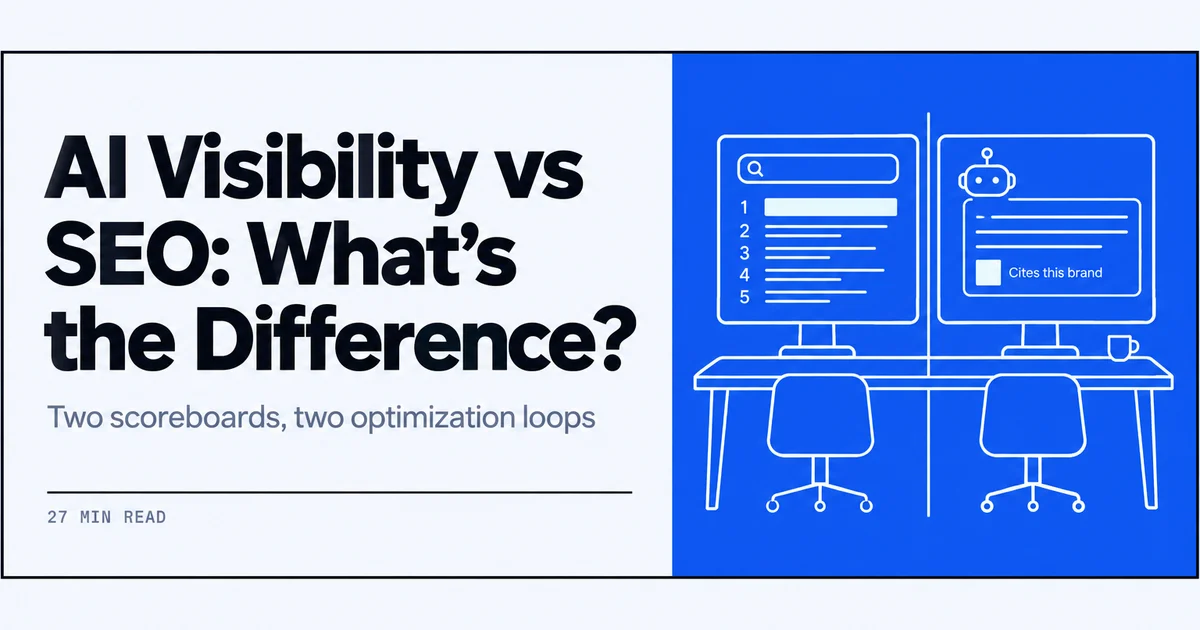
I treat AI visibility vs SEO as two scoreboards with different units, not a rebrand of the same report.
- 02
Measurement for AI is citation presence and platform mix; measurement for SEO is rank, crawl, and clicks.
- 03
The optimization loops run on different clocks, so I do not wait for a ranking change to judge a citation test.
- 04
Consistent brand entity mentions across several domains were the citation pickup pattern I built a content map around.
What I Measure When I Compare AI Visibility vs SEO
<p>I treat ranking and citation as two measurement problems. A page can sit in the top three of a SERP and never appear inside a generated answer. I have also logged brands cited in ChatGPT or Perplexity that were not winning the classic ranking. When I compare ai visibility vs seo, I do not blend two scores. I ask if the brand is findable in a list, and separately if it is named inside an answer, which is why I keep a closer look at aeo vs seo next to the ranking log.</p>
SEO as a Ranked-List Problem
<p>When I measure SEO I am measuring a ranked list. Search Console and rank trackers tell me position for a query, impressions, clicks, and whether the URL is indexed. I also log crawl stats: how many URLs the crawler requested, how many returned 200, how many were excluded. Index coverage is the floor. If the page is not in the index, rank does not exist.</p>
<p>What this scoreboard can tell me: relative position against other URLs, click-through from the SERP, and whether technical access is intact. What it cannot tell me: whether an assistant will name the brand, quote a passage, or skip the site entirely while still using facts from elsewhere.</p>
<p>I still record average position, clicks, impressions, index coverage percentage, and crawl errors every week. Those units have not been replaced. They answer a list problem. They do not answer a citation problem. Mixing them into one number would hide which system actually moved, and I would repeat the wrong work.</p>
AI Visibility as a Citation Problem
<p>AI visibility, as I measure it, is whether the brand appears inside a generated answer and how it appears. I log presence or absence for a fixed prompt, the form of the mention (named, linked, quoted, or only implied), and which assistant produced the answer. I also note whether the citation points to a URL I control or to a third-party page that talks about the brand.</p>
<p>This is a citation problem, not a ranked-list problem. There is no stable “position 3” across ChatGPT, Perplexity, Gemini, Copilot, Grok, and Claude. An answer can name three brands with no links, or cite one URL without naming the company. I treat those as different outcomes.</p>
<p>I do not convert a citation into an equivalent rank. A mention in the opening sentence is not “rank one.” It is a different unit. The work I change to earn that unit, passage shape, entity consistency, extractable claims, is not the work I change to move a SERP slot.</p>
Why I Split the Work in 2026
<p>I split the work because people now use both systems in the same week. Pew's 2026 nationally representative survey of 5,119 U.S. adults found about half of U.S. adults report using AI chatbots, up substantially from the summer of 2024, and the accompanying report notes roughly one in four use them daily. That is context, not a KPI. It tells me citation work is no longer a side experiment.</p>
<p>Reuters reporting on Sensor Tower data said the ChatGPT app crossed 1 billion monthly active users globally by June 2026. The same piece noted U.S. ChatGPT users who installed Anthropic's Claude app in Q1 2026 spent about 5% less time on ChatGPT one month after installation. I read that as platform mix: I sample more than one assistant because usage is not locked to one product. None of those figures replace rank tracking. They are why I run two programs instead of waiting for one scoreboard to absorb the other.</p>
Video: AI Visibility vs SEO: The Basics Still Matter · @roloffconsulting
Scoreboards I Use for AI Visibility and SEO
<p>I keep separate logs for ai visibility and seo. One is the SEO sheet I have used for years: rank, clicks, impressions, index coverage. The other is a citation sheet: presence in an answer, how the brand is named, and which assistant said it. I do not average them. When I need a reminder that the instruments differ, I reread more on geo vs seo and return to the two sheets. The units differ, so the columns stay different. I read both every Monday.</p>
Rank, Traffic, and Index Coverage
<p>Every Monday I still record average position for the query set, organic clicks, impressions, and the index coverage share Search Console reports for the property. I add crawl request counts and the number of excluded URLs. Those are the SEO units I trust because I can point to the source system for each one.</p>
<p>What they can tell me: whether a URL is eligible to rank, whether position moved, and whether clicks followed. What they cannot tell me: whether an assistant cited the page, ignored it, or used a third-party summary of the same facts. A traffic spike from the SERP is not proof of citation. A traffic drop is not proof the brand vanished from answers.</p>
<p>I treat index coverage as a gate, not a goal. If coverage falls, I stop reading citation noise until crawl and index are stable again. Rank and traffic remain the weekly SEO scoreboard. They do not become a proxy for share of answer.</p>
Share of Answer and Platform Mix
<p>For citations I log three things per prompt: whether the brand is present, where it sits in the answer (opening, middle, closing, or only in a source list), and which assistant produced that answer. I sample ChatGPT, Perplexity, Google AI Overviews, Gemini, Copilot, Grok, and Claude on the same prompt set so the week is comparable.</p>
<p>Share of answer, for me, is the share of sampled answers that name or cite the brand. It is not a traffic number. Platform mix is the breakdown of that share by assistant. I have watched a brand hold steady in one assistant while disappearing in another the same week. That is why I refuse a single blended citation percentage.</p>
<p>I also record the citation type: named only, named with a URL I control, named with a third-party URL, or quoted passage. Those four states are the units. I do not map them onto SERP positions. They stay in the citation log, not the rank tracker.</p>
Why One Report Never Held Both
<p>I tried a blended visibility score once. Rank points plus citation points, weighted. The number moved when either system moved, so I could not tell which work to repeat. A crawl fix lifted the SEO side and the blend looked like a citation win. A lucky mention in one assistant lifted the blend while average position had not changed.</p>
<p>I keep two logs because the failure modes differ. SEO fails when the URL is not crawled, not indexed, or outranked. Citation fails when the brand is not an entity the model will name, or when the passage is not extractable, even if the page ranks. One report hid that distinction.</p>
<p>The other reason is cadence. Rank can sit still for two weeks while citations flicker prompt to prompt. Averaging those clocks produced a smooth line that did not match either reality. Two sheets, same Monday, separate columns. That is the whole method. I have not gone back to one report.</p>
Optimization Loops That Run on Different Clocks
<p>The SEO loop I still run is crawl, index, rank, then refine the page. The citation loop is publish, get mentioned off-site, then get cited inside an answer. Those loops do not share a clock. I plan SEO tests in weeks and citation tests in re-prompts. I use aeo vs geo in 2026 when I need to keep those loops from collapsing into one another, even on the same page. The feedback arrives on different delays. I schedule them as two jobs.</p>
Crawl, Index, Rank, Refine
<p>The SEO loop I run starts with access. I confirm the URL is crawlable, renders, and returns 200. Then I wait for indexation. Only after it is indexed do I watch position for the target queries. If rank moves, I refine title, intro, or internal links. If it does not, I check competition and coverage before I rewrite the body.</p>
<p>Feedback lag is the part I plan around. A crawl change can show in logs within days. Indexation often takes longer. Rank movement after a content edit is the slowest of the three, and I do not call a test done on day two. I set a window, usually two to four weeks for a rank test on an already indexed URL, and I do not stack a second on-page rewrite inside that window.</p>
<p>This loop is still the right one when the job is a SERP slot, not a mention inside an answer I cannot see in rank trackers.</p>
Publish, Get Mentioned, Get Cited
<p>The citation loop starts with a publish, but the publish is not the test. I write a passage I can attribute, a short claim with a number, a definition, or a method step, and I ship it. Then I work on mentions: consistent brand entity language on other domains, not duplicate articles. Mentions are the middle of the loop. Citation is the end.</p>
<p>To see if anything moved, I re-prompt. Same prompt set, same assistants, same week window. I am looking for the brand to appear where it was absent, or for a URL I control to replace a third-party citation. One new mention in a single assistant is a signal, not a win.</p>
<p>I do not wait for crawl stats to confirm this loop. Assistants can cite a page that ranked last month or a page that never ranked. The test is the re-prompt, not the index coverage report. If the re-prompt is unchanged, I change the passage or the entity string, not the title tag.</p>
Feedback Lag I Actually See
<p>I call an SEO test done when the URL stayed indexed for the window and position either moved or clearly did not, usually after two to four weeks. I do not call it done because one day's rank tracker ticked. Crawl errors I treat as faster: if a 404 cluster appears, I act that day, but the rank test around the fix still waits out the window.</p>
<p>Citation tests I call done after two or three weekly re-prompt rounds on the same set. A single answer that names the brand on Tuesday and drops it on Thursday is not a result. I need the presence to hold across the sample, or to stay absent across the sample, before I change the next passage.</p>
<p>That lag is the operational difference I see in ai visibility vs seo: I will not put both tests on one calendar cell. SEO wants a longer still period; citations want repeated samples.</p>
Content I Change When I Want a Citation, Not a Rank
<p>When a page already ranks and I still do not see the brand inside answers, I stop rewriting titles for click-through and start rewriting the passages an assistant can lift. The CMS screen looks the same. The job is not. Rank work asks whether the page can win a slot. Citation work asks whether a sentence can stand alone as a sourced claim. That is the practical split I use on ai visibility vs seo once the URL is live and I need the answer, not another blue link.</p>
Passage Shape and Extractable Facts
<p>I write the claim first, then the proof, then any caveat, in that order, inside a short paragraph. The assistants I sample lift a compact, attributable sentence more readily than a long setup. So I put the brand, the number, and the date in one breath: who measured what, when, and on what sample. I do not bury the fact after three sentences of context.</p>
<p>I keep units explicit. Hedging that still names the method stays; vague superlatives go. If a sentence cannot be quoted without the rest of the page, I rewrite it until it can. That extractable-fact test happens before I ship a citation-oriented draft. I do not invent precision. If I only have a range, I publish the range and where it came from. I also name the method in the same paragraph so the lift carries attribution. Passage length I aim for is two to four sentences, enough for a model to grab a block without stitching half the article.</p>
Structure I Still Keep on the Page
<p>A citation goal does not mean I strip the page. I still use one H1, nested headings that match the questions I prompt, and a public URL that renders without a login. Schema I keep is the ordinary kind: Article or FAQ where the page actually is that type, plus author and dateModified. I do not mark up types the page does not support.</p>
<p>Internal links stay, pointed at definition pages and original-data pages rather than at generic category hubs. Images get alt text that names the chart, not a keyword string. Canonicals, robots directives, and sitemap inclusion stay on the checklist because an unindexed URL cannot be cited from a crawl I cannot see. None of this is the citation lever. It is the floor I refuse to remove while I reshape passages for pickup. I still fix broken headings and duplicate titles because messy structure makes extraction worse, even when rank is already fine.</p>
What I Stop Tweaking After a Page Ranks
<p>Once the URL holds a stable SERP slot for the queries I care about, I stop the ranking-era loop: title tests, meta-description rewrites aimed at click-through, above-the-fold layout tweaks, and packing secondary keywords into H2s. Those edits move clicks. They rarely change whether an answer names the brand. I still watch rank so I notice a slip. I do not spend the week chasing another position.</p>
<p>I also stop lengthening the page to cover every adjacent query. Extra sections that exist only to catch related searches dilute the extractable claims I just tightened. I leave the ranking title alone unless it is factually wrong. Hours I used to spend on snippet formatting go into tightening claim paragraphs and lining up the same entity name off-site. If rank slips, I open a separate ticket. I do not mix those tickets in the same commit. Blending the two in one deploy is how I used to fool myself that both scoreboards had moved.</p>
Entity Mentions That Changed How I Plan Content
<p>I used to plan content as a set of URLs. I now plan it as a set of entity mentions that should agree with each other. The change came after I watched the same brand name, product name, and one-line description show up on several domains in the same week, then saw citation pickup move on prompts I had not touched on-site. That was not a controlled study. It was consistent enough that I rebuilt the content map around mention consistency instead of around more pages. Agreement beat volume in the cases I logged.</p>
What I Noticed When Mentions Clustered
<p>When the brand string, the category noun, and a short factual descriptor appeared in the same form on our site, a partner article, a directory, and a talk transcript, the assistants I sample started treating that cluster as the entity. Misspellings and renamed product lines delayed that. I did not see pickup from a single mention as fast as from several agreeing mentions. A press mention that used a different category label did not join the cluster I was watching.</p>
<p>I log three fields: exact name, what it is, and one proof point. When those fields matched across domains, later prompts cited the brand without new on-site copy that week. When they conflicted, old product name on one site, new name on ours, answers mixed the two or skipped us. That pattern is why I treat entity copy as a shared record, not as page-level wordsmithing I can vary for freshness. I correct drift before I write another article. Consistency was the signal I had been underweighting.</p>
The Cross-Platform Content Map I Ran
<p>The map is a table, not a calendar of posts. Rows are entities: brand, product, method, dataset. Columns are surfaces: owned pages, guest articles, profiles, docs, transcripts. Each cell gets the same canonical name, the same one-sentence definition, and a unique fact that belongs on that surface so I am not pasting one paragraph everywhere.</p>
<p>I schedule the unique fact on the surface that can actually host it. I do not schedule a rewritten bio. If a directory only allows a short field, I still use the canonical name and the same category noun. I review the table once a month and fix name drift before the next publish. The goal is agreement, not volume. Duplicate bios that disagree cost more than fewer mentions that match. Guest copy gets a new datapoint or a method note, never a paraphrased homepage. This is how I keep mention work from turning into syndicated noise, and how I keep ai visibility and seo from sharing a content calendar they should not share.</p>
How I Track AI Visibility Week to Week
<p>I do not trust a single prompt on a single day. I run a fixed set of prompts across a fixed set of assistants every week so this Monday compares to last Monday. Rank data still comes from Search Console and a rank tracker. Citation data comes from the prompt set and a checker I built so I was not screenshotting answers by hand. That split is how I keep ai visibility and seo from turning into one mood. Guessing is what I was doing before I froze the sample.</p>
Prompt Sets and Platforms I Log
<p>I lock a prompt set before the week starts. Same wording, same order, same brand and competitor names. I mix three types: category questions with no brand, comparison questions that name two brands, and who should I use for X questions. I sample ChatGPT, Perplexity, Google AI Overviews, Gemini, Copilot, Grok, and Claude because those are the surfaces this work is about.</p>
<p>I do not rotate the set midweek. If a product name changes, I add a new prompt; I do not edit the old one, so the time series stays intact. I log presence, whether we are named in the prose, whether a URL is cited, and roughly where in the answer we appear. A citation on one assistant and silence on the others is a platform note, not a win I roll into a single score. I keep the same account state I can control, logged-out or a dedicated login, so personalization is not the hidden variable. I store the raw answer text with the date, not just a yes/no.</p>
Building a Checker So I Was Not Guessing
<p>Manual pasting did not scale past a few brands. I built AI Rank Checker to send the same prompt set and record where a brand appeared in the generated answer, named in the prose, cited with a URL, or absent. I use it as a log, not as a ranking of the assistants themselves. Each row is prompt, platform, date, brand, presence, and a short excerpt.</p>
<p>That is the credential and the limit: it tells me what showed up in the sample I ran, not what every user saw. I still read a slice of answers myself so I catch tone and misattribution the grid misses. Building the checker did not change the definition of the work. It removed the week I used to spend copying answers into a spreadsheet. I export the week as a table I can diff against the prior week. I do not let the tool invent a blended visibility score; that would hide the platform mix I actually need to see.</p>
Reading a Week of Results
<p>A week is a sample, not a verdict. I look for direction across the prompt set, not a single miss. If one comparison prompt drops us and the category prompts still name us, I note the comparison and wait another week before I rewrite. If presence falls on several platforms at once, I check entity drift and whether we published a conflicting claim.</p>
<p>I never average ChatGPT and AI Overviews into one number. I also do not treat a new citation on a prompt I just added as a win against last week. Comparable weeks only. I write a three-line note: what moved, what I will change, what I will leave. That note is what I read the following Monday so I do not relitigate noise. If I cannot point at the two logs, I do not call the week a result on ai visibility vs seo. One noisy prompt never ships a rewrite by itself. I want a second week that rhymes.</p>
Where AI Visibility and SEO Still Share Work
<p>I still run two scoreboards. That does not mean I duplicate every task. Crawl access, public URLs, and original claims sit under both programs because both systems need to read the same page. I log that work once, then I decide which scoreboard it serves this week. The overlap is hygiene and evidence, not ranking and citation. Treating AI visibility vs SEO as one KPI is how I used to hide a coverage fix inside a citation win. I do not do that anymore.</p>
Technical Access Both Systems Still Need
<p>I still check the same access layer before I argue about either scoreboard. If a URL returns a block, a login wall, or a client-only render with no HTML fallback, neither a crawler nor an assistant that fetches the page can use it. I verify robots.txt, canonicals, sitemap membership, and that the rendered body matches what I published. I also confirm the page is reachable without parameters that rotate weekly.</p>
<p>What this tells me is limited. Access is a prerequisite, not a ranking or a citation. A crawlable page can still sit on page two. A public URL can still never appear in an answer. I do not treat a green coverage report as proof the brand will be named. I treat it as permission to keep measuring. When I find a noindex, a 404 on a cited URL, or a JS shell with empty body text, I stop citation experiments on that URL until it is readable again.</p>
Original Facts and Authorship Signals
<p>The other shared layer is evidence I can attribute. I keep bylines, dates, and method notes on the page because both ranking systems and answer engines have to decide whose claim they are looking at. I write unique numbers I actually measured, sample size, date range, unit, not recycled round figures. I name the person who did the work. I keep the same entity string off-site so brand, author, and claim stay aligned.</p>
<p>I reuse that research across both programs. A table of original measurements can earn a snippet and also get lifted into an answer. I do not rewrite the fact for each scoreboard. I rewrite the surrounding passage: longer context for the ranked page, a short extractable sentence for citation. Authorship is the same signal I need if I want the claim to travel with a name attached. If I cannot source the number on the page, I do not use it in a prompt test either.</p>
Work I Do Not Double-Count
<p>I refuse to log the same hour on both boards. A title-tag test that moves position is SEO work. A passage rewrite I then re-prompt is citation work. Shared access and original facts are inputs, not dual wins. I record a robots.txt change on the SEO log, where coverage shows up first. I do not also tick a citation KPI because the page became fetchable.</p>
<p>I do not count a first-page ranking as share of answer, or a brand mention in an assistant as organic sessions. Link work I cannot see inside an answer stays on SEO. Entity outreach I cannot see in Search Console stays on citation. If a task could sit on either list, I pick next Monday’s scoreboard and put it only there. Double-counting is how I used to think both programs were moving when only one was.</p>
How I Split Hours Between AI Visibility vs SEO
<p>I start from a default split and I move hours when the logs tell me to. AI visibility and SEO both need weekly attention or the unused one drifts. I do not wait for a blended score. I look at rank movement, coverage, citation presence, and whether the page is fetchable. The split below is my starting allocation on brands that already have a crawlable site and a prompt set, not a promise both sides move at the same speed.</p>
A Default Split I Use on Brands
<p>On a brand that is indexed, ranking for a core set, and already in my prompt log, I start at roughly 60 percent classic SEO and 40 percent citation work. SEO hours go to coverage gaps, template issues, internal links, and pages that still earn clicks. Citation hours go to extractable passages, entity consistency, off-site mentions I can verify, and the Monday re-prompt.</p>
<p>I count hours on the work, not on meetings. A two-hour passage rewrite I will re-prompt counts as citation. A two-hour crawl debug counts as SEO. Shared hygiene, a robots fix, a byline, a unique table, I assign to whichever board is blocked. If coverage is red, the hygiene hour sits on SEO. If the page ranks and still never appears in answers, the next hygiene hour sits on citation. I revisit the 60/40 split every four weeks against the two logs for AI visibility vs SEO, not against a slogan about where search is going.</p>
When I Overweight AI Visibility Work
<p>I put more hours on citation experiments when three conditions hold at once. The site is crawlable and the core pages already rank well enough that another title test is not the bottleneck. The prompt set shows the brand missing from answers where competitors are named. And the entity string is inconsistent off-site, or the on-page claims are too long to lift.</p>
<p>I also overweight citation when the people I care about already ask assistants, not only a results page. A 2026 Pew survey of U.S. adults found about half report using AI chatbots. The detailed 2026 report notes roughly one in four say they use them daily. That is demand context, not a citation KPI. It does not tell me this brand will be named. It tells me I should not park assistant work until next year. I still need the prompt log to prove anything moved.</p>
When I Send Work Back to Classic SEO
<p>I pause citation experiments when the page cannot be fetched, when coverage collapsed, or when the URLs I would want cited are 404, noindex, or canonicalized away. I also send work back when the brand has no ranking footprint on the queries that match my prompt set. An assistant can still mention a brand that does not rank, but I have watched tests stall for weeks on pages that were not in the index.</p>
<p>If Search Console shows a sharp drop in impressions on the money URLs, I stop rewriting passages and fix templates, internal links, and indexation first. If the sitemap we fetched does not include the URL I keep prompting, I add it and wait for coverage before I call the citation test a failure. Recovering a readable, indexed document is the job those weeks. I return to citation hours only after the SEO log shows the URL is back in play.</p>
The Weekly Cadence I Run Across Both
<p>I keep a Monday-to-Friday rhythm so the two logs stay comparable. Monday is measurement. Tuesday through Thursday I allow a small set of changes. Friday I write the notes that next Monday will read. I do not ship a redesign midweek and then pretend I know which program moved. If I change the prompt set, the URLs, and the titles in the same week, I cannot separate AI visibility vs SEO in the log.</p>
Monday Measurement, Midweek Changes
<p>Monday morning I pull rankings and coverage first, then I run the fixed prompt set across the assistants I sample. I record position, URL, index status, citation presence, and where in the answer the brand appeared. I do not edit pages on Monday. I want a clean snapshot.</p>
<p>Midweek I allow at most one class of change per program. On the SEO side that might be a title, an internal link, or a coverage fix. On the citation side that might be a passage reshape or an entity-string correction. I do not do both to the same URL in the same week unless the URL is broken. If I must fix a 404, that override is documented. I re-prompt only after the change is live long enough for a fetch, I do not hit the same prompt ten minutes after publish and call it a result. Thursday I freeze further edits so Friday notes describe a stable state.</p>
Prompt Refreshes and Entity Checks
<p>I do not refresh the whole prompt set every week. A moving prompt list makes week-to-week citation rates incomparable. I keep a core set frozen for four weeks. I add at most two exploratory prompts, tagged so I can drop them from the trend line. I retire a prompt only when the wording no longer matches how people ask, and I note the swap in Friday’s log.</p>
<p>Entity checks sit on a slower clock. Once a week I search for the brand string, the product names, and the author names on a short list of off-site pages I already care about, Wikipedia if a page exists, major listings, a handful of articles that previously cited us. I am looking for drift: a renamed product, a missing legal name, a byline that no longer matches the on-site entity. I do not blast new mentions for volume. I correct mismatches so the cluster I already have stays consistent.</p>
Notes I Keep So Next Week Compares
<p>Friday I write a short record with the same fields every week: date range, prompt-set version, assistants sampled, URLs changed, class of change (SEO or citation), coverage flags, citation presence by prompt, and whether I overrode the freeze. I note anything that would break comparison, a platform outage, a prompt I retired, a URL that redirected.</p>
<p>I keep the two logs in separate tables so I cannot accidentally average them. Next Monday I read last Friday’s note before I look at new numbers. If citation presence dropped on one prompt and held on the rest, I do not rewrite the page. If rankings moved on a URL I also rewrote for extraction, I mark the test mixed and claim neither program won. I write the note so I cannot invent a story later. Comparable weeks are the only way I can still tell AI visibility and SEO apart after a month of small edits.</p>
Frequently asked
I still run both. SEO captures ranked clicks; AI visibility is about being cited in answers. Pew’s 2026 survey of 5,119 U.S. adults found about half now use AI chatbots, and roughly one in four use them daily. I treat the two as parallel tracks on the same brand, not a swap.
I check SEO rankings weekly on core queries. For AI visibility I rerun a fixed prompt set for the same brand across ChatGPT, Perplexity, Gemini, Copilot, Grok, and Claude every two weeks. Pew found roughly one in four U.S. adults use chatbots daily, so answers can shift between monthly reports.
Yes. I plan one calendar around entities, FAQs, and source pages that both rank and get cited. Each piece has a SERP target and a citation target. I do not write a second article for AI. I reuse the same briefs, then add extractable facts, dates, and named sources so engines can quote them.
I first check whether the brand appears as a cited source on the exact prompt, not whether the domain ranks. I log presence, citation position, and which URL was named. Rankings can look healthy while the answer never mentions us. That gap is the starting diagnostic, before I touch content or links.
Backlinks still shape how I prioritize SEO work: they remain a ranking signal I track. For AI visibility I weight links less. I still earn them for crawl and authority, but citation tests focus on quotable pages, entity clarity, and third-party mentions the models already surface, not on link velocity.
I ignore rank movement for that test. Success is a change in citation rate on the same prompt set: brand named, URL cited, or competitor displaced in the answer. I compare a two-week baseline to the two weeks after publish. If citations rise and rankings stay flat, the experiment still worked.
