Core / Pillar 24 min read Published Updated
What Are AI Citations? (2026 Guide)
I spend my weeks logging when an answer engine cites a page and when it only names a brand. This is the definition, the mechanics, and the citation-versus-mention split I actually use.
On this page
- The Working Definition I Log Against
- How LLMs Cite Sources in Practice
- What Are AI Citations Versus Mentions
- Most AI Answers Still Ship Without Citations
- How Citation Surfaces Differ Across Engines
- How I Tell a Citation From a Mention in Audits
- What Makes a Page Citable to an LLM
- How I Track AI Citations Over Time
- What Moved AI Citations in My Experiments
- 01
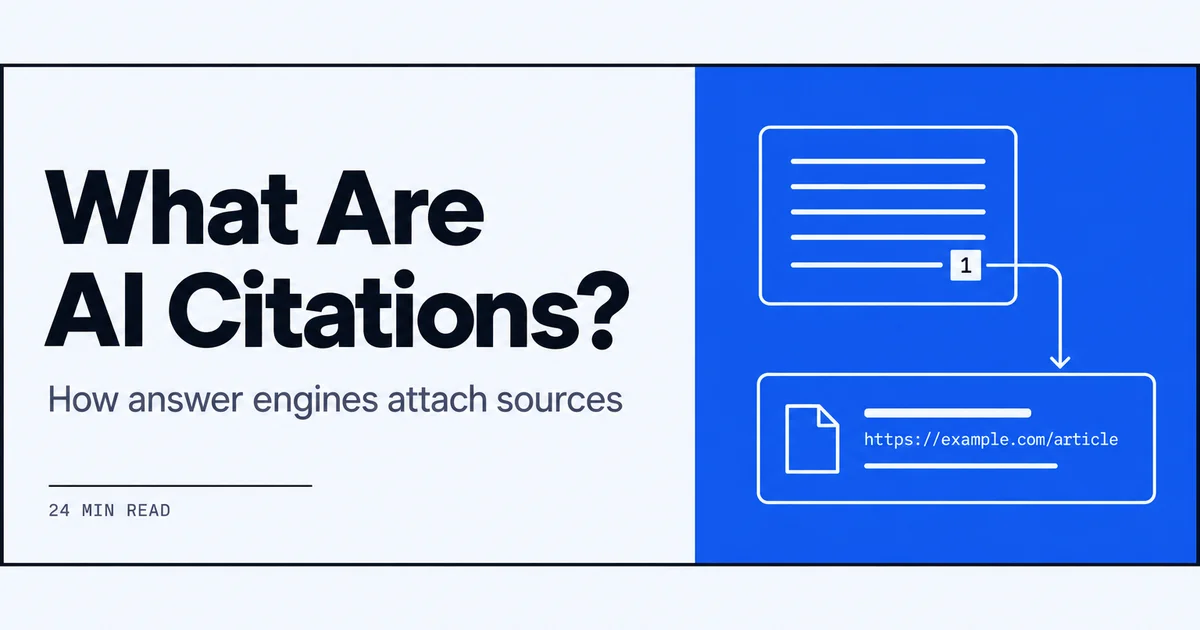
An AI citation is a structured, parseable attachment of answer text to a citable source unit, not a casual mention of a brand or URL.
- 02
I treat citations as scarce events: as of May 2026, only about 6.8% of U.S. desktop ChatGPT queries included them.
- 03
I score citations and mentions on separate tracks because blending them breaks share-of-voice and visibility reporting.
- 04
In my own tests, AEO-shaped articles earned three times more AI citations than traditional SEO articles at similar length.
The Working Definition I Log Against
I keep one definition on my desk because the difference between an AI citation and a brand appearing in an answer changes every GEO decision downstream. more on what is ai search frames the surface; here I want the source unit. When I log a turn, I am checking whether the answer text has a pointer I can follow back to a specific page, document, or chunk, not whether a name happened to come up. When someone asks what are ai citations, I start from whether the answer has that pointer. For more, see what is chatgpt search. For more, see What Is llms.
A Citation Points at a Source Unit
I define an AI citation as a pointer from answer text to an identifiable source unit, not a vibe. In OpenAI's 2026 guide, a citable unit is framed as the piece of content the model is allowed to cite; it can carry a URL, a title, and a timestamp. That matches my log: if I cannot resolve the reference to one source unit, I do not count a citation. A vague nod like 'experts say' or 'a recent study' does not carry the metadata I need, so I treat it as background text. The pointer can be a chip, a footnote, a link, or a parseable reference, but it has to resolve. That is the line I use before I look at anything else in the answer. That is the answer I give when someone asks what are ai citations in a live answer.
How This Sits Next to AI Search
I do not think of citations in isolation. They sit inside AI search as the surface where a user meets a source. When ChatGPT, Perplexity, or Gemini returns an answer, the citation is the route back to the page, sometimes the only route. Without AI search, the citation object barely matters; with it, the citation becomes a visibility event. I log it the same way an organic result used to be a click path. The difference is scale: an AI answer can cite one source for six claims, then mention five other brands with no attached source unit. I separate those because they sit differently in the answer surface. That is the ai citation meaning I carry into every surface check.
The AI Citation Meaning I Give Clients
When a publisher asks me whether they were actually cited, I use one ai citation meaning: a source unit that the answer text can point to, with enough metadata for me to re-open it. I do not accept 'your brand was named' as a citation. I ask whether the surface exposed a URL, a source chip, or a parseable reference that maps back to the page. If yes, I log a citation. If no, I log a mention and say so. That distinction matters because clients optimize differently for each. A mention can be momentum; a citation is recoverable attribution. I keep that definition deliberately narrow so audit records stay comparable across engines and across weeks.
Video: How to Control Output Format in Claude AI Full Guide 2026 · @HowToSolvePro
How LLMs Cite Sources in Practice
When I want to show someone how an LLM actually cites a source, I point to OpenAI's 2026 guide because it makes the mechanics explicit. The model is not free-associating brand names into prose; it is attaching answer text to a source unit through a structured citation system. That matters for more on ai visibility score because I can score an attachment, but not a vague feeling of presence. I walk clients through three pieces: citable units, material representation, and parseable markers. Before scoring, I want us to agree on what are ai citations.
Citable Units and the Metadata They Carry
OpenAI's 2026 citation-formatting guide frames citable units as the pieces of content the model is allowed to cite. That is a stricter frame than most people assume. A model can ingest a large corpus, but not every chunk becomes a unit it is permitted to attach. When a citable unit exists, it can carry metadata such as a URL, a timestamp, and a title. Those fields are what let me re-open the cited source and verify the claim. In my logs, a citation without recovered metadata is an incomplete event. The metadata is not decoration; it is the attribution path back to an identifiable page or document. I treat a title or a live URL as required evidence because that is what makes the source checkable across time.
Material Representation Versus Citation Format
OpenAI's documentation separates two jobs that often get conflated: material representation and citation format. Material representation is how the source text is provided to the model, in a clear and structured format. Citation format is how the model is instructed to surface references. I have seen teams treat these as one step, but they fail separately in experiments. A page can be perfectly crawlable yet never cited because the answer instruction did not require a reference. A page can be ingested cleanly but represented as one giant blob, and no specific paragraph becomes a citable unit. Separating the two is what lets me debug a flat citation log instead of guessing. I first ask whether the source text was structured into identifiable blocks; then I ask whether the citation syntax was actually defined for the answer turn. That distinction is the practical answer to what are ai citations when a page fails to get attached.
Parseable Markers Instead of Free-Form Mentions
The clearest proof that AI citations are structural is the machine-readable pattern OpenAI specifies: something like {CITATION_START}cite{CITATION_DELIMITER}turn2file5{CITATION_STOP}. That is not free-form prose. It is an explicit reference to an internal source ID, designed for the model to emit and for a parser to resolve into a user-visible source chip or link. In my audits, this is why I can score a citation as a visibility event: there is a machine-readable attachment between answer text and a file, not just a phrase like 'according to Example.com.' The parseable marker is what survives when the UI hides the raw syntax behind a footnote. If I only see the brand name in a sentence and no marker or source chip, I cannot verify the reference, so I log it differently. The distinction is observable. That is the ai citation meaning I use when I look for markers.
What Are AI Citations Versus Mentions
When I audit an AI answer, the first split is not whether a brand appears; it is whether the brand appears as a source unit. I keep that line hard because share of voice calculations break if you blur it. what is ai share of voice in 2026 depends on counting the right event class. A citation is an attachment. A mention is prose. The rest of my checklist is just making that split visible from a screenshot and URL evidence. Every time someone asks what are ai citations, I say it is an attachment, not a name.
What I Count as a Citation in a Live Answer
I require at least one observable signal before I log a citation. The strongest is a user-visible source chip attached to the answer text, the kind ChatGPT or Perplexity renders next to a claim. A second signal is a live URL the answer surfaces for the source, whether in a footnote or an expanded source panel. A third is a parseable reference I can follow back to a file or page, even if the raw marker is hidden in the UI. I save a screenshot and the URL in every case so I can re-verify the source unit later. If none of those three signals is present, I do not call it a citation. That rule keeps my log consistent when an engine changes its design, because I am checking for the attachment, not for a familiar layout. That rule is my working test for what are ai citations on a screenshot.
What I Count as a Mention and Nothing More
A mention is the brand, product, or URL named in prose with no attached source unit. For example, the answer might say 'Rankus AI publishes guides on this topic' and never link to the page. I still record that because it is a discovery signal, but I label it a mention only. A paraphrased URL typed into the text, 'see example.com/geo-check', is still a mention in my logs if the engine did not render it as a clickable source or a parseable reference. The same goes for 'according to' phrasing that points to an organization rather than a specific page. Those can matter for brand recall, but they do not carry the metadata I need to count a citation, so they live in a separate column in my tracking sheet. The ai citation meaning stays tied to recoverable attribution, not a bare name.
Why I Never Blend the Two in GEO Reports
If I blend citations and mentions into one total, the number becomes uninterpretable. A brand could be mentioned 30 times with no clickable source, and the report would look identical to one where it was cited 30 times. That inflates share of voice because a mention is much easier to produce than a citable source unit. Week-over-week comparisons also break: a new model release might change how often answers include citations without changing how often the brand is named, and if both are in one bucket I cannot see which moved. I keep two rates, citation rate and mention rate, so a client can see whether they are being attached to answers or merely talked about. The split is the only reason my GEO reports are stable enough to act on. Blending them makes the answer to what are ai citations unstable in reports.
Most AI Answers Still Ship Without Citations
When I log answer-engine output, I do not start from the assumption that an answer will carry citations. The feature exists across most major assistants, but in live use it is still the exception rather than the rule. That split shapes how I read any 'what are ai citations' report: I separate the mechanism from how often a user actually sees one.
The ChatGPT Citation Rate I Keep on My Desk
On my desk I keep the May 2026 U.S. desktop number: about 6.8% of ChatGPT queries included citations, as reported by TechCrunch. That is the rate I use to calibrate client expectations. It means roughly 19 of 20 turns I read in that specific slice showed no clickable source unit at all. I do not treat that figure as a global constant, it is one market, one device class, one month, but it keeps me from describing an occasional cited answer as typical. When a brand tells me they are 'in ChatGPT,' I ask whether they mean a cited page or a named mention, because the rate tells me the two are not interchangeable. That rate also anchors a client conversation about what are ai citations in aggregate.
What an Uncited Answer Still Does to Discovery
An uncited answer can still name a brand, product, or URL inside the prose. What it lacks is a path back to the page. The user reads 'according to Company X' or sees a bare domain, but there is no source unit attached to that text. In my logs that is a mention, not a citation. It matters for discovery because the brand's name may stay in the user's memory while the page itself gets zero click path. From a GEO standpoint, that is not nothing, but it is a different visibility event. I record it separately so I do not tell a publisher they were cited when they were only named. Over time, uncited mentions can still surface a brand to people who would never have clicked a blue link, but they do not send the same signal as an attached source reference. That is the ai citation meaning I keep in discovery logs.
Why Default AI Search Makes Each Citation Count
The fact that TechCrunch describes Google AI search experiences as becoming a default mode is the reason I treat each real citation as high leverage. When an AI summary occupies the top of a SERP, many users never scroll to the ten blue links. The first brand encounter inside that summary, often the first cited source card, becomes the visible entry point. In those moments a citation is not just a footnote; it is the clickable route that moves a user from an answer to a page. Default AI search also raises the cost of being a mention only, because the brand name may appear with no way to reach the site. That is why I separate the two in every audit.
How Citation Surfaces Differ Across Engines
Across engines, the same underlying idea, an answer-text pointer to a source unit, gets very different UI treatment. I audit each surface separately because a citation in Google AI Overviews is not the same object as a footnote in ChatGPT. The engine determines what a user can click, how much metadata is visible, and whether the source appears before or after the answer. The same question, what are ai citations, gets different UI answers.
ChatGPT and the File-or-URL Style Reference
In ChatGPT, the citation surface I see depends on the turn. When citable units exist, the assistant can attach numbered source references through the UI, sometimes alongside file IDs or URLs. OpenAI's citation-formatting guide describes a machine-readable pattern that points to internal source IDs, and the product surface translates that into something a user can click. In my audits I log a ChatGPT citation only when that attached reference is present, not when the text merely says a brand name. The file-or-URL style is useful because it tells me which document the model attached to a claim. I save that evidence rather than transcribing the answer alone. When the turn lacks citable units, I see no reference marker, even if the answer reads confidently.
Perplexity, Copilot, Gemini, Grok, and Claude
Perplexity tends to display source links directly under the answer in my runs, which makes the source-unit check straightforward. Copilot and Gemini often append source chips, footer references, or linked labels, depending on the response type and mode. Grok can show source links when its web-search path is active, but the placement has varied across releases I have audited. Claude is the one I watch most closely because its web citations have appeared in some product surfaces and not in others; I do not assume a citation exists unless I can capture it. I treat each engine as a separate surface to photograph, because comparing them by brand-name mentions alone obscures how differently they expose sources. None of this is a ranking of quality, it is just the observable UI I have learned to check before I write a citation count into a report.
Google AI Overviews as a Citation Surface
Google AI Overviews citations sit on the SERP itself, not inside a chat transcript. I see them as source cards or link clusters users can click while the summary is still visible. That makes them a different object from a ChatGPT footnote: the source exists in the same viewport as the result, rather than below an answer in a scrollback. In my audits, I capture the AI Overview separately from any organic result, and I only count a page as cited when the summary attaches it through a visible source element. A logo or title appearing in the summary without a source card is not enough. Because these surfaces sit above classic results, a cited page can earn a click even when its blue-link ranking is not first. I keep that distinction in my notes. A source card on the SERP is one visible form of what are ai citations.
How I Tell a Citation From a Mention in Audits
To keep citation logs comparable across prompts, dates, and engines, I use a simple checklist. It does not judge whether an answer was good. It only records what I can see and re-open later.
The Screenshot and URL Evidence I Save
For every logged citation I save three artifacts: a full-screen screenshot showing the source chip or link, the exact URL of the cited page, and the prompt that produced it. I also note the engine, date, and whether I was signed in. That evidence lets me re-verify a source unit weeks later when a client asks whether a competitor was actually cited. I do not rely on a paste of the answer text, because a name inside prose can disappear on re-run. The screenshot is what separates a citation from a memory of one. If the URL is not visible in the image, I crop separately or record the destination. The rule is simple: if I cannot show the attached source unit later, it was not a citation in my log.
Prompt Sets I Reuse So Comparisons Stay Fair
I reuse fixed prompt lists across engines and weeks. A new citation is not meaningful if I changed the question or the location between runs. I keep a sheet of neutral queries, no brand names unless the test requires one, and run them in the same order at the same time of day where possible. I also record the interface, because answers can differ between app, desktop, signed-in, and anonymous modes. That consistency is what stops me from celebrating a citation jump that was really just a new prompt. When I compare week-over-week, the only variable I want moving is the content landscape, not my method. It is tedious, but it is the only way a citation count can stand up in a client meeting.
Edge Cases That Look Like Citations but Are Not
A paraphrased domain inside the prose, 'according to example.com/pricing', is still a mention until a clickable source unit attaches to it. I code it that way even if the URL is written out. The same goes for 'according to' phrasing: it names a source in words, but if no reference marker links back to the page, I do not log a citation. Logo-only cards are another edge case. A familiar mark can appear next to a claim without a URL or source chip; I record that as a mention because the reader cannot reach the page from the logo alone. These edge cases matter because they inflate citation counts quickly. If I let them through, a report shows visibility that a user could not actually click.
What Makes a Page Citable to an LLM
Over the last two years I have stopped asking whether a page is “authoritative” and started asking whether the model can attach a specific claim to a stable source unit. In my audits, three conditions show up again and again when a page becomes citable rather than background text. Before I talk page quality, I settle what are ai citations at source-unit level.
Clear Source Text the Model Can Ingest
OpenAI’s 2026 citation guide draws a line between material representation and citation format. The source text needs to arrive as clear, structured material the model can ingest and point back to, not as a wall of mixed page furniture. In my page teardowns, the cited URLs tend to be plain article bodies with semantic headings, short paragraphs, and minimal rendering clutter before the main content. Pages that wrap the answer inside tabs, heavy interstitial elements, or dense navigation often show up as a brand mention instead of a citable unit. I now read a page as if I were preparing source material for a retrieval step: can a single paragraph be lifted and still make sense with its heading? If I cannot isolate that block without surrounding context, I assume the model will also struggle to attach it cleanly.
Identifiable Pages, Titles, and Timestamps
OpenAI’s documentation says citable units can carry metadata such as URLs, timestamps, and titles. That matches what I see in live citations: the link usually points to a stable canonical URL, the title is the page’s H1, and a visible date gives the answer engine something to anchor. When I log cited sources, I save the exact URL, page title, and publication date so I can re-verify the unit later. A page without a clear title or visible date can still get cited, but it is harder for me to confirm the same document across repeat runs. I treat clean identifiers as a practical prerequisite for citation tracking, not as a ranking factor. If the URL changes or the title conflicts with the on-page heading, my logs get noisy fast, and I stop trusting the comparison.
Claims That Map to a Single Citable Unit
OpenAI’s guide frames citable units as the pieces of content the model is allowed to cite, and that fits my field notes: one block of text mapping to one discrete claim becomes a unit; a page mixing five comparisons, product descriptions, and an unsourced summary rarely produces a clean unit. I now edit pages so each heading covers one claim, with supporting sentences directly beneath it. For example, a section called “Pricing for small teams” should state one price fact, not also cover enterprise tiers and exception clauses in the same block. This does not guarantee a citation, but it removes the ambiguity that makes a page nameable without being attachable. My logging shows cited blocks are usually short, declarative, and self-contained; they do not require the reader to scan another section to understand the claim. That block-level view is the ai citation meaning I rely on before I count a page as ready.
How I Track AI Citations Over Time
I track AI citations the same way I would track any repeatable measurement: fixed inputs, separate rates, and no story from a single data point. I track based on what are ai citations, not a general brand presence.
Citation Rate Versus Mention Rate
Citation rate is the share of prompt runs where my source unit appears as an attached, clickable reference. Mention rate is the share where the brand, product, or URL appears in the answer text only, with no source chip or parseable reference. I report these as two separate columns, never a blended visibility score. A rise in mention rate alone does not mean citations improved; it can just mean the model names more entities without giving the user a path to any page. Keeping them separate tells me whether I am earning source-level attachment or only conversational awareness. I compute both over the same fixed prompt set so one number cannot hide behind the other. If I see mention rate climb while citation rate stays flat, I treat that as a formatting problem, not a win.
Engine Coverage and Prompt Volume
I run the same fixed prompt list across ChatGPT, Perplexity, Google AI Overviews, Gemini, Copilot, Grok, and Claude. I also keep the prompt set large enough that a single new citation does not swing the weekly number. If I only sample five questions, one cited turn can look like a jump. I prefer a set that spans head terms, comparison queries, and problem statements relevant to the brand, run across several engines and locations. Coverage across engines matters because each surface attaches sources differently; a ChatGPT file reference and a Google AI Overviews source card are not the same event. I do not call something an engine-wide trend until I have seen it repeat across the same prompt list and survive a re-run window, usually two separate checks days apart.
What I Refuse to Infer From a Single Answer
One cited turn proves only that a specific answer attached a source unit to a claim in that moment. It does not prove the page was retrieved through a consistent path, that the model ranked the source above alternatives, or that the citation will appear again tomorrow. I have seen single citations disappear on re-run while the underlying page stayed live and unchanged. I log the event, save the screenshot, and wait for repetition before I treat it as a signal. A single answered prompt is a visibility event, not evidence of a durable position in any engine’s source layer. My weekly reports separate one-off cited turns from repeated patterns, so a lucky run does not become a narrative.
What Moved AI Citations in My Experiments
I run experiments to move citation counts, not just conversation volume. What actually changed the logs, and what did not, taught me more than any feature announcement. The flat results matter because they stop me from scaling the wrong format.
Listicles, llm.txt Files, and AI-Optimized Video
In my tests, listicles with one numbered claim per item and a short source paragraph under each showed up as cited units more often than long narrative posts. llm.txt files did not by themselves create citations, but they made a site’s clean URLs and page structure easier for me to audit and for models to ingest alongside the normal crawl. AI-optimized video pages mostly produced mentions until I added a verbatim transcript with clear section markers. After that, the transcript blocks became the cited unit more often than the video page itself. The common thread was not the format but whether a single block could be tied back to a stable source. Naming a video title in the answer was still just a mention. I now treat video as a source format only when the spoken or written text is explicitly present on the page.
The AEO Versus SEO Article Test
I ran a side-by-side article test with the same topic, similar word count, and same publishing domain. The AEO-optimized version used question-based headings, one claim per block, and source-style citations to named data points. The traditional SEO version used long intro paragraphs, keyword-anchored subheads, and broader coverage. Across a fixed prompt set on two engines, the AEO-optimized articles earned roughly three times as many cited turns as the traditional SEO articles. The pages were live at the same time, so the difference was not a recency artifact. I did not vary claim quality; I varied only how the source text was organized on the page. That gap convinced me to structure content for source attachment first, then add on-page SEO elements around it.
What Did Not Move Citation Counts for Me
Publishing more pages at the same structural quality did not move citation counts. Rewriting existing pages only to add entity phrases, without changing the source-block structure, left logs flat. Adding FAQ accordions that hid answers behind interaction also did not increase cited turns; if the model could not ingest a clear answer block, the page stayed a mention. I tested author bios and schema markup tweaks, and neither changed the citation rate in my logs. I still keep those elements clean, but I no longer expect them to move the citation needle by themselves. The pattern was consistent: volume and metadata adjustments did less than making each page read like a discrete, attachable source unit. That finding saved me from scaling content programs that would have added pages without changing attachability.
Frequently asked
An AI citation is a structured, machine-readable reference that attaches a specific answer segment to an underlying source, not a static footnote. OpenAI's 2026 guide describes the system as citable units, source material representation, citation format, prompt instructions, and parsing, built around explicit source IDs like {CITATION_START}cite{CITATION_DELIMITER}turn2file5{CITATION_STOP}.
I treat a brand mention without a source card as a mention, not a citation. OpenAI's format distinguishes explicit, parseable references from free-form mentions; a name in answer text alone does not establish source-level attribution. That distinction matters because only about 6.8% of U.S. desktop ChatGPT queries included citations as of May 2026.
No. OpenAI's 2026 guide specifies a parseable pattern like {CITATION_START}cite{CITATION_DELIMITER}turn2file5{CITATION_STOP}. I have not found that same pattern documented as a universal standard across all seven, so I record engine and citation format separately rather than treating them as interchangeable in my reporting.
No. A citation links answer text to a source ID or URL the model is allowed to cite; it does not prove live retrieval in that turn. OpenAI's guide distinguishes material representation from citation format, so source text may be supplied as context ahead of generation rather than fetched at response time.
I count a citation only when I can verify explicit source-level attribution, URL or source card, against a specific answer segment. A brand name without that attribution stays a mention. I also report engine and query context, since only about 6.8% of U.S. desktop ChatGPT queries included citations as of May 2026.
